Samsung-dong GBC... 14 Trillion Won Invested in the Heart of Gangnam
Development Impact Surpassing 2nd Lotte World
Magok District 'MICE Complex'
Project to Change Gangseo-gu Map
Lotte Construction Consortium to Complete in 2024
Cheongnyangni Selected for Urban Regeneration New Deal
Reborn as a Bio Industrial Complex
Newlywed Complex Near Yongsan Station
Seoul Downtown's First Urban Regeneration Case
[Asia Economy Reporter Donghyun Choi] Although the Seoul Gangnam area’s housing price surge has slowed due to the government’s stringent speculative suppression policies, variables that could lead to housing price increases remain in various places in the new year. These are development windfalls.
Areas with large-scale development plans are highly likely to stimulate the surrounding real estate market despite regulations. In fact, in the past, major development issues have often served as a catalyst for housing price increases. An industry insider advised, "Real estate has localized characteristics, so areas with development windfalls show patterns completely different from the overall market situation." Let’s examine the major development issues expected to impact the Seoul real estate market this year.
◆ Groundbreaking of GBC... Changing the Gangnam Development Map = The most notable development project in Seoul this year is Hyundai Motor Group’s Global Business Center (GBC). Considering it is located in the heart of Gangnam and the astronomical scale of the project, its influence is expected to surpass that of the past Jamsil Second Lotte World development.
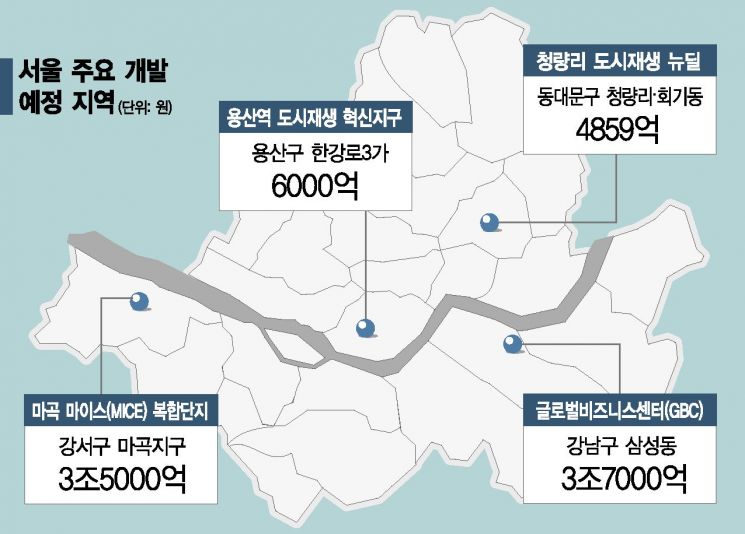
GBC is a project to build the tallest building in Korea (height 569m) along with office, accommodation, and cultural facilities on the former Korea Electric Power Corporation site in Samseong-dong. The land acquisition cost alone is 10.55 trillion KRW, and the development cost is 3.7 trillion KRW. Seoul City granted the building permit for GBC last year, and full-scale construction is planned to begin this year. Completion is scheduled for 2026.
The GBC project is expected to generate a production inducement effect of 264.8 trillion KRW over the next 27 years and create 1.22 million jobs, which is one-quarter of the total jobs in Seoul (5.03 million). Once GBC construction accelerates, related projects such as the Jamsil MICE (Meetings, Incentives, Conferences, Exhibitions) sports complex and the Yeongdong-daero underground complex development project are also expected to gain momentum.
Even before groundbreaking, land prices at the GBC site have skyrocketed in recent years. According to the Ministry of Land, Infrastructure and Transport, the official land price of this site surged 41.7% from 40 million KRW per square meter in 2018 to 56.7 million KRW last year. This year, it is expected to rise another 14.6% to about 64.98 million KRW. Compared to the official land price of 25.65 million KRW per square meter in 2015, right after Hyundai purchased the site from Korea Electric Power in 2014, the price has increased about 2.5 times.
◆ The Last Puzzle of Magok District, 'MICE Complex' = The Magok MICE complex development project is considered a large-scale project that will change the map of Gangseo-gu. The land sale bid base price (minimum price) alone approaches 1 trillion KRW, with a total project cost of 3.5 trillion KRW. The total floor area is about 790,000 square meters, 1.5 times the size of COEX in Samseong-dong and comparable to Lotte World Tower (800,000 square meters).
Seoul Housing and Communities Corporation (SH Corporation), which is in charge of this project, selected the Lotte Construction consortium as the preferred negotiation partner in November last year and signed a business agreement a month later. The Lotte Construction consortium plans to build convention centers, hotels, cultural and assembly facilities on about 82,000 square meters of land within Magok District. They will also support the creation of the Magok Smart City, which SH Corporation is promoting. The consortium plans to complete permits and approvals within this year, start construction in 2021, and complete the project around the second half of 2024.
◆ Cheongnyangni Transforming from Red-Light District to Bio Hub = Just a few years ago, the area around Cheongnyangni Station in Dongdaemun-gu, Seoul, had a strong red-light district image, but it is undergoing a dramatic transformation due to transportation windfalls and expanded redevelopment projects. Once a representative slum in northern Seoul, it is being reborn as a transportation hub with five subway lines, the GTX (Metropolitan Express Railroad), and the KTX Gangneung Line passing through.
The Hongneung area, including Cheongnyangni-dong and Hoegi-dong, will be reborn as a bio-industrial complex. In October last year, the government selected the area around Cheongnyangni Station as an urban regeneration New Deal project site to develop it as a bio (biotechnology) cluster. The urban regeneration New Deal project is one of the Moon Jae-in administration’s key national tasks, aiming to restore the industrial base of underdeveloped areas to revitalize the economy and create jobs. The Cheongnyangni Station development is the first large-scale 'economic base-type' urban regeneration project implemented in Seoul, with up to 25 billion KRW of national funds supported out of a total project cost of 485.9 billion KRW.
The government plans to make the Hongneung area a bio and medical research and development (R&D) hub and create a bio cluster by linking nearby universities, research institutes, companies, and hospitals. On the 5th of last month, the 'Regional Open Building,' one of the three buildings of Seoul Bio Hub built on the site of the Rural Economy Research Institute, opened, marking the completion of the first phase of the project. The second phase this year will include the 'BT·IT Convergence Center,' followed by the 'Global Cooperation Building' in 2021 and the 'Advanced Medical Device Development Center' in 2024.
◆ Yongsan Station Area Opens the First Large-Scale Urban Regeneration in Seoul’s Downtown = Due to the surge in Seoul housing prices since 2018, development projects in the Yongsan-gu area were on hold for a while, but development will resume this year, focusing on the area near KTX Yongsan Station.
The government will invest about 600 billion KRW this year to create a complex for newlyweds and youth housing near Seoul KTX Yongsan Station. This is the first time such a large-scale project under the name of urban regeneration is being carried out in downtown Seoul. On the 14,000 square meter 'Yongsan Innovation District,' four buildings will be constructed, including startup support spaces, new industry experience facilities, newlywed hope town (120 households), and youth housing (380 households). Alternative public offices for Ministry of National Defense-affiliated institutions such as the Defense Acquisition Program Administration research center and the National Defense University finance learning center will also be established. Until now, the government and local governments have refrained from large-scale development projects, citing their role as catalysts for Seoul’s housing price surge, but expectations are growing that the Yongsan Station development will lead to revitalization of the construction industry.
© The Asia Business Daily(www.asiae.co.kr). All rights reserved.

















