Minister Park Young-sun Holds On-site Executive Meeting at Smart Store and Announces New Year Plans
At the cafe 'Lounge X' located on Teheran-ro in Gangnam-gu, Seoul, the hand holding the hand drip kettle to make the coffee ordered by Park Young-sun, Minister of SMEs and Startups, began to move. However, the one holding the kettle was not a person. A robot barista started the delicate hand drip process, adjusting the amount, direction, and speed of pouring water according to the type of coffee beans. While Minister Park was admiring this, the robot barista efficiently completed the coffee extraction, and soon the fragrant aroma of coffee began to spread gently. This was the scene of the first executive meeting of the Ministry of SMEs and Startups (hereafter, the Ministry) held on the morning of the 3rd.
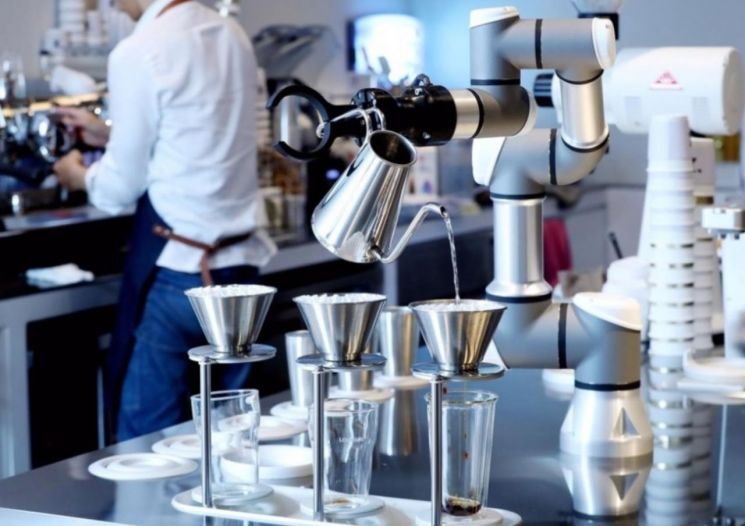
The Ministry held the executive meeting at the smart store 'Lounge X' to announce its determination to achieve a 'Smart Korea' this year both internally and externally. Lounge X is a future-oriented restaurant integrating information and communication technology (ICT), including a robot barista and unmanned robot serving, operated by the food tech startup Yukwol. The robot technology used for serving here was provided by Bear Robotics, which won the 'K-Startup Grand Challenge' competition hosted by the Ministry in 2017. After personally experiencing the robot barista and robot serving, Minister Park emphasized, "The great transformation to a digital economy has already begun. We need to shift our perspective on the economy. Smart factories for SMEs, smart stores for small business owners, and smart services led by venture companies and startups cannot achieve results without a 'shift in perspective' beyond conventional thinking."
Minister Park continued, "In the rapidly changing economic environment, the Ministry must change itself more and produce results based on the power of connected small entities so that our SMEs, venture companies, and small business owners can adapt," presenting the Ministry's policy vision for 2020. This includes ▲ spreading smart factories, introducing smart services, and smart stores ▲ strengthening small business owners' response capabilities to environmental changes such as online shopping ▲ accelerating inclusive growth through the expansion of voluntarily cooperative companies ▲ bold regulatory innovation led by regulatory free zones ▲ and entering the world's top four venture powerhouses through the activation of the K-Unicorn project.
The core among these is to promote the spread of smart factories, the introduction of smart services, and smart stores centered on SMEs, startups, venture companies, and small business owners to realize a smart Korea. Cha Jung-hoon, Director of Startup Venture Innovation at the Ministry, announced plans to distribute 30,000 smart factories by 2022 and focus on advancing smart factories based on data, 5G, and artificial intelligence (AI). Additionally, by introducing smart services, the Ministry plans to support preemptive notification and improvement of product issues and parts replacement timing based on the Internet of Things (IoT), AI, and big data analysis. They also plan to establish smart stores incorporating 4th Industrial Revolution technologies such as smart orders, smart mirrors, and smart maps in 20 pilot shopping districts.
On this day, Minister Park and the Ministry's department heads agreed that without smart business methods and management utilizing ICT technology, survival in the 4th Industrial Revolution era is impossible, and they announced plans to sequentially visit the sites of smart factories and smart services, which are the core of Smart Korea, in the near future.
© The Asia Business Daily(www.asiae.co.kr). All rights reserved.
![Clutching a Stolen Dior Bag, Saying "I Hate Being Poor but Real"... The Grotesque Con of a "Human Knockoff" [Slate]](https://cwcontent.asiae.co.kr/asiaresize/183/2026021902243444107_1771435474.jpg)
















