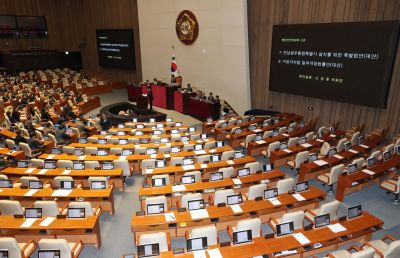
 Shin Jeong-hoon, Chairman of the National Assembly's Public Administration and Security Committee, is explaining the special bill for the establishment of the Jeonnam-Gwangju Integrated Special City and the partial amendment bill of the Local Autonomy Act (alternative) at the National Assembly on the 1st. Photo by Yonhap News Agency
The political and business communities in Gwangju have welcomed the passage of the special law for the Jeonnam-Gwangju administrative integration by the National Assembly and expressed high expectations for the successful implementation of the integration.
On March 2, the Gwangju Metropolitan Council issued a statement, describing the passage of the special law as "a historic starting point that opens a new era for 3.2 million residents of the city and province."
The council evaluated that "the administrative integration of Gwangju and Jeonnam is not merely a change in administrative districts, but a significant turning point for realizing balanced national development beyond the Seoul metropolitan area-centered system and paving the way for joint growth."
They also noted that "the launch of the megacity has laid the foundation for the transfer of authority and the securing of special fiscal provisions," and expressed expectations that "it will enable concentrated investment in nurturing future high-tech industries and expanding the metropolitan transportation network by reducing administrative redundancy and budget waste."
Furthermore, the council emphasized "proper integration over speed," vowing, "We will fulfill our responsible role to ensure that this leads to tangible regional development through legal and institutional improvements."
The Gwangju Chamber of Commerce and Industry also issued a statement on the same day, welcoming the move: "Jeonnam-Gwangju Integrated Special City, which is being launched as a single community after 40 years of separation, will serve as a foundation for leaping forward as an integrated metropolitan economic zone where economy, industry, and culture are organically fused."
The Gwangju Chamber highlighted the special provisions and authorities stipulated in the law, stating that "they will serve as a real driving force for attracting businesses and expanding investment," and stressed that "the consistency and efficiency of integrated administration will lead to the attraction of large-scale national projects and the expansion of metropolitan infrastructure, creating a virtuous cycle for businesses and jobs."
© The Asia Business Daily(www.asiae.co.kr). All rights reserved.












