Welcoming the Passage of the Special Act... "The Real Test Begins Now"
Key Issues Like Main Office Location and Personnel Authority Must Be Resolved Before Launch
Taegyun Kim, Chairman of the Jeonnam Provincial Council, expressed his welcome on March 2 regarding the passage of the "Special Act on the Establishment of the Integrated Jeonnam-Gwangju Metropolitan City" in the National Assembly plenary session on March 1. He made a surprise proposal to establish a "four-party consultative body" as an organization to resolve key tasks for the successful launch of the new city.
On this day, Chairman Kim stated, "This is the starting point for Jeonnam and Gwangju to become one again after more than 40 years," expressing his gratitude to the citizens of both the province and the city who have supported the integration.
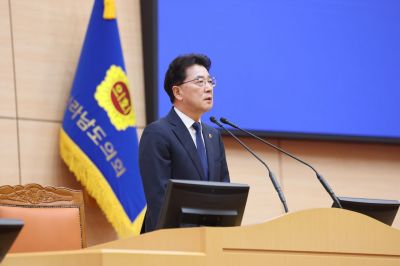
He said, "A united Jeonnam and Gwangju will leap forward as a core growth axis of the Republic of Korea, focusing on foundational industries such as steel and petrochemicals, as well as future high-tech industries such as secondary batteries, artificial intelligence (AI), and semiconductors. In line with the government's policy of overcoming the dominance of the Seoul metropolitan area through region-led growth, this will serve as a new starting point for balanced national development."
However, Chairman Kim offered a pointed critique, emphasizing that the passage of the special act does not mean the "completion of integration."
He identified several key tasks that must be addressed in the follow-up process: specifying the location of the main government complex and the integrated council, establishing a new integrated national medical school, prioritizing basic income support for rural and fishing communities, strengthening local legislative authority, and clarifying national tax support criteria. He especially expressed strong concern regarding the design of the administrative system, including the main government complex, organizational structure, personnel, and budget.
Chairman Kim stressed, "The location of the main government complex is not merely a symbolic or geographical issue, but the core of integration that determines the distribution of authority and the functional structure. If the matter is postponed with an ambiguous standard, such as 'to be determined by ordinance after integration,' unavoidable social confusion and conflict will arise at the time of the launch on July 1."
As a breakthrough, Chairman Kim urged the immediate formation of a "four-party consultative body" consisting of the Jeonnam Governor, Jeonnam Provincial Council Chairman, Gwangju Mayor, and Gwangju City Council Chairman, in which both the executive branches and councils of the two regions would come together for direct discussions.
Chairman Kim repeatedly emphasized, "If administrative functions are dispersed and conflicts over office location or personnel authority continue, the integration could fall into a structural deadlock, making no progress compared to before. Such risks must be preemptively prevented."
He further added, "Through the four-party consultative body, we must ensure sufficient public discussion and deliberation, transparently release the results to the citizens of both regions, and finalize a concrete implementation plan so that there is not the slightest disruption to the launch of the integrated metropolitan city on July 1."
© The Asia Business Daily(www.asiae.co.kr). All rights reserved.












