Shanghai Composite Index Drops 0.27%
In the wake of large-scale airstrikes on Iran by the United States and Israel, Asian stock markets opened lower on March 2.
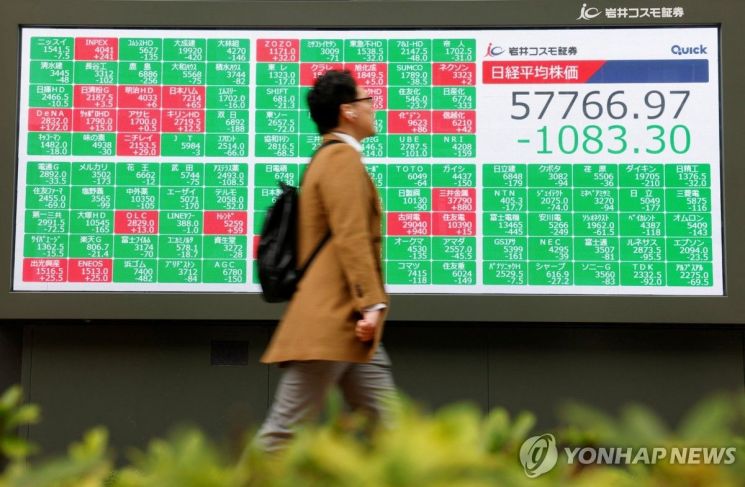 Amid the sharp decline in Asian stock markets due to the U.S. and Israeli airstrikes on Iran, a man is seen walking past the Nikkei index board in Tokyo on the 2nd. Photo by Yonhap News
On this day, the first trading session after the rapid escalation of tensions in the Middle East, the Shanghai Composite Index in China recorded 4,151.8 at around 9:30 a.m. (local time), down 0.27% from the previous trading day.
At the same time, the Shenzhen Component Index also opened down 1.16% at 14,327.65. The ChiNext Index, which tracks IT and tech stocks on the Shenzhen Stock Exchange’s secondary board, began trading at 3,257.05, a decline of 1.61%.
The Hang Seng Index in Hong Kong also started the session at 26,305.58, down 1.22%.
Japan's benchmark Nikkei 225 Average (Nikkei Index) fell by more than 1,500 points to 57,285 at around 9:30 a.m. compared to the previous trading day, with the maximum drop reaching about 2.7%. However, the market rebounded and ended the morning session at 57,950, down 1.53%.
Nikkei reported, "Investor risk aversion intensified due to the attack on Iran by the United States and Israel, as well as a subsequent surge in oil prices."
The yen-dollar exchange rate also edged higher due to yen weakness. As of 9:07 a.m. that day, the exchange rate rose to the 156.7 yen range, compared to the previous trading day’s close of 156.08 yen. Nikkei explained that as investors moved to buy dollars in preparation for emergencies, the value of the yen declined.
According to Yahoo Finance, Singapore’s Straits Times (ST) Index showed weakness after opening, falling by more than 1.8%. Indonesia’s Jakarta Composite Index (IDX) dropped by 1.32%, and Malaysia’s Kuala Lumpur Stock Exchange (KLSE) Index fell by 0.95%.
© The Asia Business Daily(www.asiae.co.kr). All rights reserved.












