Polymarket Prediction Market Faces Suspicion Over Airstrike-Related Trades
Abnormal Betting Detected on Khamenei’s Potential Ouster
Just before the United States and Israel launched large-scale airstrikes against Iran, it was confirmed that substantial bets had poured into online prediction markets, sparking suspicions of insider trading.
According to Yonhap News Agency on March 1 (local time), citing Bloomberg and Business Insider, a total of 529 million dollars (approximately 764 billion won) was traded on the world’s largest prediction market platform, Polymarket, in bets related to the Iran airstrikes.
Blockchain analytics firm Bubblemaps analyzed that certain accounts displayed classic patterns of insider trading. Six accounts, which earned about 1.2 million dollars on Polymarket, secured their funds within 24 hours of placing their bets. After specifying February 28 as the likely date of the airstrikes, these accounts began massive purchases at a low price of around 10 cents per unit just a few hours before related news reports emerged.
Nicolas Wymann, CEO of Bubblemaps, pointed out, "Prediction markets are products that allow direct betting on geopolitical events," adding, "The high level of anonymity-since transactions require only a wallet address-can incentivize those with privileged information to engage in anticipatory trading."
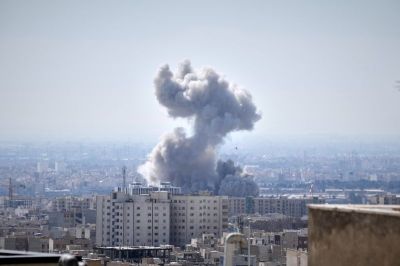 On the 1st (local time), smoke is rising from a building in downtown Tehran due to airstrikes by the United States and Israel on Iran. Photo by Yonhap News Agency
Another analytics firm, Polysights, revealed that it had detected abnormal signals in a separate bet regarding whether Iran’s Supreme Leader, Ali Khamenei, would be ousted by the end of March. While the general participants’ betting ratio on his ouster hovered around 40 percent, accounts suspected to be insiders concentrated approximately 90 percent of their wagers on the ouster outcome.
Controversy also arose over the platform’s judgment criteria. Polymarket decided the outcome of the bet on the question "Will the United States forcibly oust Khamenei?" as "No," citing the reason that "the United States was not directly involved in an assassination," which drew backlash from users.
Kalshi, another prediction market where 55 million dollars were traded on the topic of Khamenei’s potential removal, announced, "We do not offer markets that are conditional on someone’s death," and subsequently suspended related trades and returned investments. Kalshi is regulated by the U.S. Commodity Futures Trading Commission (CFTC).
In contrast, Polymarket’s main trading infrastructure is located outside the United States, and it does not accept U.S. residents as clients, so it is not directly subject to CFTC oversight. Last month, two individuals-including an Israeli reservist and a civilian-were indicted for allegedly using classified military information in their bets on Polymarket regarding military operations.
Polymarket, established in 2020 by Shane Coplan, is a blockchain-based prediction market platform that offers betting products on subjects such as election results, cryptocurrency prices, and global political and economic events.
© The Asia Business Daily(www.asiae.co.kr). All rights reserved.












