Deputy Speaker Lee Hakyoung Declares End to Filibuster
Immediate Vote on National Referendum Act to Guarantee Voting Rights for Overseas Koreans
The filibuster-an unlimited debate tactic to delay parliamentary proceedings-initiated by the People Power Party in opposition to the Democratic Party's attempt to pass the amendment to the National Referendum Act, ended in the afternoon on March 1.
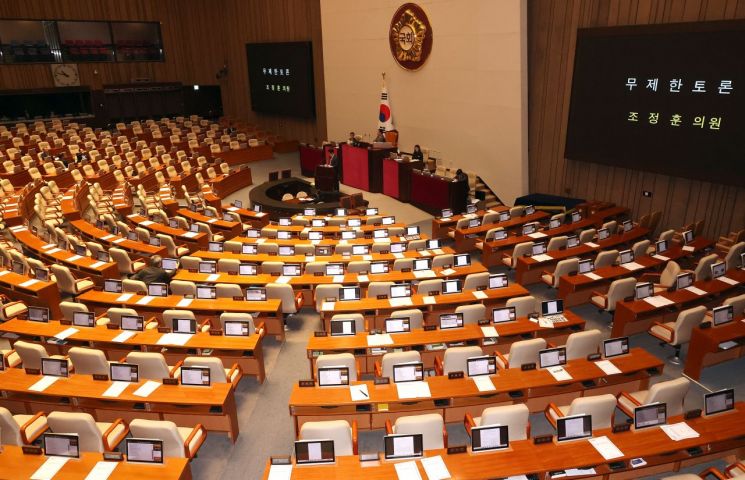 On the 1st, Jogunghoon, a member of the People Power Party, continued unlimited debate on the Comprehensive Revision Bill of the National Referendum Act (alternative) at the National Assembly plenary session. Photo by Yonhap News.
Lee Hakyoung, Deputy Speaker of the National Assembly, announced at the plenary session that, as Assemblywoman Kim Jungjae of the People Power Party had finished her remarks and there were no other members wishing to participate in unlimited debate on the amendment to the National Referendum Act, he would declare the conclusion of the debate in accordance with the National Assembly Act. With this, the People Power Party's filibuster, which began six days earlier on February 24 in protest against the Democratic Party's unilateral passage of judicial reform bills such as the Misrepresentation of Law Act, came to an end.
Deputy Speaker Lee declared a recess at the plenary session to ensure smooth proceedings. Once the session resumes, a vote on the amendment to the National Referendum Act, which includes provisions to guarantee voting rights for overseas Koreans, is expected to take place. According to the National Assembly Act, once unlimited debate concludes, the relevant bill must be put to an immediate vote without delay.
Initially, the People Power Party had planned to continue debate for seven nights and eight days in opposition to the passage of the Commercial Act and judicial reform bills, as well as the Jeonnam-Gwangju Integration Special Act. However, the party strategically decided to end the filibuster after demanding that the Democratic Party process the Daegu-Gyeongbuk (TK) Integration Special Act, which, due to the People Power Party's opposition, had not yet been submitted to the plenary session.
Previously, Song Eon-seok, floor leader of the People Power Party, explained that this decision was made to break the impasse, as the Democratic Party was using the filibuster as grounds to refuse to convene the Legislation and Judiciary Committee.
© The Asia Business Daily(www.asiae.co.kr). All rights reserved.












