"Pentagon Pizza Index" Used as an Indicator of Military Tensions
The "Pentagon Pizza Index" has proven accurate once again, as pizza orders surged at restaurants around the Pentagon just before the U.S. invasion of Iran.
In the early morning of March 1 (local time), the "Pentagon Pizza Report" account on X (formerly Twitter) shared the order status of restaurants near the U.S. Department of Defense headquarters in Virginia. The poster noted, "Orders at 'Pizza Toe Pizza,' the closest late-night pizza shop to the Pentagon, increased as of 1:28 a.m. Eastern Time," adding, "There is usually no wait for pizza orders at this hour, but today there was a noticeable surge." The number of orders at a nearby Papa John's, approximately 2.3 miles from the Pentagon, was more than ten times higher than usual, and the local Domino's Pizza branch also saw a significant increase.
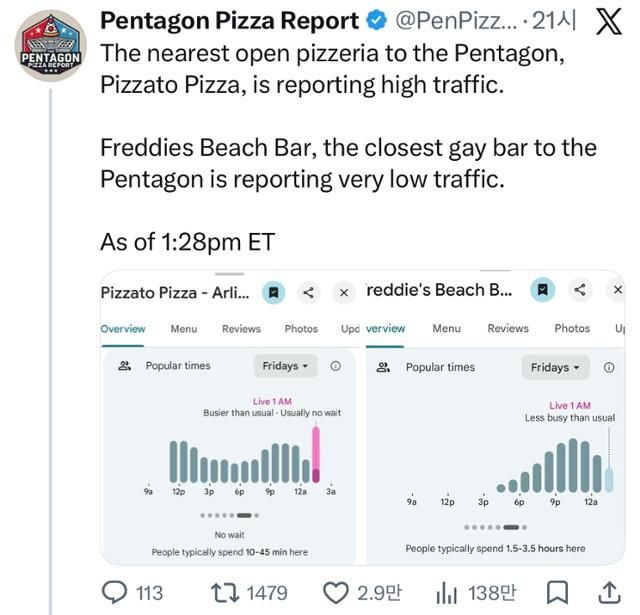 The order volume at 'Pizato Pizza,' a late-night pizzeria near the U.S. Department of Defense headquarters, posted on X (formerly Twitter) by 'Pentacon Pizza Report' at around 1:30 AM on the 1st. X (formerly Twitter)
Around 2:30 a.m. that day, U.S. President Donald Trump posted a video on social media, officially announcing the invasion by stating, "The U.S. military has just launched a large-scale combat operation in Iran." The spike in late-night pizza orders can be inferred to have been caused by Pentagon staff working overnight shifts.
The "Pentagon Pizza Index" is an unofficial indicator that has been known since the Cold War era. Although there are many fast-food outlets inside the Pentagon, there are no pizza shops, so staff must order pizza from outside. When crises such as war escalate, government office workers tend to stay in the office longer, which leads to an increase in pizza orders. Therefore, a spike in pizza orders is seen as a sign that a crisis is becoming severe.
This notion began with remarks made by Frank Meeks, who operated 60 Domino's Pizza stores in the Washington, D.C. area, home to many government offices, during a 1991 interview with the Los Angeles Times. At the time, he said, "At 2 a.m., the news media are in bed, so they can't know if something major is happening, but all the delivery drivers are out," adding, "The night before Iraq invaded Kuwait, more than 20 pizzas were delivered to the CIA."
Following his comments, more people began paying attention to pizza order volumes near government buildings ahead of wartime crises, and the term "Pizza Index" was coined. Wolf Isaac Blitzer, who covered the Pentagon as a CNN reporter in the 1990s, even advised junior reporters, "If you want to know what's happening at the Pentagon, always monitor the pizza orders."
In fact, just before the Gulf War, the number of pizza orders to the White House jumped from about 50 to 125. Before the U.S. invasion of Panama in December 1989, Pentagon pizza deliveries doubled, and during the Iranian missile attack in 2024, pizza shops near the Department of Defense were reported to be much busier than usual.
Recently, the accuracy of this indicator has been enhanced by using "Google Maps Visitor Busiest Times" data, which is based on mobile phone location data. Notably, increases in orders at pizza shops during the early morning hours tend to closely reflect U.S. military activity. 'Pizza Toe Pizza' also saw a surge in orders in the early morning of the 3rd last month, when the U.S. attacked Venezuela, drawing public attention.
© The Asia Business Daily(www.asiae.co.kr). All rights reserved.













