Reviewing Phased Responses Including Release of Oil Reserves and Securing Alternative Routes
Closely Monitoring the Ripple Effects of Rising Oil Prices and Logistics Costs
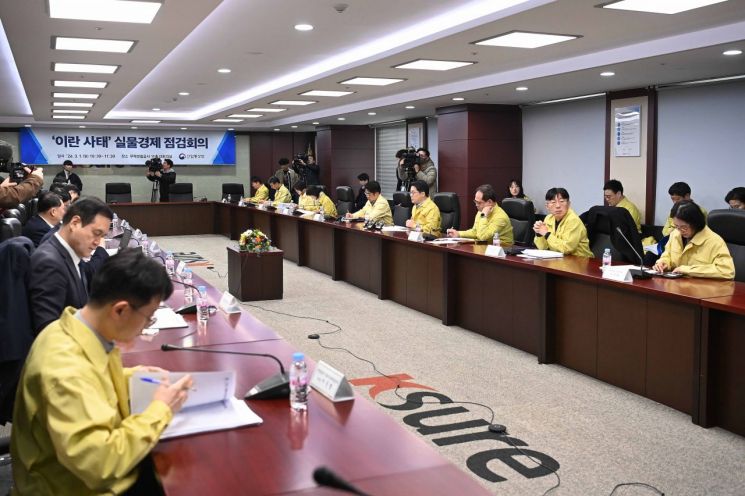 Moon Shinhak, Deputy Minister of Trade, Industry and Energy, along with government officials, held the "2nd Real Economy Inspection Meeting" on the 1st at the Korea Trade Insurance Corporation in Jongno-gu, Seoul, to assess the impact of the Iran situation. Ministry of Trade, Industry and Energy.
With the situation in the Middle East rapidly deteriorating due to the United States and Israel striking Iran, the government has launched an emergency inspection of the real economy. Authorities have begun a comprehensive review covering crude oil and gas supply, maritime logistics, export and supply chains, and financial markets. They have also activated a response system that considers even the possibility of the Strait of Hormuz being blocked.
The Ministry of Trade, Industry and Energy announced on the morning of March 1 that it held the "2nd Real Economy Inspection Meeting," presided over by Vice Minister Moon Shinhak. The meeting was attended by officials from the Ministry of Foreign Affairs, the Ministry of Environment, the Ministry of Oceans and Fisheries, and the Financial Services Commission, as well as industry associations and organizations such as Korea National Oil Corporation, Korea Gas Corporation, Korea Trade-Investment Promotion Agency (Middle East Office), and the Korea Energy Economics Institute.
The government believes that, considering recent developments in the conflict, the possibility of the Strait of Hormuz being blocked cannot be ruled out. As a result, the need to manage maritime transport risks-such as by adjusting tanker schedules and securing alternative routes-has been raised. International oil and gas prices are expected to become more volatile depending on the situation.
For now, authorities assess that supply capacity remains sufficient. The government and the industry have secured several months’ worth of oil reserves, and gas inventories also exceed mandatory storage levels. Thus, the likelihood of an immediate and physical supply crisis is considered limited.
However, if supply disruptions from the Middle East do become a reality, the government plans to implement a phased response. First, the private sector will seek to secure additional volumes from regions outside the Middle East. If the situation becomes prolonged and private oil inventories fall below a certain level, thus worsening the supply crisis, the Ministry of Trade, Industry and Energy will convene its own assessment meeting to decide whether to release stockpiled oil. Plans are also in place to supply oil stored at nine national reserve bases, including Yeosu and Geoje, to the market if needed.
Following instructions from Minister Kim Junggwan, Korea National Oil Corporation has also begun an emergency inspection of its contingency manual, reviewing measures such as importing overseas production, exercising joint stockpiling priority purchase rights, and checking readiness to release reserves.
So far, the impact on maritime logistics has been limited. Since the Red Sea crisis in 2023, major container shipping companies have already been using alternative routes around the Cape of Good Hope in Africa instead of the Suez Canal. However, even though the Middle East accounts for only about 3% of total exports, if the situation is prolonged and oil prices and logistics costs rise, the ripple effects on overall exports could expand.
Accordingly, the government is steadily implementing existing measures such as providing liquidity support to companies suffering export losses in the Middle East, offering logistics cost support through export vouchers, and supporting the use of overseas joint logistics centers. In addition, if logistics bottlenecks worsen, additional responses such as dispatching temporary vessels will also be considered.
In terms of supply chains, the government assesses that, aside from oil and gas, there are few items with high dependence on the Middle East. For certain chemical products such as bromine-a flame retardant raw material-and ethylene glycol for synthetic fibers, Middle Eastern dependence is high. However, the government expects that it will be possible to minimize the impact through domestic production and inventory utilization, as well as alternative imports.
There has been no direct impact on power supply so far. The Ministry of Environment is monitoring the situation together with Korea Electric Power Corporation and power generation companies, in preparation for possible oil price spikes or disruptions in LNG imports, and will strengthen its cooperation system with the Ministry of Trade, Industry and Energy.
Meanwhile, immediately after the situation began, the Ministry of Trade, Industry and Energy activated an "emergency response team" led by Yang Kiwook, policy chief of the Office of Industrial Resource Security. The ministry plans to strengthen cooperation with related ministries while monitoring developments in the conflict, domestic price trends, and shipping operations in real time.
Vice Minister Moon stated, "We will thoroughly review emergency measures such as the release of reserves and make every effort to ensure that fluctuations in oil prices do not excessively translate to domestic gasoline and gas prices, thereby minimizing the impact on consumer prices."
© The Asia Business Daily(www.asiae.co.kr). All rights reserved.












