Government Ministries on Emergency Alert
As Iran attempted to blockade the Strait of Hormuz after being subjected to airstrikes by the United States and Israel, concerns are mounting over the shockwaves this could send through the entire Korean economy. Observers predict that, in the event of a complete blockade of the Strait of Hormuz, international oil prices could soar to as high as $150 per barrel. In the short term, the situation is highly likely to put upward pressure on international oil prices and inflation, and increase the burden on the trade balance. The simultaneous realization of uncertainties in trade due to the nullification of reciprocal tariffs and the risks arising from the Middle East has now become a reality.
At around noon on March 1, the government plans to convene an emergency response task force meeting with relevant ministries to discuss countermeasures in light of the airstrike crisis. At the joint situation assessment meeting, to be chaired by the Ministry of Economy and Finance, attendees plan to review the potential impact of the crisis on the Korean economy. Earlier, Deputy Prime Minister and Minister of Economy and Finance Koo Yooncheol stated, "We plan to respond proactively in cooperation with relevant agencies," instructing all departments within the ministry to maintain a tight response posture.
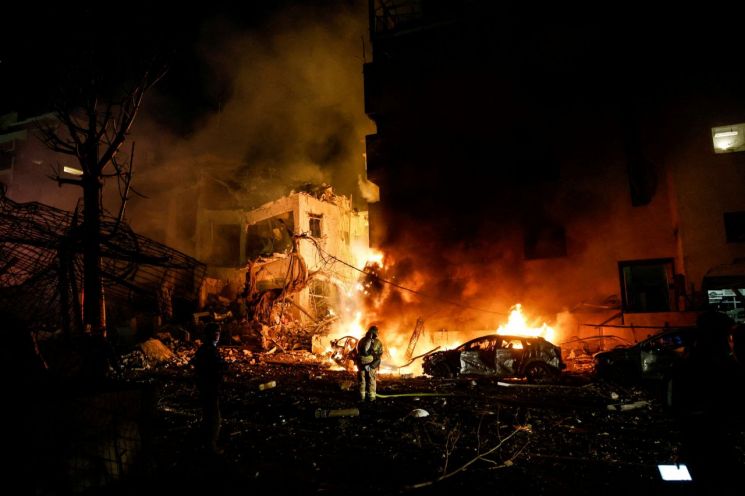 On the 28th (local time), after Israel and the United States conducted airstrikes against Iran, Iran launched missiles at Israel in retaliation. Israeli firefighters are extinguishing vehicle fires at the missile impact site. Photo by Reuters, Associated Press, Yonhap News Agency
The government is closely monitoring the possibility that the repercussions of this crisis could spill over into the real economy. The Strait of Hormuz is the import route for Middle Eastern oil entering Korea, with approximately 20% of global crude oil and about 40% of seaborne crude oil passing through this chokepoint. According to Bloomberg News, numerous oil tankers are currently avoiding passage through the Strait of Hormuz, which links the Persian Gulf and the open sea. There are also reports from foreign media that insurance companies are canceling existing policies for ships passing through Middle Eastern waters or are sharply increasing maritime insurance premiums.
The government anticipates that, should the Strait of Hormuz become effectively blockaded, securing alternative routes will be challenging. While some volumes could be rerouted via pipelines toward the Red Sea, experts note this would be difficult given the limited effective capacity. Although the likelihood of a complete blockade of the Strait of Hormuz is considered low, there are projections that an effective blockade through measures such as vessel seizures, combined with escalating military conflict, could drive international oil prices above $150 per barrel. This would be more than double the current level, which is in the high $60s per barrel. There are also concerns that a prolonged blockade of the Strait of Hormuz could plunge the global economy into an unpredictable crisis, fuel a flight to safe-haven assets in global financial markets, and severely impact foreign exchange and stock markets.
International oil prices have already started to rise. Although the international oil futures market was closed over the weekend, in the over-the-counter market, West Texas Intermediate (WTI) crude rose to $75.33 per barrel-about 12% higher than the previous close. Due to the ongoing tensions between the United States and Iran, international oil prices have already increased by around 20% since the beginning of this year. On February 27 (local time), just before the U.S. and Israeli strikes on Iran, fears of an Iranian airstrike pushed the price of April WTI crude up 3% from the previous session. On February 19, when U.S. forces gathered in the Middle East and President Trump issued a final ultimatum to Iran, prices surged to a six-month high, up 2%.

If the crisis at this key supply chain chokepoint becomes prolonged, the impact on the Korean economy is expected to be significant. In the context of rising trade uncertainty following the U.S. Supreme Court's decision to nullify reciprocal tariffs, the outbreak of a full-scale war in the Middle East would mean Korea, a small, open economy with high dependence on energy imports and exports, could face considerable damage from two simultaneous wars. The rise in international oil prices translates into increased corporate costs and higher inflation, negatively affecting the overall economy. According to the Korea International Trade Association, a 10% rise in oil prices results in a 2.09% increase in export prices and a 2.48% decrease in export volumes. Overall export value is projected to decrease by 0.39%.
A sharp surge in oil prices could act as a stimulus for inflation. Last month, consumer prices rose 2.0% year-on-year, hitting a five-month low. The stabilization of consumer price inflation was largely due to lower international oil prices resulting from increased supply. If the upward trend in oil prices persists for an extended period, the government's inflation trajectory forecast could also change. When the Ministry of Economy and Finance announced its economic growth strategy last month, it assumed this year's international oil price (based on Dubai crude) would average around $62 per barrel. If international oil prices spike, the first sectors to feel the impact will be industrial products and electricity, gas, and water utilities, which are directly linked to oil prices.
Some observers warn that a shock similar to the one caused by the Russia-Ukraine war, which broke out in February 2022-triggering a sharp rise in international energy prices, inflation, supply chain disruptions, and trade deficits-could once again strike the Korean economy.
The government has decided to consider releasing strategic oil reserves should disruptions occur in crude oil supply. The Ministry of Trade, Industry and Energy convened an emergency meeting four hours after the U.S. and Israeli strikes to closely monitor petroleum and gas supply, international price trends, and shipping operations. Currently, Korea holds several months' worth of oil reserves and gas stocks that exceed mandatory reserve levels, so authorities believe the country has sufficient capacity to respond to possible supply crises. The government and industry plan to make decisions on releasing reserves stored at the nine national storage facilities across the country after their own situation assessment meetings if the situation in the Middle East deteriorates.
© The Asia Business Daily(www.asiae.co.kr). All rights reserved.













