Moon Sunghoon, Vice President of MX Hardware, Briefs on the Technology
Recognizing the Importance of Privacy...A Replacement for Polarizing Films
Precisely Controlled at the Pixel Level...Developed Over Five Years
When the user slightly twisted the Samsung Galaxy S26 Ultra in their hand, the popup window at the top darkened. This is thanks to the 'Privacy Display' feature, the world’s first in the mobile industry and developed entirely with Samsung’s proprietary technology. Depending on user preferences, not only the entire screen but also specific notification windows or password entry fields can be hidden from those nearby. Users can also choose to apply it to particular applications (apps) they wish to conceal, such as YouTube or KakaoTalk.
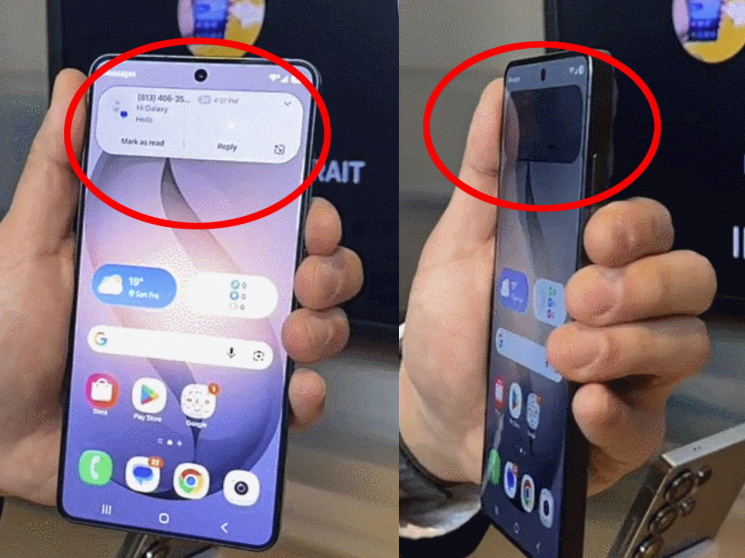 On the Galaxy S26 Ultra, the text message notification panel shows the 'Privacy Display' mode activated. Privacy Display is a feature that limits the viewing angle so that people around you on public transportation or in public places cannot see your smartphone screen. Photo by Bokyung Kim
Moon Sunghoon, Vice President of Samsung Electronics (in charge of hardware at the MX Division), held a hardware briefing in San Francisco, USA, on the 26th of last month (local time), where he explained the story behind the development of the Privacy Display and plans for the future.
"Preventing Information Leakage Through the Screen" - The Motive for Development
According to Samsung's own research, more than half of users (56%) perceive the exposure of their smartphone screen to others as a form of privacy violation. This is the so-called "Shoulder Surfing" concern. Users are particularly worried about privacy breaches through shoulder surfing when entering passwords in financial apps or exchanging opinions with colleagues via mobile messenger.
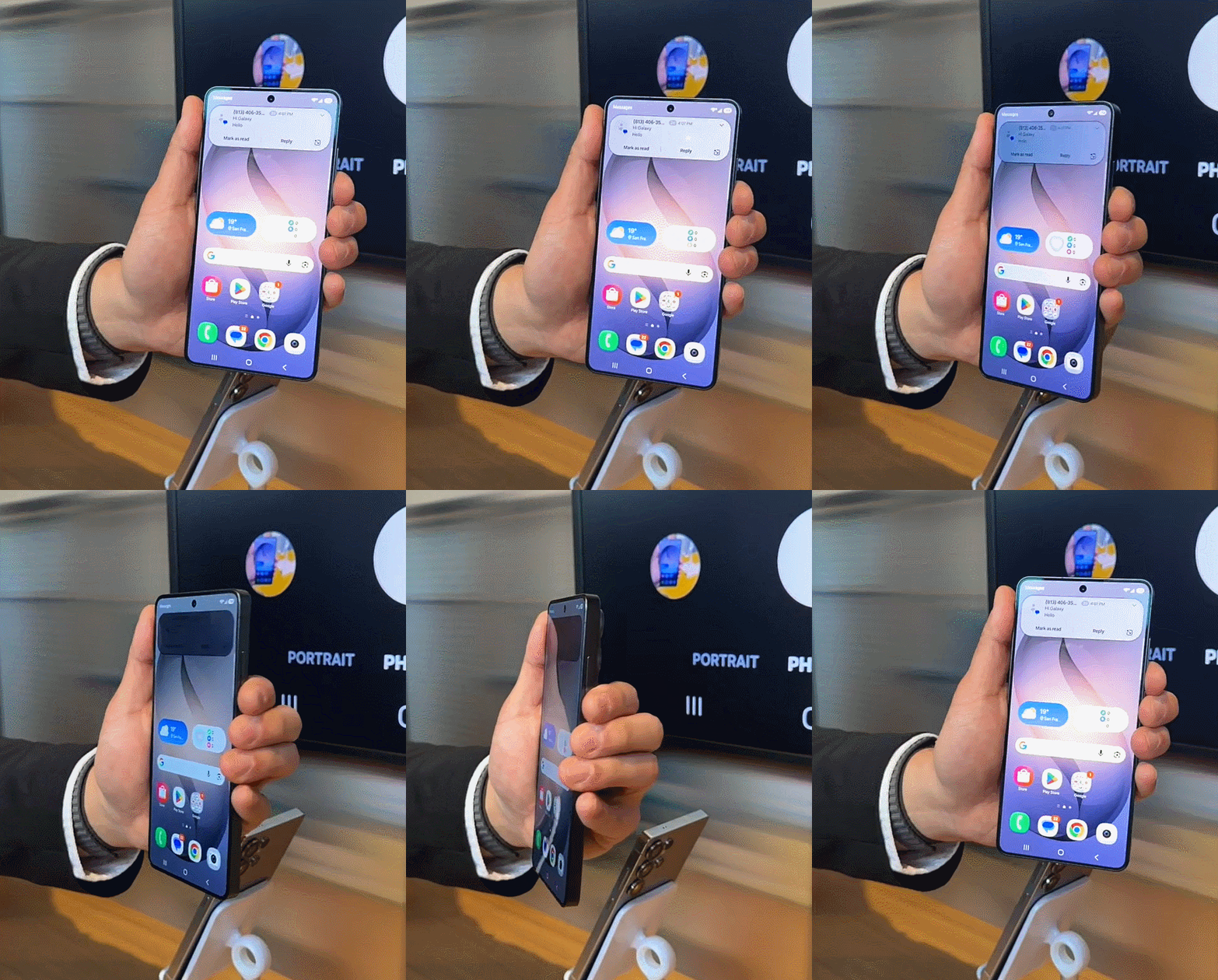 The 'Privacy Display' mode activated on the message notification window of the Galaxy S26 Ultra. Privacy Display is a feature that restricts the viewing angle to prevent people around you from seeing your smartphone screen on public transportation or in public places. Photo by Bokyung Kim
In response, the MX Division at Samsung Electronics set a goal to "prevent information leakage through the screen." Vice President Moon said, "Customers were applying polarizing films for privacy, preventing them from experiencing the best display quality," adding, "This made us realize just how important privacy is." He continued, "We believed it would be even more valuable if users could freely turn the setting on and off according to their preference."
How Does the Technology Work? Controlled at the Pixel Level
The core of the Privacy Display is that the screen appears dark to people next to or behind the user. This technology is implemented through precise pixel design and operation. Pixels are divided into narrow pixels and wide pixels. Narrow pixels emit light vertically, while wide pixels emit light at a wider angle. In standard mode, both types of pixels operate, providing a display that is bright and clear from all angles.
 On the 26th of last month (local time), at the Galaxy Hardware Innovation Briefing held in San Francisco, USA, Moon Sunghoon, Vice President in charge of hardware at Samsung Electronics' MX Division, is seen explaining. Provided by Samsung Electronics
In privacy mode, the display mainly uses narrow pixels, minimizing the operation of wide pixels. As a result, the screen remains bright and clear from the front, but is barely visible from any angle except straight on. This offers more advanced privacy than typical screen protectors that limit viewing angles only to the sides.
Vice President Moon explained, "Commercialization became possible only after we achieved precision at the pixel level and stabilized performance," adding, "It took five years, and there are many engineers internally who were so happy they celebrated as if it were a party."
"Difficult to Avoid Patents... For the Time Being, a Galaxy-Exclusive Experience"
Another feature is the variety of options available to tailor the mode to user preferences. Vice President Moon explained, "We've also implemented a 'Maximum Privacy Mode' for times when users absolutely do not want others to see their screen, even if it means the display appears a little darker to them." He also noted, "You can set it so that privacy mode is automatically activated only when drawing a pattern or entering a password on the lock screen, or so it works only in selected apps like banking apps or messenger apps such as KakaoTalk."
 On the 26th of last month (local time), at the Galaxy Hardware Innovation Briefing held in San Francisco, USA, Samsung Electronics MX Division's Vice President of Hardware, Seonghoon Moon, is seen explaining. Provided by Samsung Electronics
The Privacy Display is a proprietary Samsung technology that was developed over approximately five years of research. The company also claims to hold a patent portfolio that would be difficult for other manufacturers to circumvent. Vice President Moon stated, "The MX Division proposed the idea and began development in collaboration with Samsung Display," adding, "Each company holds separate patents." He further explained, "It would be difficult for others to create a privacy display while avoiding our patents. Although it’s possible we could sell the patents to other companies, that is unlikely and not currently planned. For the time being, it will remain a unique experience for Galaxy users."
Further advancements to the feature are also expected through future updates. For example, the device could automatically turn privacy mode on or off by detecting people nearby, or it could be applied only to specific areas within certain apps. Vice President Moon said, "If the radio signals around me are clear, the mode can remain off, but if there are many people nearby, it can automatically recognize a public setting and turn on. We can also collaborate with app developers to apply it only to specific areas within their apps."
© The Asia Business Daily(www.asiae.co.kr). All rights reserved.














