February Exports Up 29.0%, Semiconductors Surge 160.8%
Three Fewer Working Days Due to Lunar New Year, Daily Average Exports Rise 49.4%
Record-High Trade Surplus Achieved, Marking 13 Consecutive Months in the Black
Despite a decrease in the number of working days, exports in February showed an increase, driven by strong semiconductor performance. The export growth trend that began in June last year has continued for nine consecutive months.
According to the Ministry of Trade, Industry and Energy's announcement on March 1, titled "Trends in Exports and Imports for February," export value reached USD 67.45 billion, marking a 29.0% increase compared to the same month last year. This is the highest export performance ever recorded for the month of February.
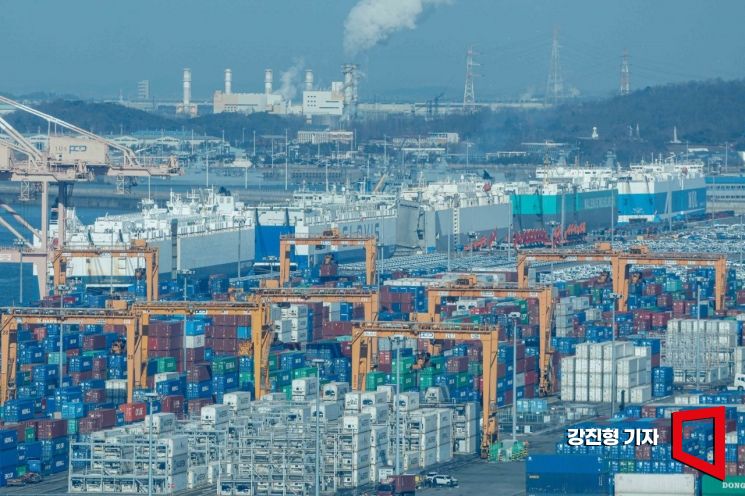 Export containers are waiting to be shipped at Pyeongtaek Port, Gyeonggi Province. Photo by Kang Jin-hyung
In February, due to the Lunar New Year holidays, the number of working days was three days fewer than in the same month last year. Even after adjusting for the number of working days, average daily exports increased by 49.3% to USD 3.55 billion, exceeding USD 3 billion for the first time in history.
In February, exports increased for five out of the 15 major export categories. Semiconductor exports (USD 25.16 billion, up 160.8%) maintained a record high for any single month, driven by continued excess demand from expanded investments in artificial intelligence (AI) and a consequent sharp rise in memory prices. Semiconductors also surpassed USD 20 billion in exports for the third consecutive month.
By region, exports increased in seven out of the nine major export destinations. Exports to the United States (USD 12.85 billion, up 29.9%) achieved the highest February figure ever, with semiconductors and computers posting triple-digit growth rates, and other items like bio-health, petroleum products, and secondary batteries also showing robust increases. Exports to China rose by 34.1% to USD 12.75 billion, despite a reduction in working days due to the Lunar New Year holiday (February 14-18) and the Spring Festival (February 15-23), as many items underperformed; however, exports of semiconductors, computers, and petroleum products increased significantly overall.
Imports in February rose by 7.5% to USD 51.94 billion. While energy imports (USD 9.29 billion, down 1.4%) declined, non-energy imports (USD 42.64 billion) increased by 9.6%.
Energy imports saw a decrease in crude oil (USD 5.43 billion, down 11.4%) due to falling oil prices, while gas imports (USD 2.64 billion, up 15.9%) increased. Among non-energy items, imports of semiconductors (USD 6.76 billion, up 19.1%), semiconductor equipment (USD 2.56 billion, up 43.4%), and telephones (USD 1.03 billion, up 80.2%) increased.
The trade balance for February recorded a surplus of USD 15.51 billion, an increase of USD 11.55 billion compared to the previous year. This marks the largest surplus ever recorded for any period, continuing a streak of 13 consecutive months of surplus since February last year.
© The Asia Business Daily(www.asiae.co.kr). All rights reserved.












