Emergency Meeting Convened at 7:00 p.m. on the 28th
Safety of South Korean Nationals Overseas Given Top Priority
Assessment of Security and Economic Impact at Home... Immediate Report to President Lee
The National Security Office at the Blue House convened an emergency National Security Council (NSC) working-level coordination meeting regarding the U.S. and Israeli airstrikes on Iran. The office conducted a multifaceted assessment of the situation involving Iran and, in anticipation of a prolonged crisis, reviewed the government's comprehensive preparedness posture.
On February 28, starting at 7:00 p.m., the National Security Office held the emergency meeting to evaluate the overall situation in Iran and the Middle East and to first check on the safety of South Korean nationals residing in the area. The National Security Office stated, "We assessed the potential impact of the current situation on our security and economy, and reviewed the actions of the relevant ministries as well as future plans."
The participants acknowledged the possibility that the crisis might not be resolved in the short term. They agreed to closely monitor future developments and to continue taking necessary precautions. The National Security Office said, "Taking into account the potential for a prolonged crisis, we will remain vigilant and continue to prepare accordingly. The outcome of the discussions was reported to President Lee Jaemyung, and the National Security Office will continue to take necessary measures in cooperation with relevant ministries."
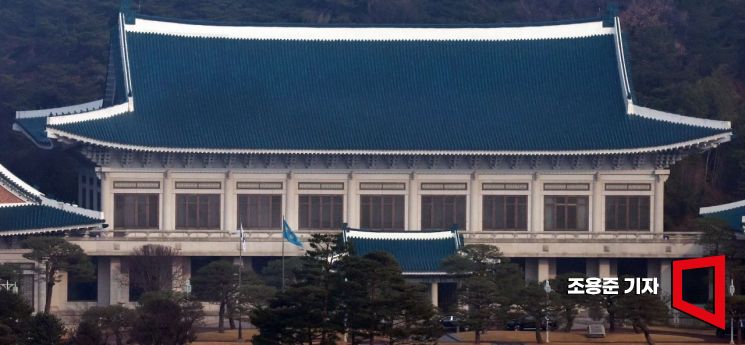 On December 29, 2025, as President Lee Jae-myung commuted to the Blue House, marking the official reopening of the Blue House era after 3 years and 7 months, the phoenix flag was raised at the Blue House in Seoul. Photo by Jo Yongjun
President Lee Orders "Safety of Overseas Koreans Is Top Priority"
The Blue House previously called for "all parties to make maximum efforts to ease regional tensions" in response to the U.S. and Israeli airstrikes on Iran, and expressed its commitment to ensuring the safety of South Korean nationals residing in Iran. After being briefed, President Lee also reviewed the domestic impact and countermeasures, and instructed officials to "prioritize the safety of South Korean nationals in Iran and neighboring regions."
Under the leadership of the Ministry of Foreign Affairs, the government is also implementing measures to protect overseas nationals. On the same day, the Ministry of Foreign Affairs convened a joint situation assessment meeting between headquarters and eight overseas missions, including the Embassy of the Republic of Korea in Iran, to review the situation in the Middle East and discuss safety measures. The Embassy in Iran stated that it is checking the safety of South Korean nationals residing in the country on a daily basis, continuously recommending departure whenever flights are available, and reviewing evacuation plans in case of emergency.
Given that the emergency meeting addressed diplomatic, security, and economic risks from multiple angles, the Blue House is expected to convene additional meetings and implement phased response measures as the situation develops.
On the same day, the Israeli Minister of Defense carried out a "preventive strike" against Iran. Reports indicate that the targets included major military facilities, government agencies, and intelligence assets in Iran. U.S. President Donald Trump also acknowledged the U.S. attack shortly after the airstrikes by posting on Truth Social, "Just moments ago, we initiated major combat operations inside Iran."
According to AP and BBC, the National Communication Center (NCC) of Bahrain announced that the headquarters of the U.S. Navy's Fifth Fleet, stationed in the country, was attacked by missiles following the Israeli and U.S. airstrikes.
With the full-scale airstrikes by the U.S. and Israel on Iran, airspace across the Middle East has been closed, causing disruptions to global air travel. According to the airline industry, as Iran began retaliatory attacks against U.S. military bases in the region, most Middle Eastern flight routes are now facing significant difficulties in operating normally.
© The Asia Business Daily(www.asiae.co.kr). All rights reserved.












