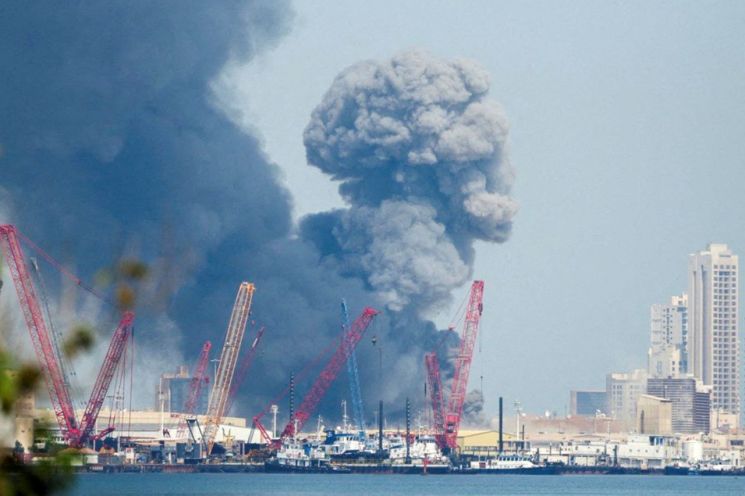
 On the 28th (local time), smoke rose into the sky following an explosion sound at the US Navy base in Manama, Bahrain, which was targeted by Iran's missile attack. Photo by Reuters Yonhap News
As the US and Israel have intensified their strikes against Iran, the government is closely monitoring the situation while maintaining a tight response posture.
On February 28, Koo Yooncheol, Deputy Prime Minister and Minister of Economy and Finance, stated, "We plan to respond proactively in cooperation with relevant agencies," and instructed all departments of the Ministry of Economy and Finance to maintain a close response posture.
The Ministry of Economy and Finance reported that Deputy Prime Minister Koo made this request, emphasizing that they are carefully monitoring the related situation.
In this regard, Deputy Prime Minister Koo is scheduled to hold a 'Joint Situation Assessment Meeting on Iran' with relevant agencies around noon on March 1.
The Korean economy, which is a small open economy with high dependence on energy imports and strong exports, now faces the need to closely monitor the possibility of a sharp rise in international oil prices and increased volatility in the financial and foreign exchange markets due to the recent airstrikes.
The worst-case scenario anticipated by the market is a complete blockade of the Strait of Hormuz, the world's largest oil shipping route, by Iran as a retaliatory measure.
The Ministry of Trade, Industry and Energy held the 'First Emergency Situation Assessment Meeting' at 7 p.m. on February 28, presided over by Minister Kim Jeonggwan, to check the supply of resources such as oil and gas and assess the impact on domestic industries.
So far, no unusual incidents have been reported in the operation of oil tankers and LNG carriers, but since some oil tankers are scheduled to pass through the Strait of Hormuz, the authorities have identified the need to secure alternative routes and strengthen situation management.
© The Asia Business Daily(www.asiae.co.kr). All rights reserved.












