March 19-29 at Daloreum Theater, National Theater of Korea
The story unfolds on the premise "What if Anpyeong had survived?"
Featuring An Gyeon, painter of "Dream Journey to the Peach Blossom Land," and Mushim, Anpyeong's daughter
The recently spotlighted film "The Man Who Lives with the King" is set against the historical backdrop of Sejo, the 7th king of the Joseon Dynasty (Prince Suyang), who seized power through the Gyeyujeongnan coup, and subsequently ordered the deaths of his younger brother, Prince Geumseong, and his nephew, King Danjong. Next month, a changgeuk (Korean traditional opera) based on the Gyeyujeongnan will be staged.
The National Changgeuk Company of Korea, an affiliated troupe of the National Theater of Korea, will present the changgeuk "Boheoja: He Who Walks in the Void" at the Daloreum Theater of the National Theater of Korea from March 19 to March 29. "Boheoja" tells the story of those left behind in the darkness of history, 27 years after the Gyeyujeongnan. The protagonist is Prince Anpyeong, another younger brother of Sejo, who was killed by Sejo. "Boheoja" drew significant attention during its premiere last year, selling out every performance.
The inspiration for this work, "Boheoja," is a musical piece that originated from the Song Dynasty in China during the Goryeo period and became established as court music during the Joseon Dynasty. It carries wishes for health, longevity, and an era of peace and prosperity. The changgeuk "Boheoja" focuses on the condensed meaning of the piece’s title, "He Who Walks in the Void." The production uses this as a metaphor for the fate of people who yearn for a free and peaceful life, yet are bound by the constraints of reality-left to precariously wander as though walking in empty air with nowhere to set foot.

Playwright Bae Samsik, who wrote the script, focused on the historical void that Prince Anpyeong was executed only eight days into his exile, yet no tomb or epitaph remains. Bae unfolds a story under the hypothetical premise "What if Anpyeong had survived somewhere?" set 27 years after his disappearance. The story begins as Mushim, Anpyeong’s only living blood relative and his daughter, is released from slavery, 27 years after the Gyeyujeongnan. Mushim, An Gyeon-the painter who created "Dream Journey to the Peach Blossom Land"-and Dae Eohyang, Anpyeong’s former mistress, reminisce at the ruins of Suseong Palace. There, they encounter a nameless "Wanderer (Anpyeong)" who remembers Anpyeong, as well as the spirit of Suyang who follows him. Together, they embark on a journey to Daejaam Temple, where the "Dream Journey to the Peach Blossom Land," a painting from Anpyeong’s dream of paradise, is preserved. Along this journey, they confront both the dreams they once longed for and the harsh reality before them. Through the footsteps of those whose lives were crushed against their will, the production poses a profound question about the "impossible dreams" that each of us harbors, even amid the weight of reality.
The production is directed by Kim Jeongi, a young director gaining attention in the theater world. While maintaining the flow of the premiere, Director Kim has refined certain scenes for a more intense narrative. Kim commented, "This is the story of all of us, who continue to walk a precarious tightrope while holding onto hope amid our respective losses and pain," adding, "I hope that, like peach blossom petals drifting above a ruined reality, this work will bring deep empathy and quiet solace to the audience’s lives."
Han Seungseok, a music director who has worked on numerous productions with the National Changgeuk Company of Korea, is responsible for composing and creating the musical score, with composer Jang Seoyoon-known for the changgeuk "Simcheong" and the small changgeuk series "Ongcheo"-joining the team. The accompaniment, centered on melodic instruments such as the geomungo, 25-string gayageum, saenghwang, and yanggeum, maximizes lyricism. In order to capture the unique texture of the court music "Boheoja," instruments rarely used in changgeuk-cheolhyeongeum, unra, pyeonjong, and pyeongyeong-were actively utilized. The lyrics, delivered in a contemplative, poetic singing style, intentionally avoid elaborate techniques like sigimsae or buchimsae, emphasizing a transcendent sentiment with a simple and restrained approach. This revival also features conductor Jang Taepyeong, who joins anew to heighten immersion with a 14-member live Korean traditional orchestra. Amid the plaintive melodies, the choreography of contemporary dancer Kwon Ryeongeun weaves the characters’ turbulent inner emotions into modern movement.
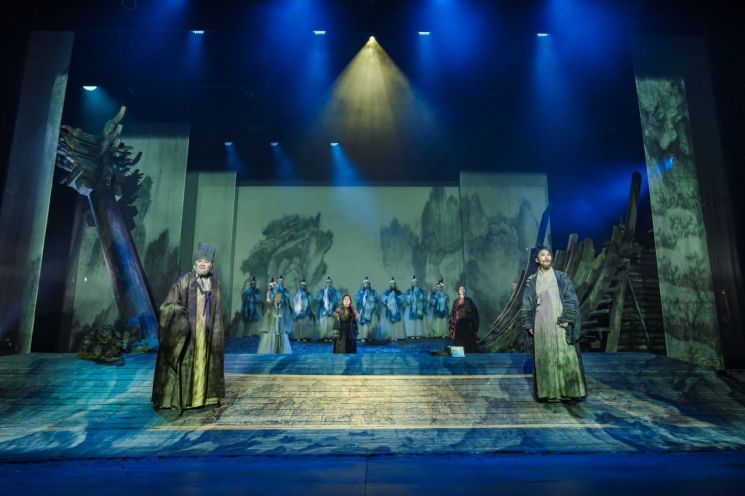
Stage designer Lee Taeseop visualized the aftermath of tragedy with the concept of "the ruins of a dream." The collapsed pillars and railings, recreated in rough-textured plywood, symbolize the remnants of tragedy, while the massive hill at center stage represents the arduous journey of the characters' lives. In particular, the scene of "Dream Journey to the Peach Blossom Land," unfolding with drifting peach blossom petals in the latter half of the play, is regarded as a highlight of the production for its dreamlike beauty.
Familiar faces from the premiere return to the stage, including Kim Junsu as the Wanderer (Anpyeong), Lee Kwangbok as Suyang, Min Eunkyung as Mushim (Anpyeong’s daughter), and Yoo Taepyeongyang as An Gyeon (the painter who depicted Anpyeong’s dream). Veteran member Kim Mijin will play the roles of Bongong, a nun at Daejaam, and Dochang, while Lee Soyeon joins the cast as Dae Eohyang, Anpyeong’s beloved, bringing fresh energy to the production. In total, 35 performers will appear on stage.
Yoo Eunseon, Artistic Director of the National Changgeuk Company of Korea, commented, "The recent film 'The Man Who Lives with the King' has been widely acclaimed for its tragic narrative of loyalty to Danjong and the struggle for power. This changgeuk will provide an opportunity to experience the unique charm of changgeuk through regret-filled songs and overwhelming sounds, depicting the intertwined lives of Prince Anpyeong, who tried to protect Danjong, and Prince Suyang, who strove for the throne-brothers whose paths diverged."
© The Asia Business Daily(www.asiae.co.kr). All rights reserved.













