Chinese Individual Investors Join ‘Buy Korea’ Trend Amid Korean Stock Market Boom
China-Korea Semiconductor ETF Trades at Up to 20% Premium
High Demand for ETF Featuring SK hynix and Samsung Electronics
Recently, as the Korean stock market has experienced explosive gains, even individual investors from China are joining the 'Buy Korea' movement. In particular, there has been a surge of capital flowing into the 'China-Korea Semiconductor ETF' listed in China, leading to an unusual situation where it is trading at prices 10 to 20 percent higher than its net asset value (NAV).
According to the financial investment industry on February 28, the 'Huatai-PB CSI KRX China-Korea Semiconductor (中韓半導體)' ETF, listed on the Shanghai Stock Exchange, closed at 4.321 yuan on February 26, up 9.64 percent. During the session, the price rose as high as 4.33 yuan, nearing the upper limit of 4.335 yuan. Trading volume for the day reached 8.699 billion yuan (approximately 2 trillion won).
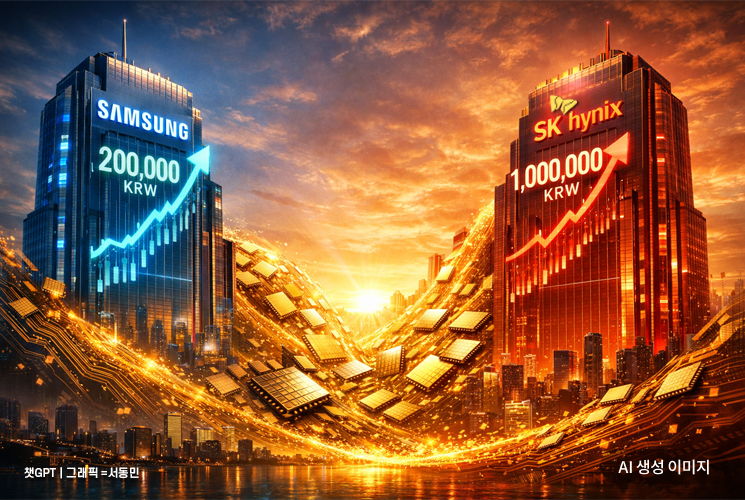
The China-Korea Semiconductor ETF, newly listed in November 2022, is the only Korea-related investment product listed on the Chinese mainland stock market. It is managed by Chinese asset management company Huatai Bai Rui, and invests in leading semiconductor companies in both Korea and China. The underlying index is the 'KRX CSI Korea-China Semiconductor Index,' jointly developed by the Korea Exchange and the Shanghai Stock Exchange.
As of this date, the top holdings include Korea's SK hynix (14.19%), Samsung Electronics (12.78%), and China's SMIC (7.07%), Naura Technology (5.72%), Hygon (5.30%), and Cambricon (5.06%). Korea's Hanmi Semiconductor is also included at 3.35%. The ETF holds a total of 58 stocks. SMIC is the largest semiconductor manufacturer in China; Naura Technology is a leading Chinese semiconductor equipment company; Hygon is a representative Chinese fabless semiconductor company; and Cambricon, often called the 'Nvidia of China,' is the country's largest artificial intelligence (AI) semiconductor design company.
The price, which hovered around 1 yuan at the beginning of last year, has surged to over 4 yuan in just over a year, rising more than threefold. Since the start of this year alone, it has recorded double-digit growth rates, and the buying momentum continues, with net buying inflows sustained for 20 to 30 consecutive trading days recently.
On this day, the China-Korea Semiconductor ETF showed an abnormally high premium (price gap). The ETF premium was 20.98 percent, meaning that the China-Korea Semiconductor ETF was trading at nearly 21 percent above its NAV. Industry experts explain that this is because it is difficult to trade foreign stocks directly in mainland China, so investors are willing to pay a premium just to buy the China-Korea Semiconductor ETF.
© The Asia Business Daily(www.asiae.co.kr). All rights reserved.












