Handwritten Notebook of B-29 Co-pilot Put Up for Sale
Recorded 43 Seconds After Atomic Bomb Drop, Capturing His State of Mind
A handwritten diary by a U.S. Army officer documenting the moment when the world’s first atomic bomb was dropped on Hiroshima, Japan, on August 6, 1945, has been put up for auction.
According to Yonhap News, citing a report by The Washington Post on February 26 (local time), rare book dealer Dan Whitmore in Pasadena, California, has listed Captain Robert Lewis’s notebook for sale at a price of 950,000 dollars (approximately 1.37 billion won).
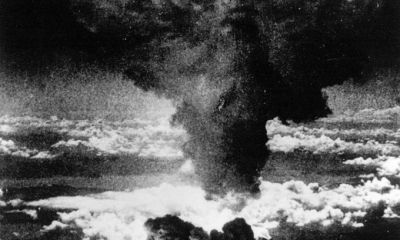
At the time, Lewis was 26 years old and served as the co-pilot of the B-29 bomber "Enola Gay," which carried the atomic bomb "Little Boy." There were a total of 12 crew members on board. In the early hours of August 6, 1945, en route to Hiroshima, he wrote his feelings in the notebook while on board. About two hours before the bombing, he wrote, "It’s a queer feeling to know that the bomb is right behind me."
The atomic bomb was dropped at 8:15 a.m., and about 43 seconds later, it exploded at an altitude of 1,890 feet (approximately 576 meters). Lewis recorded, "We turned the plane to see the results, and there was the largest explosion ever witnessed by man."
On pages added several days later, Lewis expressed remorse over the devastation. He wrote, "My God, what have we done?" and questioned, "How many people did we kill?"
This notebook is now on the market for the fifth time. It was first auctioned in 1971 for 37,000 dollars and was traded again in 2022 for 543,000 dollars. Whitmore described the record as "one of the most important documents of World War II."
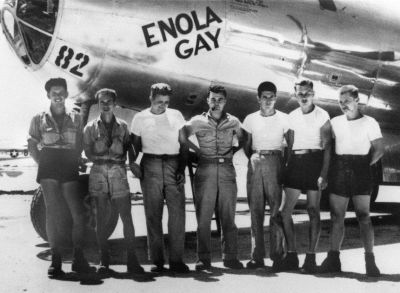 Crew members of the Enola Gay, the bomber that dropped the atomic bomb on Hiroshima. Photo by Yonhap News
Artifacts related to the Hiroshima atomic bombing also appeared at auction in February 2024. At that time, U.S. auction house RR Auction listed a wristwatch that had stopped at 8:15 a.m., the exact moment of the nuclear explosion. The watch was sold for 31,113 dollars (approximately 4.1 million won).
The watch is said to have been discovered amid the ruins by a British soldier during the reconstruction of Hiroshima immediately after the war. Although the glass became cloudy due to the blast, the hands inside remain frozen at 8:15 a.m. RR Auction described the item as "an educational symbol that serves as a reminder of the horrors of war and reveals a painful chapter of human history."
© The Asia Business Daily(www.asiae.co.kr). All rights reserved.













