Supreme Court Rulings Now Subject to Appeal
If They Infringe on Fundamental Rights or Contradict Constitutional Court Decisions
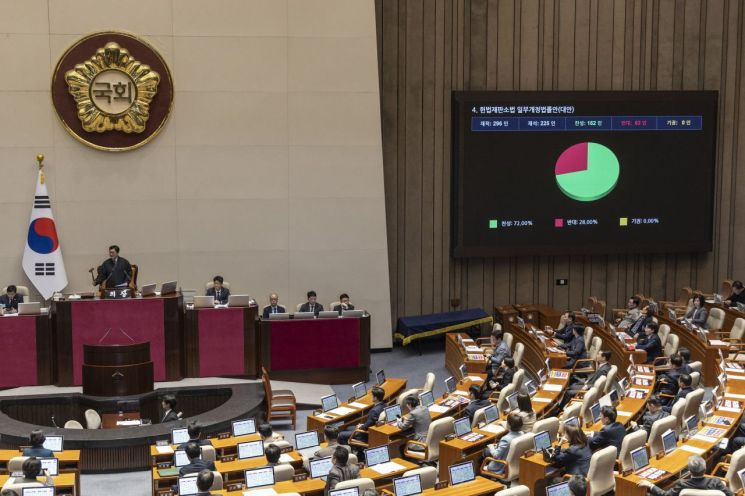
The bill for the so-called “Judicial Appeal System” (an amendment to the Constitutional Court Act), which allows the Constitutional Court to review finalized Supreme Court decisions as subject to a constitutional complaint, has long faced criticism from not only the opposition but also the legal and academic communities for effectively introducing a fourth tier of appeal. On February 27, the bill was passed at the National Assembly’s plenary session, led by the Democratic Party of Korea.
During the session, out of 225 legislators present, 162 voted in favor and 63 against, passing the Judicial Appeal System. The People Power Party expressed their opposition through a filibuster (unlimited debate) and did not participate in the vote.
While Democratic Party lawmakers were voting, they protested by standing on the main podium and holding a banner that read, "Overturning Lee Jaemyung’s Trial, Three Judicial Destruction Bills, Judicial Hell, People’s Tears."
As the commotion grew, National Assembly Speaker Woo Wonshik pointed out, "Holding up pickets has happened before and could be considered customary, but bringing in banners seems excessive."
Despite requests for restraint, shouting broke out between ruling and opposition lawmakers, including, "You hit me with a picket. Apologize," and, "Why did you say not to take photos, but you take photos?" In response, Speaker Woo stated, "Officially requesting an apology in the plenary chamber is itself a form of disciplinary action, so the Speaker cannot unilaterally demand it." As the chaos continued and People Power Party lawmakers removed the large banner, Speaker Woo declared, "Since the banner has been removed, we will proceed."
After addressing the crime of distortion of justice the previous day and the Judicial Appeal System on this day, the Democratic Party plans to process the bill to increase the number of Supreme Court justices on February 28. Some in the legal community predict that the judicial system, maintained since the 1987 constitutional amendment, could be drastically changed for the first time in 39 years.
The Judicial Appeal System allows rulings by the Supreme Court and other courts to be subject to constitutional complaint before the Constitutional Court if the verdict infringes upon citizens’ fundamental rights, contradicts a Constitutional Court decision, or was reached without due legal process.
This means that even finalized Supreme Court decisions could be overturned by the Constitutional Court. The bill sets the filing period as within 30 days of the final court decision. Currently, the Constitutional Court Act excludes “court judgments” from constitutional complaints, but this bill would make them eligible.
If the Constitutional Court finds a violation of the petitioner’s fundamental rights and rules in their favor, the original verdict is annulled and loses its legal effect. In such cases, the courts must retry the case in accordance with the Constitutional Court’s decision. The Constitutional Court may also order to suspend execution of the verdict until it reaches a final decision. This law will take effect immediately upon promulgation.
In response, the People Power Party strongly opposed the bill, arguing that it is very likely to cause significant social side effects, including prolonged litigation periods, increased judicial uncertainty, and a shortage of personnel at the Constitutional Court, and thus engaged in a filibuster.
The Supreme Court’s National Court Administration stated on February 10, "If trials are conducted outside of the courts, or if repeated litigation continues beyond the Supreme Court due to dissatisfaction with verdicts, it would be unconstitutional," expressing their opposition by calling the Judicial Appeal System itself unconstitutional.
On the other hand, the Constitutional Court argued that, "Claims that this system violates the Constitution, undermines the principle of separation of powers, or infringes on judicial independence lack constitutional basis."
As a result, the Supreme Court and the Constitutional Court are seen as being in a power struggle. The Supreme Court is the highest court in all jurisdictions nationwide and is the only court capable of issuing final, binding verdicts. The Constitutional Court, meanwhile, has the authority to dismiss even the president-the two most recent cases being the removals of Park Geunhye and Yoon Seokyeol following the Constitutional Court’s decisions.
On this day, the Democratic Party also introduced the "Supreme Court Justice Increase Act" (an amendment to the Court Organization Act), the final stage of the three judicial reform bills, with the aim of completing the legislative process for the three judicial reform bills by February 28. The Supreme Court Justice Increase Act seeks to raise the number of Supreme Court justices from the current 14 to 26.
© The Asia Business Daily(www.asiae.co.kr). All rights reserved.












