At the "Pediatric and Adolescent Cancer Treatment and Research Advancement Symposium"
Unified Call for "Urgent Need for a National Long-Term Management Plan"
Although the cure rate for pediatric and adolescent hematologic cancers in South Korea has surpassed 85%, concerns have been raised that the medical infrastructure for treating children is on the verge of collapse, highlighting the urgent need for long-term and proactive intervention at the national level.
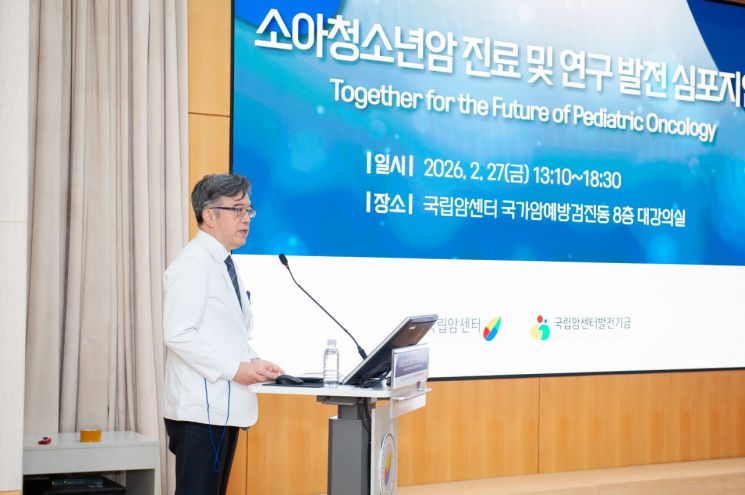 On the 27th, at the National Cancer Center Screening Building in Ilsan, Gyeonggi Province, Han-kwang Yang, director of the National Cancer Center, gave a greeting at the "Pediatric and Adolescent Cancer Treatment and Research Development Symposium." National Cancer Center.
The National Cancer Center held the "Pediatric and Adolescent Cancer Treatment and Research Advancement Symposium" on the 27th at its screening building, where discussions focused on the sustainability of the pediatric and adolescent cancer treatment system and national policy directions. The symposium was organized by the National Cancer Center, in its role as the central national cancer control institution, to respond to structural changes in the field of pediatric and adolescent cancer and the weakening foundation for clinical research, as well as to build social consensus on strengthening a public-centered treatment system.
Medical professionals noted that while treatment outcomes for pediatric and adolescent hematologic and solid cancers in Korea have improved dramatically compared to the past, there are still significant challenges in securing specialized personnel. They also emphasized the need to establish long-term follow-up management systems to support long-term survivor care.
Mirim Park, Director of the Pediatric and Adolescent Cancer Center at the National Cancer Center, said, "The five-year survival rate for pediatric and adolescent hematologic cancer patients in Korea is about 85%, which is on par with advanced countries such as the United States. This achievement was largely made possible by systematic management based on national cancer registry data, and to continue this success, it is essential to secure specialized personnel and provide sustainable research funding."
Professor Han Jungwoo of Yonsei University College of Medicine stated, "We are seeing high cure rates for major pediatric solid tumors such as neuroblastoma and Wilms tumor, and recently, the introduction of next-generation sequencing (NGS)-based precision medicine is offering new hope to patients with refractory diseases. However, it is necessary to improve access to new drugs for high-risk patients and to support multi-center collaborative research."
Professor Park Eunsil of Gyeongsang National University College of Medicine stressed, "About two-thirds of childhood and adolescent cancer survivors experience late complications such as cardiovascular disease, making it urgent to establish long-term follow-up guidelines centered around regional hub hospitals. In addition, it is critical to develop standardized integrated support programs at the national level and expand the medical workforce so that survivors can return to society in good health."
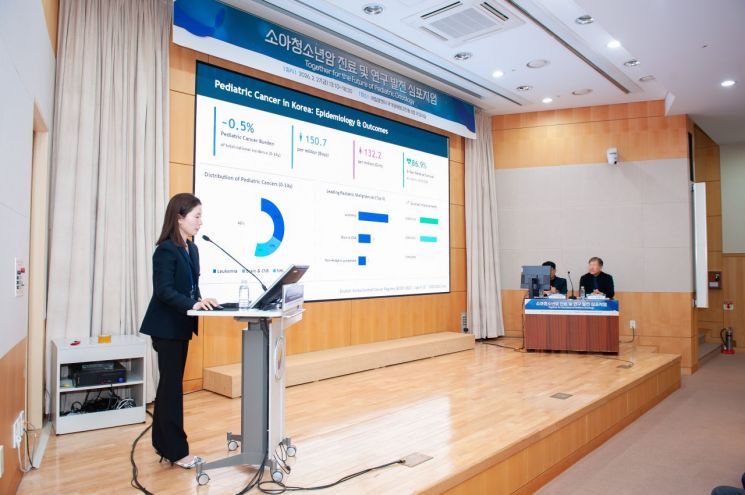 On the 27th, at the 'Pediatric and Adolescent Cancer Treatment and Research Advancement Symposium' held at the National Cancer Center Screening Building in Ilsan, Gyeonggi Province, Mirim Park, Director of the Pediatric and Adolescent Cancer Center at the National Cancer Center, gave a presentation. National Cancer Center.
Measures to strengthen institutional support for research continuity and the role of public healthcare were also proposed. Professor Sung Kiwoong of Sungkyunkwan University School of Medicine pointed out that the low incidence and rarity of pediatric and adolescent cancers make single-institution studies challenging, and therefore advocated for the establishment of a "Pediatric and Adolescent Cancer Clinical Research Support Center." He explained, "By setting up an independent support center at the academic society level, we aim to enhance the quality of clinical trials, expand treatment opportunities for patients, and ensure the sustainability of research through national support."
Professor Lim Yeonjeong of Chungnam National University College of Medicine shared the achievements of the "Treatment System Establishment Project," which was implemented to address the issue of concentrated treatment infrastructure in the capital area, despite about 50% of pediatric and adolescent cancer patients residing in non-metropolitan regions. She said, "By centering emergency response and high-level treatment systems at regional hub hospitals, the number of hospital admissions increased by 26.2% compared to 2024, thereby enhancing the completeness of care within local communities. Moving forward, it will be essential to secure a stable workforce and ensure continued national funding to resolve regional disparities in treatment nationwide."
Professor Kim Hyeri of Ulsan University College of Medicine commented, "The five-year cumulative deficit in pediatric hematology-oncology departments at tertiary hospitals has reached about 7 billion won, and the workload per specialist has exceeded 20 patients, pushing staff to their limits. To prevent gaps in care, it is necessary to introduce separate reimbursement rates that reflect the unique characteristics of pediatric and adolescent cancer and to implement a national responsibility system."
Yang Hangwang, Director of the National Cancer Center, emphasized, "Regardless of the number of patients, pediatric and adolescent cancer is an area for which the nation must take full responsibility. Through this symposium, we will actively reflect the voices from the field in our policy and research strategies, further strengthening the public-centered treatment system for pediatric and adolescent cancer."
© The Asia Business Daily(www.asiae.co.kr). All rights reserved.













