Visit to the Millennium Hanji Museum in Jeonju, North Jeolla Province
'Hanji' Awaits Decision on UNESCO Intangible Cultural Heritage Listing
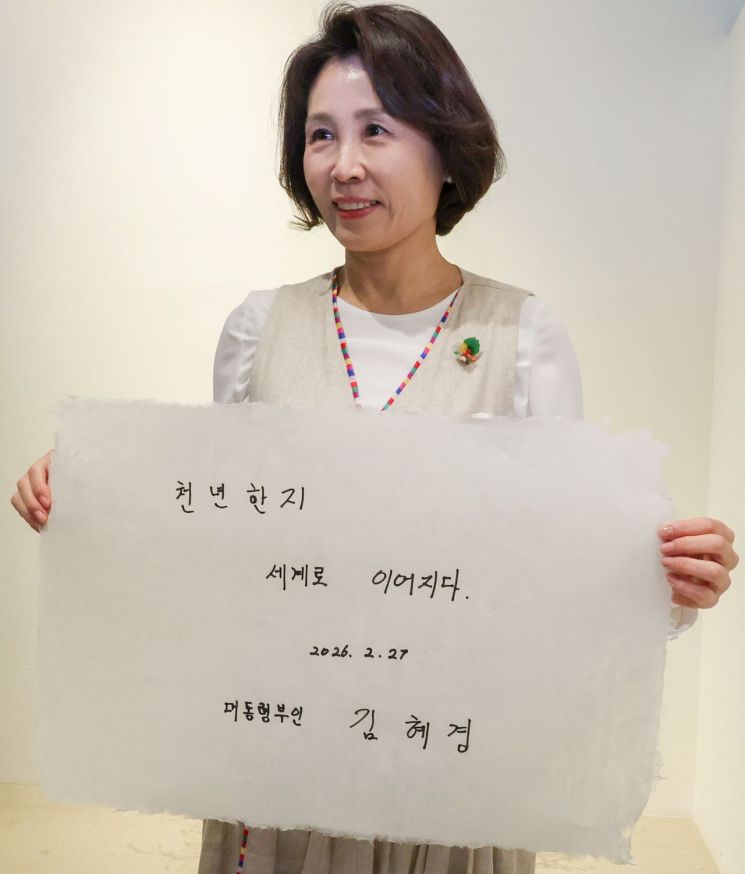
Guestbook Message: "Millennium Hanji Connects to the World"
First Lady Kim Hye-kyung, wife of President Lee Jae-myung, visited the Cheonnyeon Hanji Hall in Jeonju, North Jeolla Province, on February 26. According to Deputy Spokesperson Ahn Gwi-ryeong of the Presidential Office, she encouraged Hanji artisans and trainees, observed the Hanji-making process, and personally took part in hands-on activities.
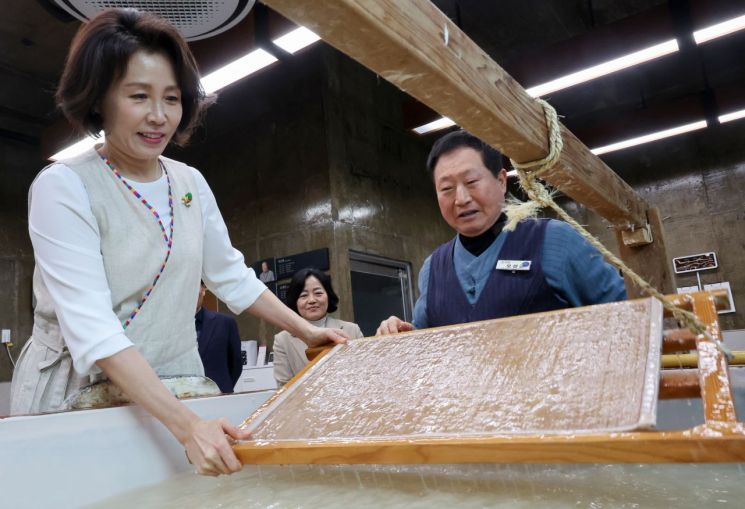
Jeonju has long been renowned as the birthplace of Hanji, Korea's traditional paper, thanks to its clear water and abundant paper mulberry trees, which have enabled the production of high-quality paper and the flourishing of Korea's record-keeping culture. In particular, Heukseokgol, where Cheonnyeon Hanji Hall is located, was once home to clusters of Hanji factories and became known as "Hanjigol," or "Hanji Valley."
Guided by Kim Hye-won, a team leader at the Jeonju Culture Foundation, Mrs. Kim toured the paper mulberry garden at the entrance, the raw material processing facility, the workshop, and the papermaking room, learning about the key steps in the production of Hanji. The process involves peeling the bark from paper mulberry trees, boiling the fibers, and then washing and pulping them to achieve a soft texture while removing impurities. The next step, called "choji" (sheet-forming), shapes the paper, which is then dehydrated and dried to complete the process.
After hearing the explanation, Mrs. Kim remarked, "I had no idea that so many hands were involved in making Hanji." To this, Team Leader Kim responded, "It is also called 'Baekji' (hundred-touch paper) because it requires a hundred touches," which prompted laughter at the scene.
Mrs. Kim then observed and participated in the Hanji-making process firsthand. In the papermaking room, Master Papermaker Park Shin-tae and trainees demonstrated how to peel the bark from the paper mulberry trees. Watching the demonstration, Mrs. Kim encouraged the trainees, saying, "This is work that requires great concentration and physical strength over a long period of time, so it must not be easy. I am proud that you are preserving our tradition."
With the help of Master Papermaker Oh Seong-geun, Mrs. Kim tried her hand at forming Hanji herself, evenly submerging and lifting the frame in the water tank containing the dissolved raw material. She commented, "It looked simple, but after trying it myself, I realize how difficult it is to make the paper thin and even," but she completed the task calmly and skillfully, earning applause from those present.
Mrs. Kim then used a dehydrator to remove excess moisture from the Hanji she made herself. While the paper was drying, she toured the Hanji storage room inside the Cheonnyeon Hanji Hall, examining various types of Hanji and discussing its excellence and potential for diverse uses. Mrs. Kim Hye-kyung noted, "At last year's APEC summit spouses' event in Gyeongju, the lanterns made from Hanji were as beautiful as chandeliers and drew admiration from many." She expressed keen interest in the modern applications of traditional materials. As the discussion turned to Hanji's expanding usage beyond paper, including clothing, furniture, and bags, Team Leader Kim Hye-won asked, "We hope you will become an ambassador for Hanji."
Mrs. Kim also tried on a Hanbok made from Hanji on the spot. As a long-time admirer of Hanbok, she showed particular interest, carefully asking whether even the collar and lining were made from Hanji. She also viewed the exhibit "Jisimcheo" and shared her impressions, saying, "The natural light created by Hanji's translucency feels mysterious and warm."
Meanwhile, Hanji is awaiting a decision at the end of this year on its inscription as UNESCO Intangible Cultural Heritage. On this day, Mrs. Kim left a message in the guestbook on the Hanji she made herself, writing, "Cheonnyeon Hanji connects to the world." She added, "From now on, I hope that all of us, myself included, will show even greater interest and support so that our precious cultural heritage can shine even more brilliantly not only in Korea but around the world."
© The Asia Business Daily(www.asiae.co.kr). All rights reserved.













