Third-Party Proposal Notice Issued
Construction Set to Begin in 2027, Completion Targeted for 2029
As the number of space objects and debris in Earth's orbit is rapidly increasing, the government has begun expanding space hazard monitoring infrastructure. The plan is to strengthen space situational awareness capabilities by constructing the Korea Space Situational Awareness Information Center through a private investment model, with a total scale of 43.7 billion won.
On March 2, the Korea Aerospace Administration announced that it had issued a third-party proposal notice for the construction of the Korea Space Situational Awareness Information Center and has begun the process of selecting an operator. The public solicitation will be open for 90 days, with the preferred negotiation partner to be chosen in the second quarter of this year and the implementation agreement to be signed within the year.
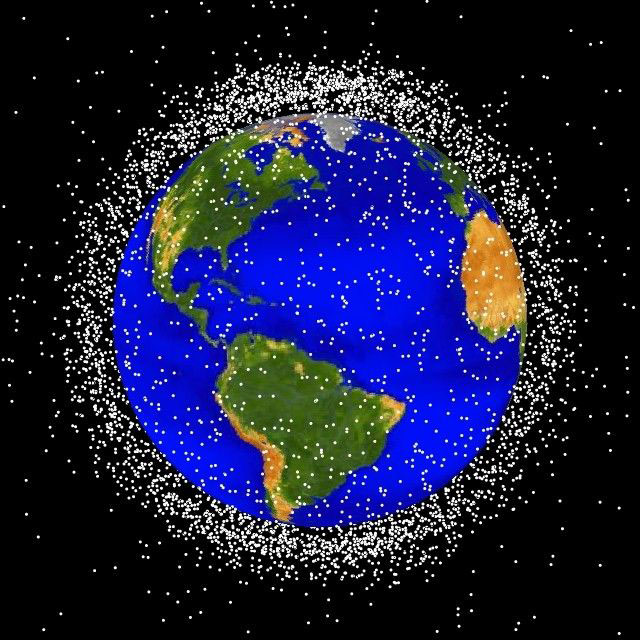 Space debris surrounding the Earth. Reference photo to aid understanding of the article. Provided by NASA
This project will be carried out as a Build-Transfer-Lease (BTL) private investment project. Under this structure, a private operator builds the facility, transfers ownership to the state, and recoups investment through rental fees over a set period. The total project cost is estimated at 43,788 million won.
The information center will be built on the site of the Korea Astronomy and Space Science Institute (Yuseong-gu, Daejeon), with one basement level, seven above-ground floors, and a total floor area of 9,800.39 square meters. The core functions include real-time space object monitoring and surveillance space, as well as expanded laboratories for large-scale research and development in the field of astronomy.
This project began in August last year with a private proposal and was finalized after a feasibility review by a specialized agency and deliberation by the Korea Aerospace Administration's Private Investment Committee. The project ceiling was secured at the 2025 regular session of the National Assembly. The Korea Aerospace Administration aims to begin construction in 2027 and complete it in 2029. The construction period is set at 720 days from groundbreaking, and operating rights will be granted for 20 years after completion.
Kwon Hyunjun, Director of Space and Aviation Policy, stated, "Space is evolving beyond scientific exploration into a strategic domain directly linked to the economy, industry, and security," and added, "We will swiftly expand space hazard monitoring infrastructure and strengthen situational awareness capabilities in response to the increase in space objects and debris."
The Korea Aerospace Administration plans to sign an implementation agreement with the selected operator and then begin the full-scale design and construction process.
© The Asia Business Daily(www.asiae.co.kr). All rights reserved.












