"A State Responsibility System Free from Legal and Financial Burdens Is Needed"
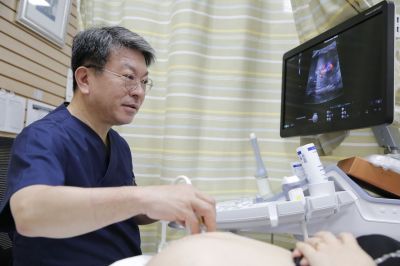 Professor Yoonha Kim, Chonnam National University Hospital. Provided by Chonnam National University Hospital
A towering figure who has kept the lights on in the delivery room at Chonnam National University Hospital for 33 years is set to retire on February 28. The main character is Professor Yoonha Kim, the head of the High-Risk Mothers and Newborns Integrated Care Center in the Department of Obstetrics and Gynecology. Having first set foot in Chonnam National University Hospital as a young doctor in 1993, Kim is now known as the "last bastion" and mentor for high-risk mothers in the Honam region, and is preparing to leave the campus he has grown fond of.
The 33 years that Professor Kim has witnessed are also a painful chronicle of the dramatic changes in South Korea's birth map.
Professor Kim recalled, "When I first put on my medical gown, the delivery room was always bustling. But now, with many local OB-GYN clinics closing, my heart aches every time I encounter high-risk mothers who travel from distant island villages or mountainous areas by helicopter to reach our center."
Professor Kim spent countless nights in the delivery room. He described his greatest sense of fulfillment as a doctor coming when he heard that a micro-preemie, born weighing just 300 grams-small enough to fit in the palm of his hand-had grown up healthy and reached adulthood. Although obstetrics is considered the most avoided specialty among residents due to its extreme physical and mental demands and the high risk of medical accidents, Professor Kim said, "The moment I hear a baby's first cry, all my fatigue magically melts away. That magical experience is what has kept me here for more than 30 years," emphasizing, "This is precisely why the essential medical system for critical care in the region must be maintained under any circumstances."
Professor Kim feels that the reality of low birth rates is much more severe than the statistics suggest. He lamented, "During my residency, the hospital saw 120 deliveries per month, but now that's been cut in half to 60. There was a nearby hospital that once delivered more than 300 babies a month, but now it doesn't even reach 10 deliveries a year."
Confronted with the social issues of ultra-low birth rates and the avoidance of OB-GYN residencies, Professor Kim, on the eve of his retirement, offered a sobering piece of advice to the nation.
"Last year in Ulsan, there was a case where a hospital was ordered to pay more than 1.6 billion won in damages after a five-day-old baby suffered brain damage. Given cases like this, the era of simply demanding a sense of duty from frontline medical staff is over. Unless a groundbreaking system-a 'state responsibility system'-is established so that essential medical professionals handling high-risk deliveries can focus solely on patient care without legal and financial anxieties, the lights in local delivery rooms may go out for good."
To younger doctors worried about the future, Professor Kim highlighted the unique value of obstetrics and gynecology.
He said, "The era of artificial intelligence has arrived, but creating and delivering life is something that machines can never replace. As long as human dignity matters, I don't believe robots will ever take over childbirth. I urge you to take pride in being responsible for pregnancy and childbirth, the natural biological processes that sustain humanity."
Although Professor Kim is stepping down from his professorial title after a long 33-year journey, he plans to continue contributing to regional medical development by seeing patients at a local hospital even after retirement. Though there is a set age for retirement, his vocation for life knows no such boundary.
"Even today, my last day at work, I have two surgeries scheduled. Over the years, more than 10,000 children have passed through my hands and are now valuable members of society," Professor Kim said. "I hope to contribute, even if only in a small way, to building a world where those very children can, in turn, become parents themselves with confidence and peace of mind."
© The Asia Business Daily(www.asiae.co.kr). All rights reserved.












