National Cancer Center Holds Symposium on Advancements in Pediatric and Adolescent Cancer Care and Research
Fewer Than 70 Specialists Nationwide; Over 10% Expected to Retire Within Five Years
Despite Medical Advances, Staff Shortages Persist
"Government Intervention Needed Under the National Cancer Control Act"
Although the cure rate for pediatric and adolescent hematologic cancers in South Korea has surpassed 85%, the medical infrastructure for treating these young patients is on the verge of collapse. The ongoing vicious cycle-where a decline in patient numbers due to falling birth rates leads to a shortage of medical personnel and weakened infrastructure-has raised calls for urgent intervention at the national level.
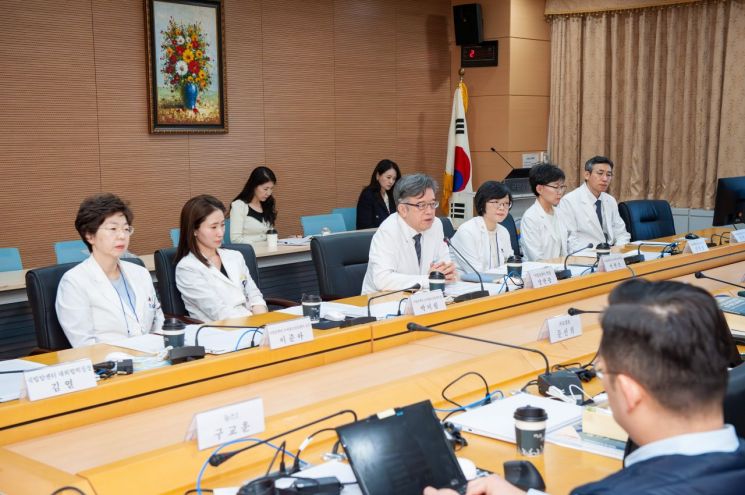 Yang Hangwang, Director of the National Cancer Center, is speaking at a press conference for the Pediatric and Adolescent Cancer Academic Symposium held on the 27th at the Examination Building of the National Cancer Center in Goyang, Gyeonggi Province. National Cancer Center.
The National Cancer Center held the "Pediatric and Adolescent Cancer Care and Research Advancement Symposium" at its Examination Building on the 27th. At a press conference preceding the symposium, Park Mirim, Director of the Pediatric and Adolescent Cancer Center, stated, "Each year, there are about 1,200 new cases of pediatric and adolescent cancer among those aged 0 to 18 in Korea, which classifies as an ultra-rare cancer compared to adult cancers." She explained, "Thanks to the dedicated efforts of medical professionals over the past 30 years, the five-year survival rate for pediatric leukemia patients has risen dramatically from 44.8% in 1993-1995 to 85.6% in 2018-2022, reaching the level of advanced countries such as the United States."
Director Park further explained, "Given that five-year survival typically leads to long-term survival beyond 10 years, the quality of initial treatment determines a child's entire lifetime." She analyzed, "This has been made possible because we were able to develop strategies such as tailored treatments by analyzing the incidence of cancer based on the national cancer registry data."
While survival rates have improved, the overall situation for pediatric and adolescent cancer care nationwide remains challenging. There are currently fewer than 70 specialists treating pediatric and adolescent cancers across the country, and more than 10% of them are expected to retire within the next five years. The concentration of personnel in the Seoul metropolitan area is also severe: in Ulsan, Gangwon, North Gyeongsang, and Sejong, there are no residents at all, and in Incheon, Gwangju, Daejeon, North Chungcheong, North Jeolla, and Jeju, there is only one specialist in each region.
The National Cancer Center is also not immune to staffing shortages. The number of pediatric hematology-oncology specialists has decreased from four a decade ago to three today, and there is currently no support from specialists in other departments.
This shortage of personnel is also hindering the delivery of advanced medical services. Kang Hyungui, Professor at the Sarcoma Cancer Center, introduced bone reconstruction surgery using 3D printing and explained, "While patient-specific surgeries are now possible, an extremely high level of expertise is required, as physicians must spend dozens of hours designing the procedure themselves."
Kim Jooyoung, Professor of Pediatrics, said, "Proton therapy is essential for children during their growth period, but due to a shortage of anesthesiologists, it is currently impossible to anesthetize more than three children at once, leaving many patients waiting for treatment."
Medical professionals unanimously agreed that government policy support is essential to maintain the pediatric and adolescent cancer care system. Professor Lee Junah of Pediatrics pointed out, "The government averted an immediate crisis by including provisions for national support for pediatric and adolescent cancer in the Enforcement Decree of the Cancer Control Act starting in 2024, and by designating five regional hub hospitals for financial support such as salaries. However, the care system remains fundamentally broken."
Yang Hangwang, Director of the National Cancer Center, emphasized, "Regardless of the number of patients, pediatric and adolescent cancer is an area where the nation must take full responsibility to the very end. We have now reached a stage where this issue cannot be resolved solely by academic societies or social autonomy. The government must intervene and manage more actively, including in the resident training system and the insurance framework."
© The Asia Business Daily(www.asiae.co.kr). All rights reserved.












