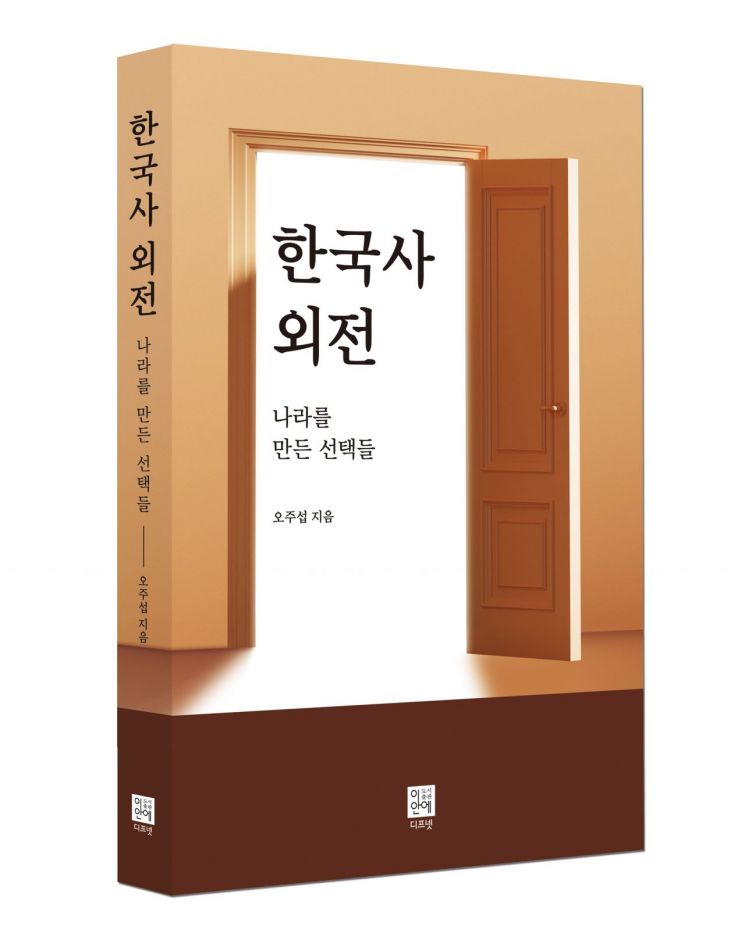
A new book has been published that reinterprets the formation of the nation through the decisions and attitudes of individuals, moving away from narratives centered on events and heroes.
On February 27 at 3:00 p.m., Oh Juseop, CEO of Gyeongbuk Ilil Newspaper, will hold a publication celebration for his book, 'Hanguksa Oejun (Choices That Made the Nation),' on the 6th floor of The Queen Convention Hall next to Pohang City Hall.
The author, Oh, is a journalist who previously worked as a reporter at Jeil Economy Daily (now The Asia Business Daily), Newsis, The Fact, and Daegu Newspaper.
This event will serve as an opportunity for the author to share his long-standing reflections on the fundamental questions that laid the foundation of the nation with local figures and readers.
'Hanguksa Oejun' boldly departs from the traditional approach of praising the achievements of founding heroes or listing the evolution of institutions.
The author poses the question, not of how a nation was formed, but of what choices were repeated to create a nation, tracing the inner thoughts and judgments of the individuals who stood at each decisive moment in history.
The book consists of four parts and a final section.
Part 1, 'Departure and Pioneering,' sheds light on founding figures such as Jumong, Onjo, and Park Hyeokgeose not as legendary heroes but as pioneers who chose to leave for survival.
Part 2, 'Re-founding on the Brink of Collapse,' deals with the decisions made by Wang Geon, Yi Seonggye, Gung Ye, and Gyeon Hwon in the face of a crumbling order, as well as their visions during the process.
Parts 3 and 4 examine figures such as Jang Yeong-sil, Heo Jun, Jeong Yak-yong, and Yi Hwang, who supported the nation from outside the circles of power through their technical skills and depth of thought.
The final section analyzes how the choices of Shin Chaeho, Ahn Changho, Kim Gu, and others, who sought to rebuild the nation through the power of record and memory even in times of national crisis, influenced the course of history.
This book begins each chapter with a narrative scene to enhance immersion and concludes by succinctly summarizing historical facts.
This structural feature allows readers to follow the choices of the characters and make their own judgments about history.
Oh Juseop stated, "History is not a distant record, but a mirror reflecting the choices we make today," adding, "I hope this publication celebration serves as an opportunity for us to reflect together on how we will shape our community going forward."
The event is expected to be a venue where various figures from the Pohang community gather to share new perspectives on Korean history.
© The Asia Business Daily(www.asiae.co.kr). All rights reserved.












