Guaranteeing Substantive Bargaining Rights for Subcontracted Workers Is Key
Bargaining Units May Be Divided According to Working Conditions
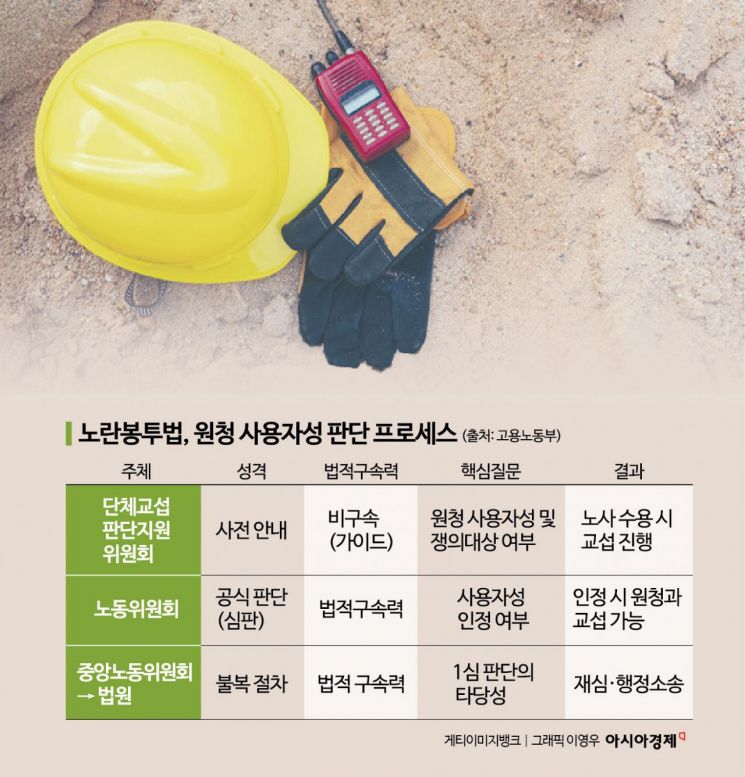
Central Labor Relations Commission to Decide on Employer Status and Disputes
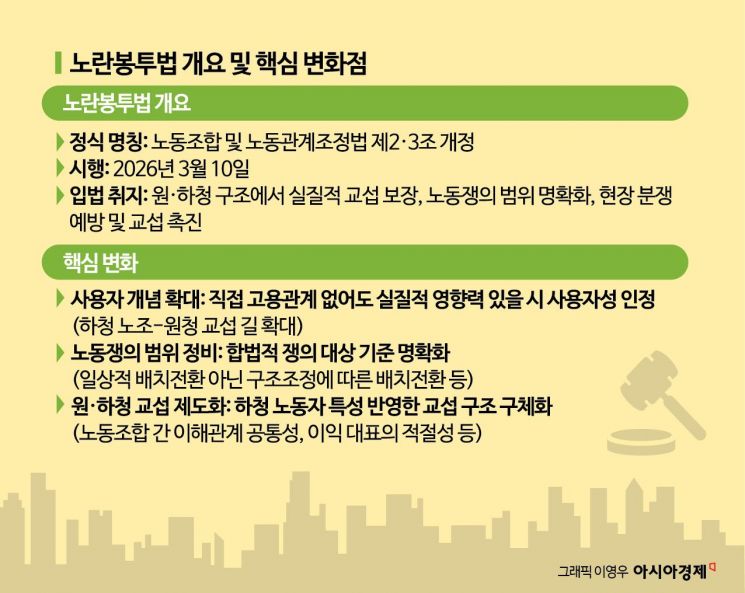
As the government prepares for the implementation of Articles 2 and 3 of the amended Labor Union Act-commonly referred to as the "Yellow Envelope Law"-it has finalized and announced a manual for the bargaining procedures between principal contractors and subcontractors. This measure aims to minimize confusion on worksites after the law takes effect and to guarantee the practical bargaining rights of subcontracted workers. The core focus is on specifying the application method for the unification of bargaining channels and the criteria for determining bargaining units.
Kim Younghoon, Minister of Employment and Labor, and Park Sookeun, Chairperson of the Central Labor Relations Commission, held a joint briefing at the Government Complex in Seoul on the morning of February 27 and released the "Mutual Growth Bargaining Procedure Manual for Principal and Subcontractors" to facilitate the on-site adoption of the amended Labor Union Act. The amended law passed the National Assembly’s plenary session in September last year and, following a six-month preparation period, will take effect on March 10, 2026.
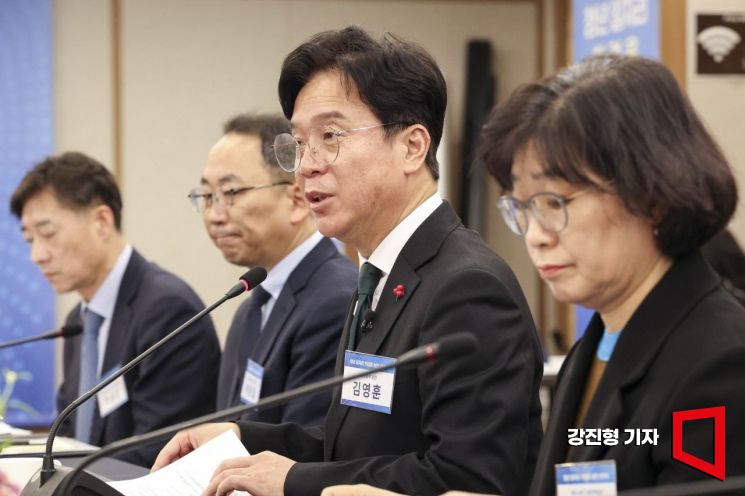 Kim Younghoon, Minister of Employment and Labor, is delivering the opening remarks at the 'Youth Job First Step Action Declaration Ceremony' held on December 8, 2025, at the Press Center in Jung-gu, Seoul. Photo by Kang Jinhyung
Criteria for 'Who negotiates and how'
The focus of the implementation manual for the amended Labor Union Act lies in the process of “identifying the negotiating counterpart, selecting a representative, and negotiating the terms.” In other words, the key point is to institutionalize the possibility of bargaining with principal contractors who exercise substantial influence over the working conditions of subcontracted workers.
According to the manual, the first step is to identify the counterpart for bargaining. If a principal contractor has a real impact on the wages or working conditions of subcontracted workers, that contractor is also regarded as an employer and included as a party to the negotiations. This means that if the company outsourcing the work is involved in determining working conditions, it must participate in the discussions. Regarding the scope in which a principal contractor is recognized as the employer, the government has presented the exercise of substantial influence over working condition decisions as the key criterion. The determination of employer status is based on a comprehensive review, not only of the contractual structure but also of the degree of direction and control over wages, work methods, and working hours.
The next step is to determine the group for joint bargaining. Subcontracted workers who work under the same conditions are grouped together to form a bargaining unit. However, if the nature of the work or wage systems differ significantly, separate groups may be established. This is because negotiating as a single group with widely varying conditions may actually be disadvantageous to some members. Specifically, bargaining unit separation is permitted if: ▲ the work content and processes differ significantly; ▲ the wage systems and core working conditions such as working hours are structurally different; ▲ the employer’s personnel or labor management systems are separate; or ▲ the physical separation of workplaces or worksites has a substantial impact on the bargaining process. Minister Kim emphasized, "This amendment is significant in that it ensures the party that actually determines working conditions participates in responsible discussions."
Subsequently, a representative for bargaining must be selected. Under the amended Labor Union Act, if there are multiple unions within the same bargaining unit, the union with the largest membership becomes the representative and conducts official negotiations with the employer. Alternatively, the unions may agree among themselves to select a common representative. Once the representative is determined, the negotiations proceed to the substantive bargaining stage, where discussions with the principal contractor or employer focus on actual working conditions such as wages, working hours, and work environment. This process is carried out in the same manner as general collective bargaining. If disputes arise regarding the separation of bargaining units or the selection of a representative, the Central Labor Relations Commission will make a judgment based on established criteria. The Ministry of Employment and Labor described this as a "mediation mechanism to reduce potential conflicts during the bargaining process."
Clarified procedures and standards enhance predictability in the field
The government stated that, with this manual, following the amendments to the enforcement decree and the introduction of interpretation guidelines, the preparations for the law’s implementation are now complete. It emphasized that the focus was on increasing the predictability of the system’s operation by gathering input from labor law experts as well as labor and management representatives. The Central Labor Relations Commission also expressed its belief that the increased predictability of bargaining procedures would help the system take root.
Minister Kim said, “We have presented concrete procedures and decision-making criteria to reduce the uncertainty regarding standards for law enforcement that have been raised in the field,” adding, “Even after implementation, the government will continue to provide administrative support and supplement the system to ensure that disputes between labor and management do not arise from shortcomings in the system.” He also urged, “The success of the amended Labor Union Act depends more on practical implementation at worksites than on the system itself. Both labor and management must approach negotiations with a sense of responsibility.”
© The Asia Business Daily(www.asiae.co.kr). All rights reserved.














