As distribution costs for agricultural and fishery products continue to rise, the government-initiated “online wholesale market” has been growing rapidly, but analysts say it still faces significant limitations in replacing the existing offline-centered structure.
According to the report “Can the Online Wholesale Market for Agricultural and Fishery Products Grow into a Core Distribution Channel?” published on the 26th by Jang Yoonjung, analyst at the Economic and Industrial Project Evaluation Division of the National Assembly Budget Office, the distribution cost ratio for agricultural products (the share of distribution costs in consumer prices) rose from 44.8% in 2014 to 49.2% in 2024. In particular, while the distribution cost ratio at the shipping stage declined slightly, costs at the wholesale and retail stages increased sharply, exacerbating inefficiencies across the overall distribution structure.
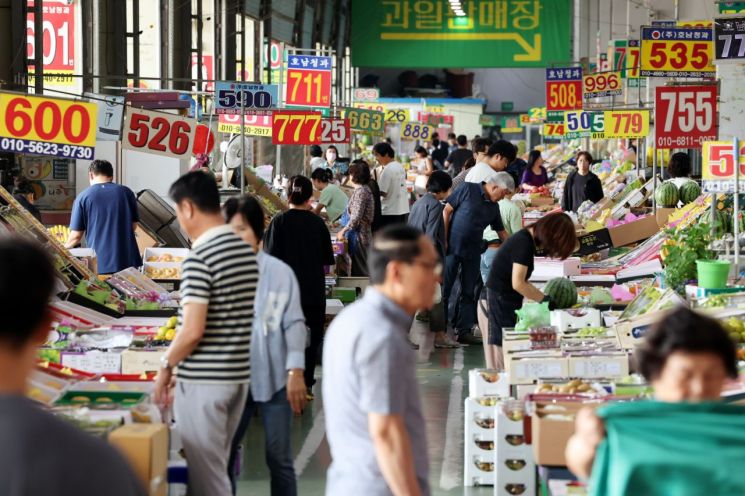
At present, distribution of agricultural products is still dominated by an offline wholesale market-centered structure. As of 2024, more than 50% of products pass through wholesale markets, and the “physical movement with each transaction stage” structure, in which goods move every time they change hands, is cited as a major cause of rising costs and greater price volatility.
To address these issues, the government launched the online wholesale market in 2023. The aim is to build an efficient distribution structure based on digital transactions and a “trade first, logistics later” model. As of 2025, transaction value in the online wholesale market reached 1.2365 trillion won, exceeding the initial target of 1 trillion won. The number of traded items also expanded to 279, indicating that the market base is growing.
However, its share of the overall distribution market remains minimal. As of 2024, the transaction volume of the online wholesale market stood at about 673.7 billion won, only 3.7% of the 18.0811 trillion won handled by offline wholesale markets. Jang particularly pointed out that the government’s target of 7 trillion won in transactions by 2030 “needs to be realistically reviewed to reflect the actual growth trend.”
Structural problems have also emerged in the course of operation. An analysis of government-supported transactions found that about 60% were suspected to be “abnormal transactions,” raising concerns over transaction reliability. This has led to calls for stronger oversight and supervision across all transactions. In addition, given the nature of online trading, where it is difficult to verify quality in advance, lack of product reliability, the potential for disputes, and insufficient quality standards are cited as major limitations. Difficulties in handling small-quantity, multi-item transactions and rising logistics costs were also identified as issues that need to be resolved. Jang warned, “There is a possibility that the online wholesale market will end up as a mere ‘online shift’ of existing distribution,” stressing that “the establishment of quality control standards and improvements in the operating system must proceed in tandem.”
It was also pointed out that there is currently no separate performance management and evaluation framework for the online wholesale market under existing laws and regulations. Since evaluation provisions were not included in the related bill recently passed by the National Assembly, institutional improvements are deemed urgent.
Jang emphasized, “To vitalize the online wholesale market, a comprehensive set of improvement measures is needed to remove constraints across quality, reliability, and the overall operating system,” adding, “Quality control standards must be clarified and operating and management systems strengthened to ensure the appropriateness and reliability of transactions.”
© The Asia Business Daily(www.asiae.co.kr). All rights reserved.












