Significant Revisions Made at the Last Minute... Passed in Plenary Session
"Revised Bill Still Potentially Unconstitutional
Scope of Punishment Remains Broad and Vague"
With the Democratic Party of Korea driving the legislative process, the so-called first of the "three judicial reform bills," the "Judicial Distortion Crime Act," has passed the threshold of the National Assembly's plenary session. However, despite amendments, there is a growing wave of concern and opposition from the legal community, which argues that the revised bill still has significant potential for unconstitutionality.
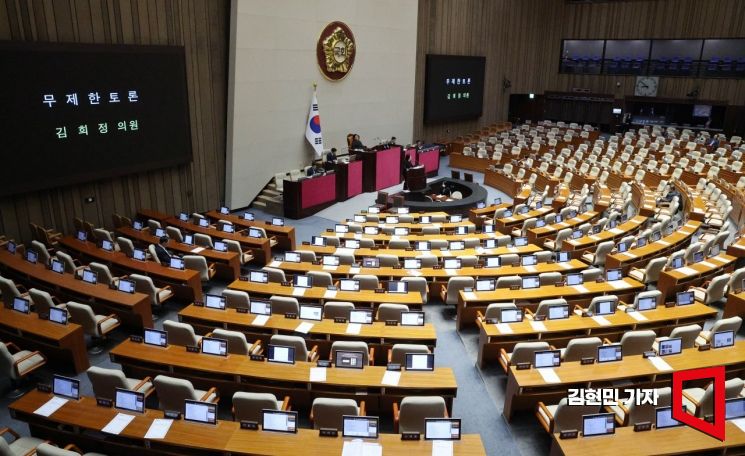 Kim Hee-jung, a member of the People Power Party, is engaged in an unlimited debate on the Constitutional Court Review Act amendment bill, which was submitted the day before, during the 8th plenary session of the February extraordinary session held at the National Assembly on the 27th. 2026.2.27 Photo by Kim Hyun-min
On the afternoon of the 26th, the National Assembly passed the amendment to the Criminal Act that newly establishes the judicial distortion crime. Previously, the Democratic Party, seeking to avoid constitutional controversy, had made significant revisions to the bill just before its submission, reducing the abstraction in the articles.
The bill stipulates that judges or prosecutors involved in criminal trials who intentionally distort the law to unlawfully or unjustly benefit or harm another person shall be sentenced to up to 10 years in prison, disqualification from office, and other penalties. However, it exempts discretionary judgments made within reasonable bounds and partially narrows the scope of those subject to the law compared to the original draft.
Nevertheless, there is a tense atmosphere within the judiciary, as concerns about the unconstitutionality of the heavily revised bill persist. One presiding judge criticized, "In this environment of increased pressure and psychological burden, judges will have to worry more about other issues than about making the right decision," adding, "The revised bill is still highly unconstitutional, and the scope of those subject to punishment is too broad and vague."
There are also voices pointing out that the law could undermine the judicial system by encouraging parties to challenge verdicts. One attorney noted, "Instead of accepting verdicts, losing parties could use this as a weapon to file excessive complaints or accusations, claiming 'the judge distorted the law to rule against me.' How many lawyers would be willing to take on cases accusing judges or prosecutors of judicial distortion, especially when they must appear in court every day?"
Collective concerns at the court level have already been formalized. At the National Chief Judges' Meeting held on the 25th, chief judges expressed strong concerns, stating, "Even considering the amended version of the judicial distortion crime, the elements constituting the offense are too abstract, which could excessively expand the scope of punishment, and the provisions could result in rampant complaints and accusations, causing serious side effects."
Meanwhile, the Democratic Party plans to continue pushing through the so-called three judicial reform bills. Immediately following the passage of the judicial distortion crime bill, the "Judicial Review Act Amendment" (Constitutional Court Act Amendment), which would allow even Supreme Court final judgments to be subject to constitutional complaints, was submitted to the plenary session. It is expected to be put to a vote on the afternoon of the 27th, once the People Power Party's filibuster (unlimited debate) concludes.
© The Asia Business Daily(www.asiae.co.kr). All rights reserved.












