Declaration of the "KE Way" value system... maximizing synergy
Interaction from integrated workspaces to joint social contributions
Chairman Cho Won-tae: "We must open our hearts to one another and blend together"
Korean Air is accelerating efforts to integrate corporate cultures between Korean Air and Asiana Airlines to foster strong chemistry among employees ahead of their merger. Going beyond a physical integration, the company is increasing opportunities for employees to interact through family invitation events and social contribution activities, with the aim of easing emotional differences and building a foundation for sharing a single set of corporate values.
According to the airline industry on February 27, Korean Air plans to bring the abbreviation KE to the forefront instead of KAL, which has been used as a brand for 60 years. At next month's regular general shareholders' meeting, the company will submit an agenda item to amend its articles of association to delete KAL, the official English corporate name abbreviation. In March last year, Korean Air announced a new corporate value system called "KE Way" and stated that it would serve as a central pillar for renewing the corporate culture. The core idea is to create sustainable relationships that encompass employees and partner companies, based on people-centered management.
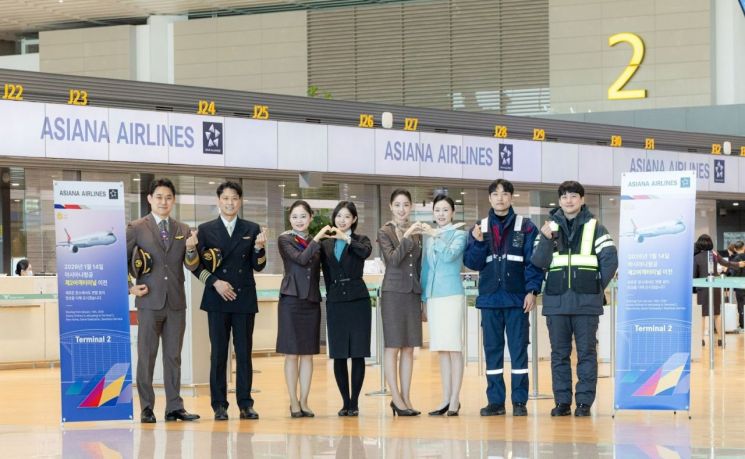 Korean Air and Asiana Airlines have been operating together at Incheon International Airport Terminal 2 (T2) since January 14. Korean Air
Strengthening 'practical cohesion' through integration of workspaces
On the ground, operations are already being carried out in a way that is effectively equivalent to an integrated system. Since last year, Korean Air has been carrying out advance integration of workspaces between the two airlines in key departments such as the Human Resources Development Center, the Maintenance Division, and the Public Relations Office.
In January this year, the company opened an "integrated pre-flight preparation room" in line with the timing of Asiana Airlines' relocation to Incheon International Airport's Terminal 2 (T2). Flight attendants from both airlines prepare for work in the same space and share rest facilities, thereby encouraging natural interaction. In addition, the company is operating "KE Wiki," an internal standard terminology dictionary, to standardize work-related terms used by the two airlines.
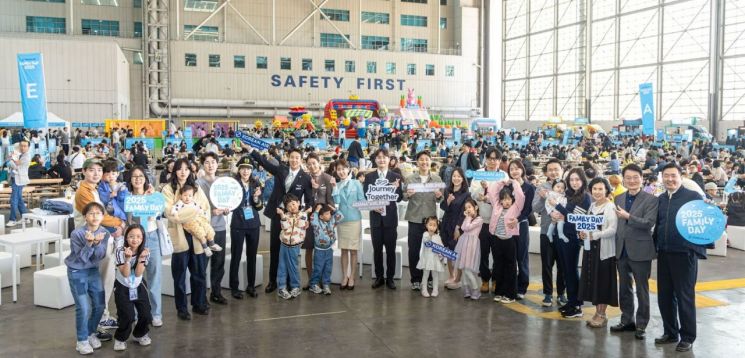
External activities in which employees of both airlines participate together are also active. At the event held last April to commemorate the 61st anniversary of the labor union's founding, 4,000 family members of employees from both airlines attended, and 17,700 people gathered to strengthen unity at the "Family Day" event held in the hangar at the headquarters in celebration of Family Month. This year, Korean Air plans to operate a variety of Family Day programs at its headquarters and the Busan Tech Center in which employees of both airlines can participate.
Social contribution activities are also being carried out jointly. More than 260 new employees from both airlines took part in a tree-planting project to prevent desertification in Mongolia, and the two companies are continuing to cooperate in various areas such as producing audiobooks and helping with farm work in rural areas.
Korean Air plans to establish a solid foundation for integration through programs such as "All Hands Meetings," which strengthen communication between leaders and employees. All Hands Meetings are programs in which each organization's leader shares the organization's direction and current issues with employees and holds a Q&A session. Last year, 87 leaders at Korean Air held a total of 101 All Hands Meetings.
Meanwhile, Hanjin Group Chairman Cho Won-tae has repeatedly emphasized corporate culture integration this year. In his New Year's address in January, Chairman Cho stated, "This year should not be a period of preparation for integration, but a period in which we create and adapt to a state that is practically equivalent to full integration," adding, "In particular, we must open our hearts to one another and blend together naturally in time for the official integration."
57.4% of employees view the integration positively... expanding communication channels
According to the results of an integration survey conducted by Korean Air and Asiana Airlines over a two-week period starting November 12 last year, 57.4% of the 15,930 employees of the two airlines responded positively to the integration. The response rate was 57.7%, indicating a high level of internal interest.
Employees cited transparent sharing of information during the integration process and timely delivery of information as key tasks. Accordingly, in February this year, Korean Air revamped "Communication Plaza," its in-house anonymous bulletin board. Moving away from the previous one-way method of simply submitting suggestions, the company established a two-way communication structure in which the responsible department responds in real time. A total of 1,126 posts were submitted to Communication Plaza last year, with more than three opinions posted per day on average, making it a key channel for internal communication.
A Korean Air official said, "The results of this survey are a valuable milestone for setting the direction in which we will move forward together," and added, "We plan to continue listening to the voices of our employees and create a path to integration in which no one is left behind."
© The Asia Business Daily(www.asiae.co.kr). All rights reserved.













