Similar Staffing Levels to District Court Bankruptcy Divisions
New Courts to Absorb "Rehabilitation Tourism" Demand
Rising Insolvency Cases... Caseload Expected to Grow
"Verification Systems Could Become Vulnerable"
Concerns Over Workload and Decline in Case Review Quality
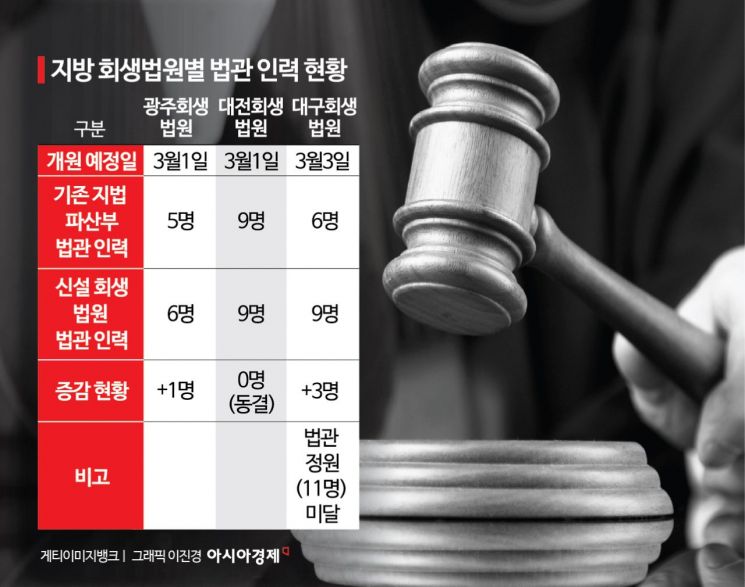
The number of judges allocated to the Daegu, Gwangju, and Daejeon Rehabilitation Courts, which are set to open next month, is almost the same as that of the bankruptcy divisions at the district courts that previously handled these cases. As the number of insolvency cases continues to rise due to the prolonged period of high interest rates, concerns are being raised not only about the workload of the rehabilitation courts, but also about potential side effects such as a decline in the quality of case review over the long term.
According to a compilation of reports by The Asia Business Daily on February 27, the number of judges assigned to the Gwangju Rehabilitation Court, which will open on March 1, has been confirmed at a total of six, including the chief judge. This is only one more than the five judges previously assigned to the bankruptcy division of the Gwangju District Court. The Daejeon Rehabilitation Court, also opening on the same day, will have the same number of judges as the bankruptcy division of the Daejeon District Court, totaling nine. In the case of the Daegu Rehabilitation Court, which opens on March 3, the number of judges is nine-three more than the six judges of the Daegu District Court’s bankruptcy division-but still falls short of the full authorized capacity of eleven judges.
Insolvency cases are increasing as a result of the prolonged high interest rate environment. Last year, the total number of individual rehabilitation filings reached 149,146, up 15% from 129,499 in the previous year. Individual bankruptcy filings also rose by 2%, from 40,104 to 40,908 during the same period. Usually, when a rehabilitation court opens, its jurisdiction expands, and it also absorbs the “rehabilitation tourism” demand that previously went to Seoul. Therefore, the number of cases filed with these newly established courts is expected to continue to increase for the time being.
In general, court personnel are allocated by judicial panel units. If there are not enough judges, the number of panels is reduced, and consequently, the number of judicial assistants and clerks assigned is also reduced in tandem. The same applies to rehabilitation commissioners, management commissioners, and investigation commissioners, who are responsible for reviewing documents and preparing reports in insolvency cases.
An attorney who previously served as a presiding judge at the Seoul Rehabilitation Court commented, “With the opening of the rehabilitation courts, a large number of rehabilitation and bankruptcy cases, which used to be handled by general civil divisions, will also be transferred. The workload will increase to the extent that a dedicated civil case panel will be necessary.”
There are also concerns about a decline in the quality of case review. A lawyer specializing in insolvency cases pointed out, “If there is less time to review documents, it may become difficult to detect malicious debtors who are hiding assets, or conversely, to fully consider the circumstances of desperate individuals in need of relief.” Another lawyer stated, “If a shortage of personnel leads to a lax verification system, it could become difficult to detect manipulations such as the use of generative artificial intelligence (AI) to forge false documents.”
The total number of judges has been frozen at 3,214 for more than 10 years since 2014, but following the revised Judge Quota Act implemented in January last year, a phased increase to 3,584 judges by 2029 has been confirmed, starting with 90 additional judges last year. However, so far, most of the newly appointed judges have been concentrated in the Seoul Metropolitan Area District Courts.
Some voices argue that the current approach of establishing small-scale rehabilitation courts at the city and provincial level should be reconsidered. This is because, while there are many individual insolvency cases handled by a single judge, large-scale corporate rehabilitation cases-which require a three-judge panel-are relatively few in each region, making it difficult for small rehabilitation courts to build expertise. A legal industry official suggested, “Just as discussions on administrative integration between local governments have become active recently, we should also consider operating rehabilitation courts on a regional bloc basis.”
© The Asia Business Daily(www.asiae.co.kr). All rights reserved.












