Expanded Utilization of the KAI Rotorcraft Flight Center and AAV Demonstration Infrastructure
Fostering the Space Service Industry in Preparation for Designation as a Satellite-Specialized Zone
Strengthening Competitiveness in Materials, Parts, and Equipment and Promoting the Discovery of Global Companies
On February 26, Jinju-si in South Gyeongsang Province held the "2026 1st Jinju-si Investment Attraction Committee" in the situation room on the 5th floor of City Hall, where it reviewed and finalized the "2026 Jinju-si Basic Plan for Investment Attraction" aimed at fostering strategic industries focused on the space and aviation sector and revitalizing investment attraction.
The 2026 Basic Plan for Investment Attraction, which has been finalized this time, was drawn up with a focus on generating tangible investment outcomes in connection with the "Gyeongnam Space Aviation National Industrial Complex." It aims to attract companies and advance the industrial ecosystem, centering on regional strategic industries such as space and aviation, root industries, and ceramics.
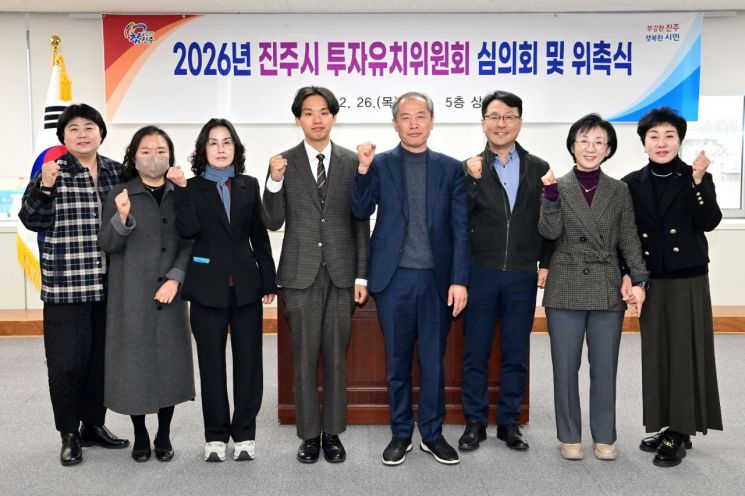 Jinju-si, Group Photo at the 2026 Investment Attraction Committee Deliberation Meeting and Appointment Ceremony
According to this plan, Jinju-si has set its annual investment attraction target for 2026 at 120 billion won and confirmed the following as key initiatives: ▲ intensive attraction of space and aviation companies and related industries to the Gyeongnam Space Aviation National Industrial Complex ▲ expanded utilization of the Korea Aerospace Industries (KAI) Rotorcraft Flight Center and demonstration infrastructure for future airframes (AAVs) ▲ fostering the satellite and space service industries following designation as a satellite-specialized zone ▲ strengthening the competitiveness of the materials, parts, and equipment industries and discovering global companies ▲ enhancing investment attraction promotion and marketing and strengthening business-to-business (B2B) networks ▲ expanding tailored incentives and administrative support for domestic and foreign investment companies.
Despite challenging conditions such as uncertainty in the domestic and global economies, weakened corporate investment sentiment, and concentration in the Seoul metropolitan area, the city plans to pursue strategic investment attraction activities based on differentiated industrial infrastructure centered on the space and aviation industry and systematic administrative support. In addition, it plans to strengthen cooperation among industry, academia, research institutes, and government, thereby providing tailored support for each stage of corporate growth and laying the foundation for the co-growth of local industries.
An official from Jinju-si said, "The Gyeongnam Space Aviation National Industrial Complex, which is scheduled for the second-phase completion in the second half of this year, will become an important foundation for Jinju-si to transition to a future industrial structure," adding, "We will faithfully implement the 2026 Basic Plan for Investment Attraction to create an environment where companies can grow stably, and through this, we will strive to create quality jobs and revitalize the local economy."
Meanwhile, to secure future growth engines centered on the space and aviation industry, the city established a dedicated investment attraction department, the "Investment Attraction Division," on January 1. This division is in charge of the entire process from establishing investment policies and attracting companies to developing industrial complexes and supporting tenant companies, thereby building a systematic investment base focused on strategic industries.
The city plans to continue to solidify its foundation as a hub city for the space and aviation industry through proactive investment attraction centered on strategic industries.
© The Asia Business Daily(www.asiae.co.kr). All rights reserved.












