Bank of Korea Releases February Economic Outlook BOX
Korea's Private Consumption Enters "Gradual Improvement" Recovery Phase
Income, Asset Prices, and Expectations Channels Weaker Than in Previous Recoveries
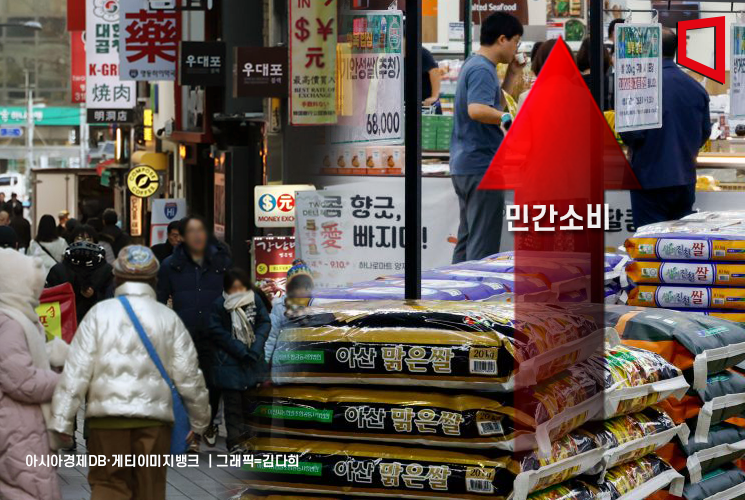
Since 2023, private consumption has remained sluggish, but signs are emerging that it is entering a full-fledged upward phase this year. However, some point out that the duration of this phase could be shorter than in previous years, as the structural vulnerabilities of the Korean economy have increased.
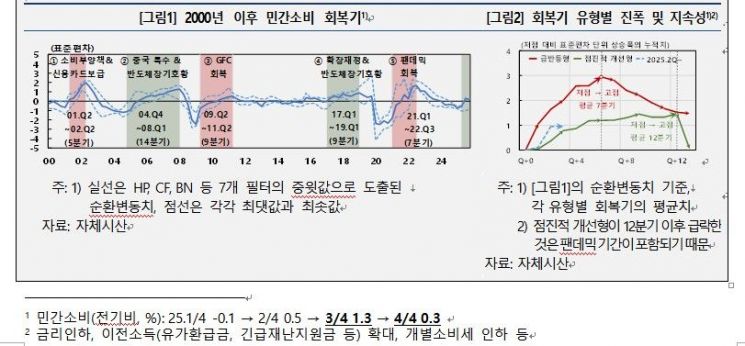
According to the Bank of Korea's report released on the 27th, titled "February Economic Outlook Box: Diagnosis of the Current Phase of Private Consumption and Future Prospects Through Comparison with Past Recovery Periods," private consumption rebounded rapidly after bottoming out in the first quarter of last year, and is expected to enter a "gradual improvement" recovery phase starting this year.
Since the 2000s, there have been a total of five private consumption recovery periods, which are classified as either "post-crisis rapid rebound" or "gradual improvement" types, depending on the drivers and speed of recovery. The periods immediately following the International Monetary Fund (IMF) foreign exchange crisis (2001-2002), the global financial crisis (2009-2011), and the COVID-19 pandemic (2021-2022) are categorized as post-crisis rapid rebound consumption recovery phases. In those periods, demand that had been suppressed by external, shock-induced economic downturns quickly recovered in a short time as it overlapped with government consumption-boosting measures, resulting in a sharp rebound in consumption. However, a key feature was that the recovery lasted for only about one year and nine months on average, which is relatively short.
By contrast, the periods from 2004 to 2008 and from 2017 to 2019, when the cumulative effects of interest rate cuts, expanding global IT demand, improved corporate earnings, and increased tax revenues continued, are classified as gradual improvement consumption recovery phases. Although the pace of recovery was moderate, these phases were more persistent, lasting an average of three years.
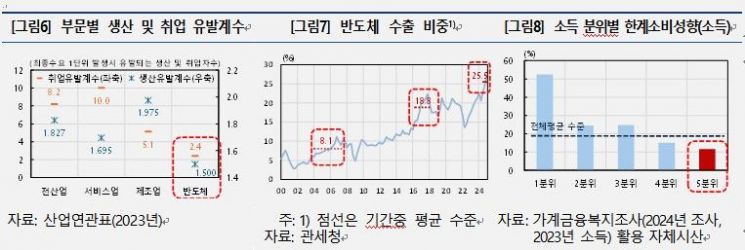
The Bank of Korea assessed that the current recovery in private consumption may be shorter in duration than past gradual improvement phases, as all transmission channels have deteriorated. First, the deepening imbalance between industries has weakened the channel through which export growth translates into higher household income and consumption compared with the past. Sectors such as semiconductors that are driving the economic upturn are highly capital-intensive and heavily dependent on imports, which reduces their backward and forward linkage effects. In contrast, non-IT sectors that have strong spillover effects on production and employment have fallen into structural stagnation due to intensifying competition with China and other factors. In essence, the increase in total household income is concentrated among a few large corporations and high-income households, limiting the breadth of the spillover effects.
The Bank of Korea also explained that rising real estate prices accompanied by increased borrowing, including principal and interest payments, are constraining the effective wealth effect, and that stock assets are also generating only a limited asset effect. Due to heightened volatility stemming from adjustments in expectations for semiconductor companies' earnings, it is difficult for households to regard these gains as a permanent increase in disposable income. In fact, holdings of bonds, stocks, and fund assets are concentrated among high-income households, which is dampening the asset effect for the economy as a whole.
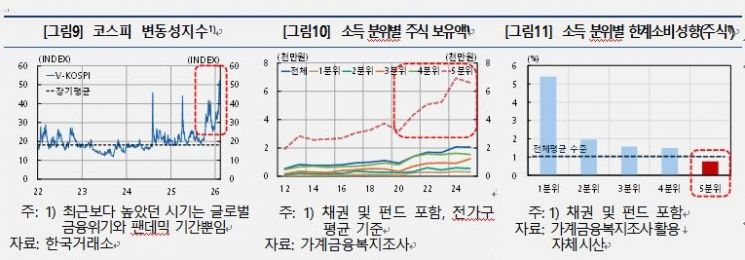
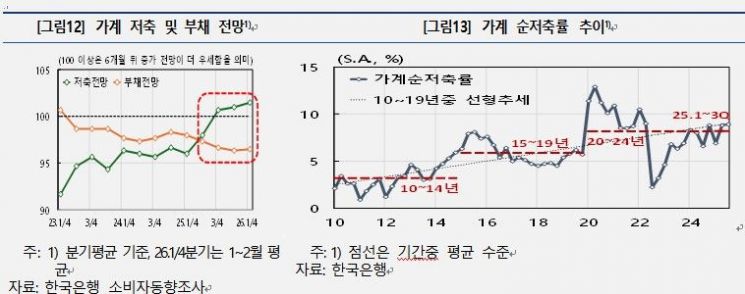
The fact that the expectations channel related to future income is more subdued than in the past is also cited as a problem. Precautionary saving (investment) and debt repayment to prepare for future uncertainty are increasing, which means that income is not being directly translated into current consumption. The Bank of Korea projected, "Given that the transmission channels through which improved conditions feed into consumption have weakened compared with the past, the pace of increase going forward is expected to be relatively moderate compared with previous periods."
© The Asia Business Daily(www.asiae.co.kr). All rights reserved.














