First?ever release of Monetary Policy Board's six?month rate outlook shows "hold" as the majority view
FX expectations become less one?sided thanks to National Pension Service's role, "supply?demand factors improve"
For real estate stability, supply, taxation, and Seoul?area concentration must be addressed
The Bank of Korea has raised its forecast for Korea's economic growth this year to 2.0%. The base rate was kept unchanged at an annual 2.50% by unanimous vote of the Monetary Policy Board members. The new "K-dot plot" interest rate projection method, introduced starting with this Monetary Policy Board meeting, suggested that the rate-freeze stance could continue for quite some time. Concerns in some parts of the market about a possible rate hike have turned into relief.
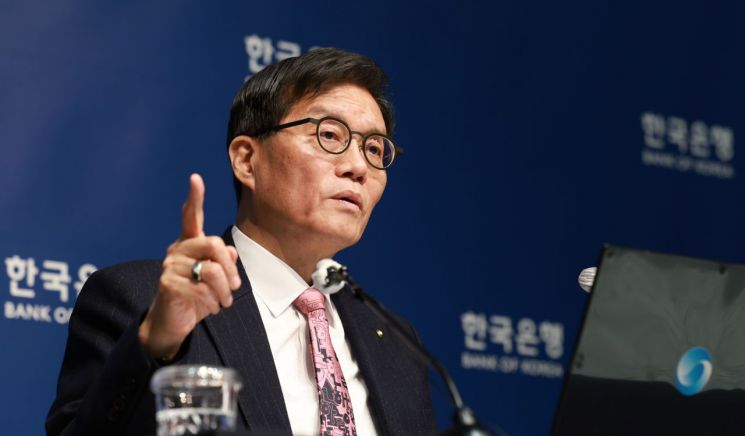 Lee Changyong, Governor of the Bank of Korea, is speaking at a press briefing held after the meeting to decide the direction of monetary policy on the 26th. Bank of Korea
Hawkish concerns ease versus January... K-dot plot shows majority expecting a hold in six months
Starting with this meeting, the Bank of Korea incorporated a six?month horizon K-dot plot into its conditional base rate projections, or "forward guidance," from Monetary Policy Board members. Governor Lee Changyong and the six other Board members each place three dots at specific rate levels for their six?month?ahead projection, taking into account both the baseline and upside/downside risks. All three dots can be placed at the same rate level or at different levels. The distribution of the total 21 dots allows markets to gauge the Board members' views on the future policy rate.
According to the Board members' K-dot plot projections, 16 out of the 21 dots pointed to the base rate remaining unchanged six months from now, accounting for 76% of the total. Four dots projected a rate cut to 2.25% in six months. One dot pointed to 2.75%, putting more weight on the possibility of a rate hike from the current level. At a press briefing held after the meeting to decide the direction of monetary policy, Governor Lee explained, "In the case where the rate was presented at 2.25%, lower than the current level (four dots), the view was that growth is in a K?shaped recovery, with large differences in the pace of recovery across sectors, so there is still a need to support growth," adding, "I also presume it reflects expectations that financial stability conditions in the foreign exchange market and housing market will be better in six months than they are now." He said the single dot at 2.75% likely reflects concerns about inflation stemming from movements in oil prices and the exchange rate. He also noted that under the previous three?month forward guidance framework, there had been no discussion that rates should be raised.
Market participants judged that, although the growth forecast was revised up to 2.0%, this was within the expected range and the forecast for next year was lowered by 0.1 percentage point, so the dot plot does not point to a strong likelihood of a hike. The single dot at a higher rate under this economic outlook is seen as "a hawkish scenario from the most hawkish Board member," implying that an actual hike is unlikely. By contrast, the four dots indicating a cut mean that at least two members see some possibility of a rate reduction, so the overall mood regarding rate hikes shifted more toward relief than concern.
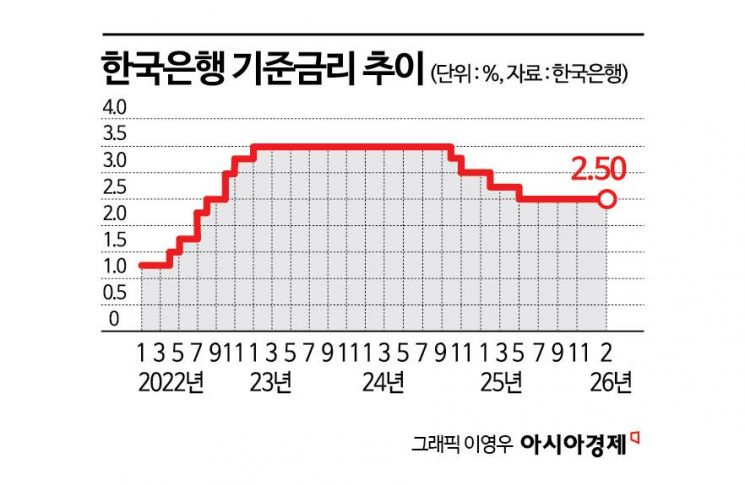
Signals that the rate?freeze stance could continue for a considerable period came from several angles. When asked whether the factors pushing rates up or down had diminished, Governor Lee referred to the dot?plot distribution and said, "The interpretation that, at least over the next six months, the likelihood of raising or lowering the rate is low (even if it cannot be completely ruled out) is a good reflection of the Board members' views as shown in the dot plot."
He also formalized, through his remarks, the assessment that current market rate levels are excessive. Governor Lee said, "Over roughly the past month, the spread between the three?year Treasury yield and the base rate has widened to more than 60 basis points, and that spread is close to levels typically seen in a rate?hike phase, even though Board members view this as a rate?freeze phase," adding, "Within the Bank of Korea, we think that spread may be excessive."
He continued, "The fact that (market rates) have risen this much likely reflects a combination of concerns about a possible rate hike, a money move from the bond market to the stock market amid the recent stock rally, and worries arising from discussions over an extra budget bill (supplementary budget). Our (Monetary Policy Board members') hope is that, at least regarding uncertainty over interest rate policy, the six?month forward guidance we announced this time will help the market reassess and adjust somewhat."
Semiconductors drive growth forecast upward... widening gap with non?IT
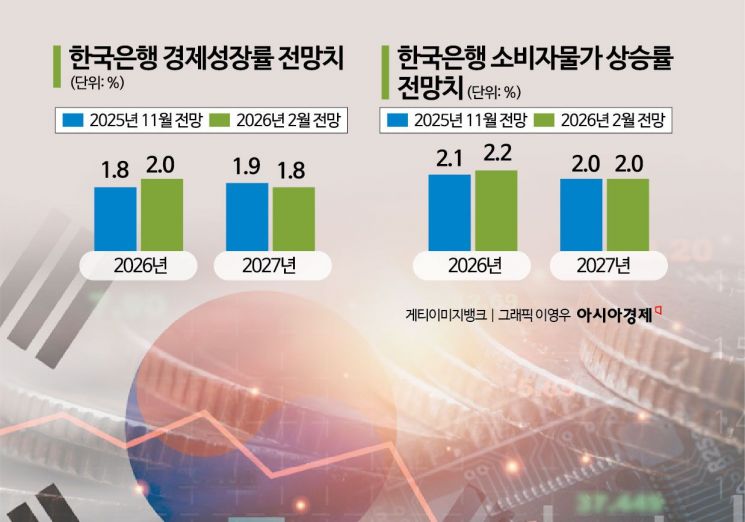
According to the Bank of Korea's February economic outlook released the same day, this year's growth forecast for Korea was set at 2.0%, 0.1 percentage point higher than the November 2025 projection. This reflects the impact of a stronger?than?expected recovery in the semiconductor cycle and a more favorable global economic environment than anticipated, which more than offset the effects of U.S. tariffs and a sluggish recovery in construction investment.
The quarterly growth forecasts for this year (quarter?on?quarter) were presented as 0.9% for the first quarter, 0.4% for the second quarter, 0.4% for the third quarter, and 0.4% for the fourth quarter. In the first quarter, consumption is expected to continue its recovery while exports post strong growth led by semiconductors, and the base effect from the previous quarter's negative growth (-0.3%) is projected to show up mainly in investment, pushing growth significantly above the earlier forecast of 0.3% to near 1.0% (0.9%). From the second quarter onward, the recovery in consumption is expected to gradually strengthen on the back of improving income conditions, while robust global investment in artificial intelligence (AI) and a better?than?expected global economic environment support continued export growth, resulting in a solid overall growth trajectory.
The Bank of Korea, however, expects the weak recovery in non?IT sectors such as construction to partially constrain growth. Governor Lee assessed, "Even though the overall growth forecast has been revised upward, the growth rate in the non?IT sector remains at 1.4%, the same as in the November 2025 projection, which means the gap between the IT and non?IT sectors has actually widened."
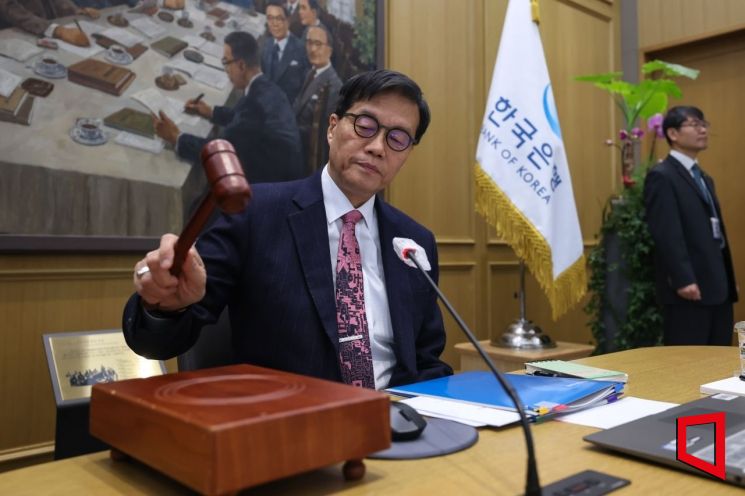 Lee Changyong, Governor of the Bank of Korea, is striking the gavel at the Monetary Policy Board plenary meeting held on the 26th at the Bank of Korea headquarters in Jung-gu, Seoul. Photo by Joint Press Pool
FX expectations become less one?sided as "supply?demand factors improve"... foreign investors may further increase their share of Korean equities
It was assessed that supply?demand factors related to domestic investors' overseas investment have improved significantly. The National Pension Service has played a major role by announcing plans to reduce the scale of its overseas investments and to increase currency hedging, and as expectations shifted in response, exporters' conversions of foreign currency into won increased, contributing to a decline in the exchange rate.
Governor Lee noted, "Statistics from last year show that domestic investors' overseas investments increased about threefold compared with before, with particularly large increases in October and November, and individual investors' overseas investments grew rapidly." Including investments in exchange?traded funds (ETFs) last year, the scale of individuals' overseas investments exceeded that of the National Pension Service. He explained, "As individuals' overseas investment increased, together with supply?demand factors, expectations that the won?dollar rate would rise into the 1,500?won range helped drive the exchange rate," adding, "That is why we said that, rather than fundamentals, supply?demand factors were putting pressure on the foreign exchange market."
He went on, "I believe the National Pension Service's announcement a few weeks ago that it would reduce this year's overseas investments by more than 20 billion dollars and conduct currency hedging while managing overseas investments flexibly made a significant contribution." This, he explained, has helped ease the one?sided concentration of expectations. As the exchange rate level fell, corporations (and individuals) that had been holding on to dollars and merely rolling them over in the market, despite current account surpluses, began selling in recent weeks, and this supply?demand factor has pushed the exchange rate lower. He added, "Even just yesterday and today, the won is showing signs of decoupling from the U.S. dollar and the Japanese yen."
That said, the scale of individuals' overseas investments remains substantial. Governor Lee said, "From January to mid?February, individuals' overseas investments, including ETFs, proceeded at almost the same pace as the very high levels seen in October and November last year," noting, "These overseas investment flows are exerting pressure on the foreign exchange market, but with the recent easing of one?sided expectations, we have seen some reduction over the past few weeks in the pace at which individual investors are sending money abroad."
Regarding the recent large?scale profit?taking by foreign investors in the Korean stock market, he cautiously raised the possibility that they could further increase their investment share and bring in additional funds. Governor Lee said, "Foreign investors' stock purchases were large early last year, and as share prices began to rise late last year and in January and February this year, we saw moves to realize profits," adding, "This does not mean foreign investors have yet increased their allocation to Korea; rather, the value of what they were holding has risen and they have realized part of their gains. If our market becomes more solid later on, I think there is a possibility they will increase their allocation and bring in additional funds."
He also highlighted that foreign investors have engaged in hedging as part of risk management as their valuation gains grew with the rise in domestic share prices. He explained, "One reason the exchange rate did not fall quickly in December last year was that, as the amount of foreign investors' stock holdings increased, they hedged part of it to lock in profits, which boosted dollar demand and pushed the exchange rate higher," adding, "Some people talk about hedging as if it were a loss?making move, but I think it is very important not to view it as a cost and, once you have earned a certain amount of profit, to hedge in order to realize that profit. In this respect, there are things we can learn from foreign investors."
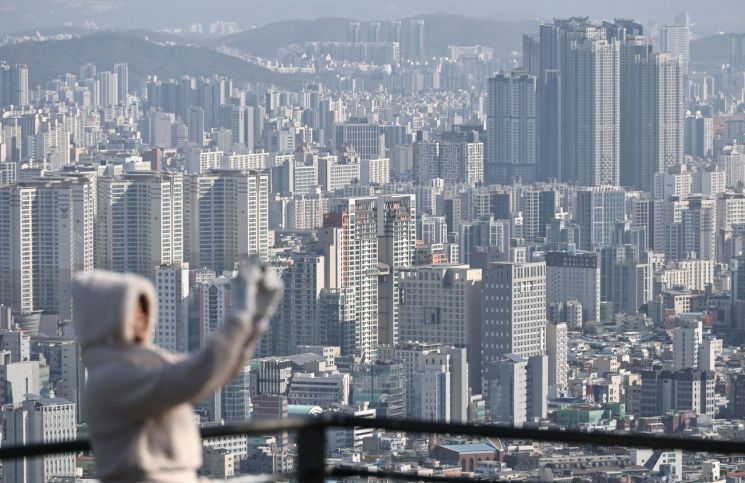
For real estate stability, supply, taxation, and Seoul?area concentration must be addressed
Governor Lee stressed that stabilizing the real estate market will require addressing supply, taxation, and the concentration of population and demand in the greater Seoul area. He said, "Recent data do show that, following government policies, the upward trend in Seoul housing prices is moderating," but emphasized, "For this shift to lead to long?term stabilization of the housing market, in addition to macroprudential policies that control demand, we need measures on supply and taxation, and ultimately, if everyone keeps moving only to Seoul, the problem cannot be solved no matter how many homes we build, so we need to ease the concentration in the greater Seoul area for the problem to be resolved." He explained that, therefore, policies must be implemented consistently over a long period.
He saw improvements in real estate taxation as particularly necessary. "Household loans through real estate lending have increased so much that they have reached a level that threatens our financial stability, so we need to reduce household loans and real estate?backed loans," he said. "From a tax perspective as well, the goal is not simply to suppress real estate prices, but, fundamentally, for reasons of tax fairness, if taxes on real estate are lower than in other areas, we cannot resolve issues such as capital concentration or unproductive uses of funds. Such comprehensive efforts must continue," he emphasized.

Current account surplus forecast sharply raised to 170 billion dollars this year
Meanwhile, the economic outlook released that day projected this year's current account surplus at 170 billion dollars, far exceeding the previous forecast path. This is well above the earlier projection of 130 billion dollars and also significantly higher than last year's record surplus of 123.1 billion dollars.
The goods account surplus is expected to expand sharply, driven by a large increase in semiconductor prices. In its February outlook, the Bank of Korea projected this year's goods account surplus at 189.6 billion dollars, far above the previous forecast of 138.6 billion dollars. However, it expects the services account deficit to widen due to increased demand for industrial service patent royalties as the economy recovers and higher spending on digital service platform subscription fees.
© The Asia Business Daily(www.asiae.co.kr). All rights reserved.














