People Power Party Filibuster Ends After 24 Hours
Democratic Party Pushes Ahead with Revision Despite Judiciary Backlash
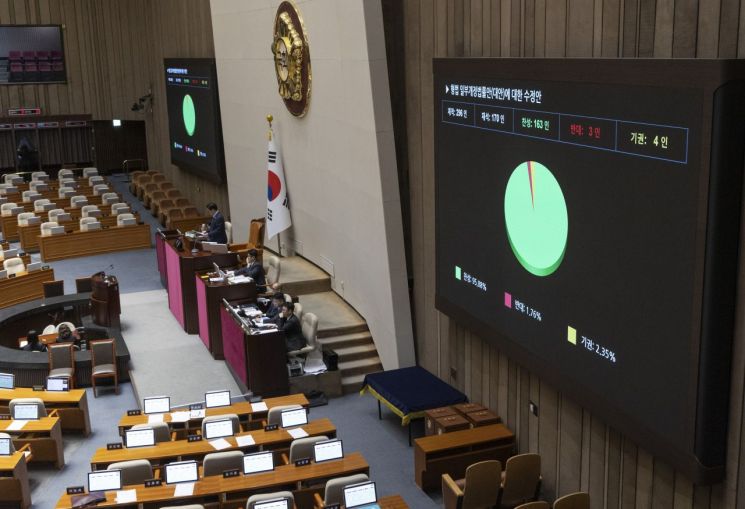
On February 26, the National Assembly passed an amendment to the Criminal Act known as the Judicial Distortion Crime Act.
At a plenary session held that day, the National Assembly passed the amendment to the Criminal Act with 163 votes in favor, 3 against, and 4 abstentions out of 170 lawmakers present. The Judicial Distortion Crime bill had been placed on the agenda at the previous day's plenary session, but a filibuster was requested by the People Power Party, leading to about 24 hours of debate.
When the People Power Party began its filibuster the previous day, the Democratic Party and the Cho Kuk Innovation Party immediately submitted a motion to end the unlimited debate. Under the National Assembly Act, more than 24 hours after the start of the filibuster, a vote was held on the motion to end the unlimited debate, and with the passage of the bill in question, the filibuster came to an end.
The amendment to the Criminal Act that passed the plenary session largely consists of provisions on the Judicial Distortion Crime and on the punishment of espionage. As originally drafted, the Judicial Distortion Crime applies to judges, prosecutors, or persons performing duties related to criminal investigations who, with the purpose of unlawfully or unjustly granting benefits to others or infringing upon their rights and interests, intentionally misapply laws and regulations in a way that makes one party to a case advantageous or disadvantageous, or who fabricate evidence related to a case or use fabricated or altered evidence in trials or investigations. It also includes a punishment clause stipulating imprisonment for up to 10 years and disqualification for up to 10 years for violations of the Judicial Distortion Crime provision.
However, the previous day the Democratic Party submitted a revision that, citing concerns about infringement on the independence of the judiciary and about the clarity of the elements constituting the Judicial Distortion Crime, limits the scope of punishable conduct to criminal cases, and strengthens the intent requirement so that it applies only where a person knowingly applies a law despite being aware that the requirements for its application are not met, or knowingly disregards a law that should be applied.
The judiciary had expressed concern over the Judicial Distortion Crime, warning that "judicial reform is being pushed ahead without sufficient deliberation." Even though the Democratic Party leadership prepared a revision in consideration of the judiciary's criticism, the judiciary voiced concern that the scope of punishment could still be excessively expanded and that serious side effects could arise. Within the party, centered on the Legislation and Judiciary Committee, there was continued backlash, arguing that, procedurally, there had been no consultation with the competent standing committee, the Legislation and Judiciary Committee, during the revision process. The Democratic Party explained that the revision was drafted through consultations among the party, the government, and the presidential office.
In addition, the amendment also dealt with provisions on espionage, allowing punishment of persons who, for a foreign state or an organization equivalent thereto, under orders, instigation, or other communications of intent from such foreign entities, detect, collect, leak, transmit, or broker state secrets, or aid and abet such acts.
© The Asia Business Daily(www.asiae.co.kr). All rights reserved.












