General Meeting Held by the Korean Distribution Law Association on the 26th
Under the Theme "Key Issues in Changes to Government Regulation of the Distribution Industry"
Criticism has been raised that government regulation surrounding the distribution industry is still stuck in a mindset focused on large offline retailers of the 1990s and 2000s.
On the afternoon of the 26th, the Korean Distribution Law Association held its spring academic conference and general meeting at the CJ Law Hall of Korea University under the theme "Key Issues in Changes to Government Regulation of the Distribution Industry." In the first session, academics and legal experts held a discussion on the topic of "Assessment and Prospects of Legal and Institutional Changes in the Distribution Sector Last Year."
Participants commonly pointed out that the current Large-scale Distribution Transactions Act remains an extension of the past "Large-scale Retail Business Notification" framework. Professor Cho Hyeshin of Handong Global University said, "The intermediary function of online platform operators has rapidly increased its share in distribution, and online and offline are becoming so integrated that it is difficult to distinguish between them," adding, "Because of the two-sided market characteristics of platforms, the economic meaning of 'consumer inducement practices' has also changed." She went on to stress, "The current regulatory framework does not sufficiently reflect these structural changes, so it needs to be reconsidered."
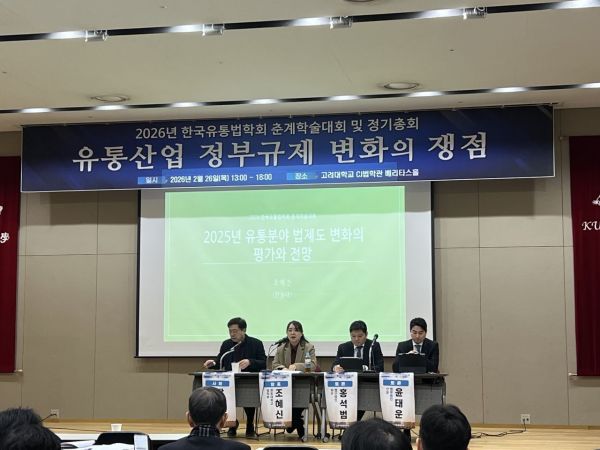 Scene from the Korean Distribution Law Association's regular general meeting held on the 26th under the theme 'Issues in Changes to Government Regulation of the Distribution Industry.' Photo by Han Yeju
The Large-scale Distribution Transactions Act was introduced in 2012 in response to the high market concentration of offline hypermarkets and department stores. At that time, the combined market share of the top three companies (CR3) reached 76% for hypermarkets and 78% for department stores, raising concerns about "abuse of purchasing power" over suppliers. However, in the 2020s, the combined market share (CR3) of the online retail market has been in the 50% range, leading to analysis that its market structure differs from that of offline distribution.
In particular, after the "Tmon & WeMakePrice (Tmon-WeMakePrice) incident" in 2024, the Korea Fair Trade Commission has been pushing to amend the Large-scale Distribution Transactions Act, and a plan is being discussed to expand the scope of the law to include online intermediary platforms above a certain size. The amendment proposal includes provisions such as limiting the settlement period for sales proceeds to within 20 days from the date of purchase confirmation and requiring 50% of the sales proceeds to be managed separately.
Beyond the Large-scale Distribution Transactions Act, the issue of regulatory equity between pure-play e-commerce operators and those conducting both online and offline business under the E-commerce Act also came under scrutiny. Attorney Hong Seokbeom of the law firm Yulchon said, "Depending on the business model, some cases result only in an administrative fine under the E-commerce Act, while others incur large surcharges under the Act on Fair Labeling and Advertising, creating differences in the level of sanctions," adding, "There are limits to an approach that deals with consumer inducement practices only within the E-commerce Act framework, which governs B2C transactions."
In response, Professor Cho argued that a special act is needed to regulate online platforms. She said, "A special act could attempt a mix of various regulatory tools that reflect the nature of platforms, for example, a combination of ex-ante, ex-post, competition-law-based, distribution-law-based, and consumer-law-based measures, and it could also consider differentiated regulation according to the market dominance of platforms," explaining, "If we are to fully reflect the two-sided market nature of platforms, we will likely need to discuss the necessity of enacting a separate special act."
By contrast, Attorney Hong proposed an approach centered on assessing "substantive restriction of competition" under the Monopoly Regulation and Fair Trade Act. He emphasized, "The Fair Trade Act is based on the 'rule of reason,' which comprehensively considers not the form of conduct but its restraining effect on competition and its impact on enhancing consumer welfare," adding, "It may provide a more suitable framework for evaluating the complex transaction structures of the platform era."
In the second session, discussions continued on the appropriateness of the surcharge system under the theme "Consistency of Sanction Tools and Levels in Special Acts on Fair Trade." Caution was voiced regarding the government's recent move to raise surcharge ceilings under certain special acts.
Attorney Park Sungjin of the law firm Bae, Kim & Lee said, "The primary purpose of the surcharge system is to deter illegal conduct," adding, "Excessive surcharges can have the side effect of discouraging even efficient transactions, and there is also the possibility of unintended consequences in which the very counterparties the system aims to protect end up being excluded from the market." He continued, "We need to go back to the concerns we had in 2003 when we introduced the surcharge system based on relevant turnover and re-examine whether the calculation method aligns with the objectives of recouping unjust gains and securing deterrence."
Assistant Professor Park Junyoung of the College of Law at Gyeongsang National University also said, "As the size of surcharges grows, demands for substantive and procedural legitimacy will inevitably become stronger," adding, "Surcharges and refund interest are linked, so if a disposition is revoked in court, the administrative burden also increases. Transparency and rigor in the calculation process are more important now than ever."
© The Asia Business Daily(www.asiae.co.kr). All rights reserved.












