Bank of Korea Holds February Economic Outlook Briefing
Q1 Growth Forecast at 0.9%...0.3-0.4% in Subsequent Quarters
"Demand-side Inflationary Pressures from Private Consumption May Grow in the Second Half"
"Consumption Effect from Rising Stock Prices Likely Limited for Now"
The Bank of Korea has raised its forecast for this year's economic growth rate for Korea to 2.0%, and expects growth of around 1% in the first quarter alone. This reflects the combined effects of a base effect from negative growth in the fourth quarter of last year, strong semiconductor exports, and a gradual recovery in consumption.
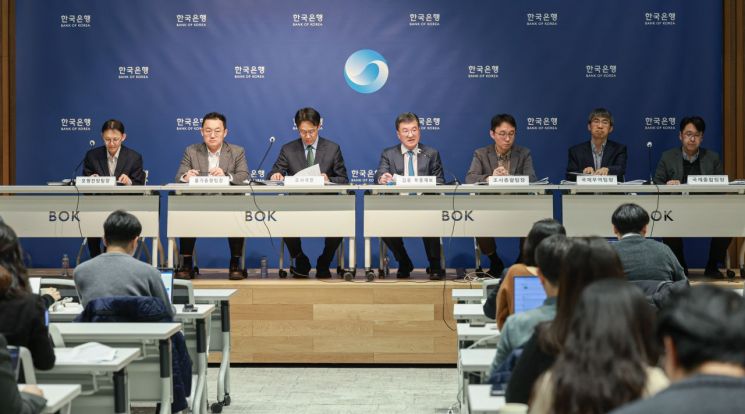 On the afternoon of the 26th, an economic outlook briefing is being held at the Bank of Korea in Jung-gu, Seoul. From left: Park Kyunghoon, Head of Model Forecasting Team; Yoon Yongjun, Head of Price Trends Team; Lee Jiho, Director of the Research Department; Kim Woong, Deputy Governor; Park Changhyun, Head of Research Coordination Team; Park Byunggeol, Head of International Trade Team; Park Sejun, Head of International Affairs Team. Photo provided by the Bank of Korea.
Kim Woong, aide to the Deputy Governor of the Bank of Korea, said at the "February Economic Outlook" briefing held on the afternoon of the 26th, "Looking at the quarterly growth path, we expect growth of around 1% in the first quarter, which we see as the highest growth rate," announcing this outlook.
In its economic outlook report, the Bank of Korea raised its forecast for annual growth this year from the previous 1.8% to 2.0%. It projected quarterly growth rates of 0.9% in the first quarter, 0.3% in the second quarter, 0.4% in the third quarter, and 0.4% in the fourth quarter.
Regarding this, aide to the Deputy Governor Kim explained, "First of all, exports are performing very well, especially semiconductors, and consumption also remains solid when we look at card data," adding, "There is also a base effect from last year's negative growth of minus 0.3% in the fourth quarter." He went on to say, "If semiconductors perform even better, the growth rate could rise further." Last year, Korea's annual economic growth rate barely managed to reach 1.0%.
The Bank of Korea revised its forecast for the consumer price inflation rate this year to 2.2%, up 0.1 percentage point from the previous projection, explaining that this reflects the accumulated cost-push pressures on electronic devices and other products caused by rising semiconductor prices. It also expects upside pressures on the demand side, including private consumption, to increase from the second half of the year. Lee Jiho, Director of the Research Bureau, said, "Looking at the quarterly path of private consumption, we expect it to rise more rapidly in the second half than in the first half," and added, "The effect could accelerate further next year, so not immediately, but we expect demand-side pressures to grow."
As for the possibility that rising stock prices will translate into stronger consumption, the assessment for now is that the impact will be limited. Aide to the Deputy Governor Kim said, "There is clearly an effect whereby higher asset prices and stock prices lead to increased consumption," but added, "Given that, amid deepening polarization, stock ownership is concentrated among high-income groups, the magnitude of the wealth effect could shrink, and considering that stock prices have risen mainly in semiconductor-related shares and that it takes time for this to feed through to consumption via dividends or wages, the consumption-boosting effect is likely to appear only gradually."
For this year's growth path, the Bank of Korea cited tariff risks as the biggest external risk factor. Director Lee said, "We thought uncertainty had eased somewhat through last year's agreement with the United States, but it still remains," and added, "The government is making efforts, but we cannot rule out a 'season 2' of the kind of uncertainty we saw last year."
The forecast for construction investment was sharply lowered from 2.6% to 1.0%. Regarding this, Park Changhyun, head of the Research Coordination Team, said, "In last year's outlook, we thought the slump might ease, but unsold housing, especially in the residential construction sector in regional areas, still has not been cleared," and added, "We also factored in the impact of high construction costs lengthening the lag between the orders we had expected and the actual start of construction, and on that basis we revised the forecast downward."
He continued, "Overall, we expect the recovery this year to be slower than previously anticipated, but the slump should be somewhat less severe than last year, so we are not projecting negative growth," and added, "Given investment in AI-related infrastructure, the construction of semiconductor component plants, and the government's expansion of SOC (social overhead capital), we expect the overall trend to be one of the slump gradually easing."
© The Asia Business Daily(www.asiae.co.kr). All rights reserved.












