Focus on Trust Mechanisms Over Governance Structures
Beware "Galapagos Regulations" That Stifle Innovation
Address Constitutional Concerns and Respect Private-Sector Autonomy
Political and academic circles have raised concerns about "overregulation" regarding two core issues in Phase 2 digital asset legislation: limits on the shareholdings of major shareholders in virtual asset exchanges, and the "51% bank equity rule" for issuing stablecoins. Speakers argued that formal controls based on equity structures would lead to stagnation rather than stability in the industry, and stressed the urgent need to establish a "substantive trust structure" that aligns with constitutional protection of property rights and global standards.
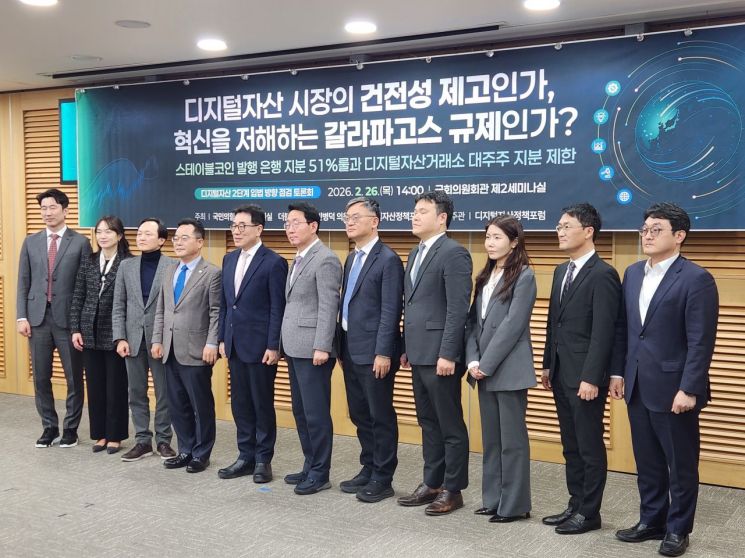 On the afternoon of the 26th, attendees at the "Digital Assets Phase 2 Legislative Direction Review Forum" held at the National Assembly pose for a commemorative photo. Photo by Lim Chunhan
◆Equity limits as a "framework of control"
Min Byungdeok, a lawmaker of the Democratic Party of Korea, said at the "Digital Asset Phase 2 Legislative Direction Review Forum" held at the National Assembly on the afternoon of the 26th, "There is a question as to whether the 51% bank equity rule really guarantees safety. The argument that a bank-centered structure can enhance stability may sound plausible at first glance, but an equity structure in itself does not guarantee safety," adding, "The essential safety of stablecoins comes from holding more than 100% in reserve assets, clear guarantees of redemption rights, transparent disclosures and external audits, and robust internal control and supervisory systems."
Assemblyman Min said, "The key should not be a formal threshold of 51% equity, but whether risk management requirements are functioning properly," and added, "If the 51% bank rule blocks the participation of innovation drivers and excludes the private sector's technological and platform capabilities, the result will be stagnation, not stability." He continued, "What we need to build for innovative industries is not a 'framework of control' but a 'structure of trust,'" stressing, "You cannot run automobiles under regulations from the horse-and-carriage era."
He went on to say, "Within a public-private cooperation structure in which the private sector leads and the government supports, we must design quickly and refine quickly," adding, "We must create international standards, not a Galapagos-style system. The 51% rule and equity limit issue is a choice that will determine whether the Republic of Korea becomes a pioneer in digital finance or a country that passively follows global standards."
Kim Sanghoon, a lawmaker of the People Power Party, said, "We need to create conditions under which foreign investors can sufficiently invest in the domestic virtual asset market," and added, "It is highly inappropriate for the government to take a regulation-only approach toward the digital asset market." He then asked, "Is it really appropriate at this point to impose equity limits on major shareholders of virtual asset exchanges?" and pointed out, "There is no precedent for this in the global market, and if we are not careful, trust in the Korean digital asset market could plummet."
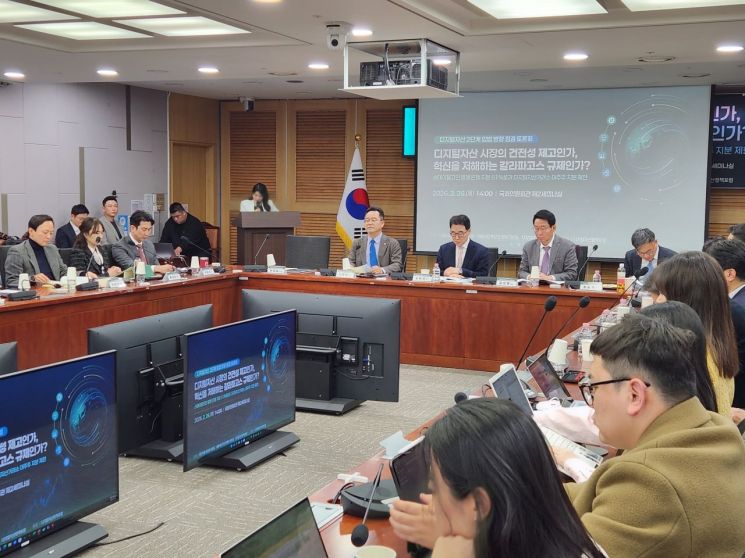 On the afternoon of the 26th, a "Discussion to Review Legislative Directions for the Second Phase of Digital Assets" is taking place at the National Assembly. Photo by Im Chunhan
◆Urgent need for design aligned with global standards
Experts emphasized that while swift legislation is important for innovation in the virtual asset industry, it must be accompanied by the establishment of trust mechanisms and the design of reasonable regulations that do not infringe on fundamental rights. Lim Jongin, head of the Digital Asset Policy Forum, said, "As legislative discussions have recently been delayed, the institutional groundwork for industrial innovation, including the issuance of won-denominated stablecoins, has not been able to gain momentum," adding, "There are also growing concerns about moves to draw hasty conclusions without sufficient review and social consensus in the wake of the mispayment-of-coins incident." He continued, "Now is the time to swiftly establish a reasonable legislative direction that balances soundness and innovation, constitutional values, and global standards," stressing that "both speed and direction are required at this moment."
Lee Jongseop, a professor at the College of Business Administration at Seoul National University, said, "The essence of the stablecoin crisis is not a problem of governance structure, but should be reframed as a problem of the trust mechanism: how to secure trust from the market," explaining, "For investors, the only collateral they can truly trust is bank deposits. A stablecoin issuance model based on a collateral pool composed predominantly of bank deposits is an unavoidable reality in the Korean market." He added, "The role of the authorities is to create a competitively neutral regulatory environment by designing regulations on asset composition, transparency, and redemption protocols."
Choi Seungjae, a professor of law at Sejong University, said, "There is a question as to whether limits on equity ownership in virtual asset exchanges are unconstitutional, and whether they run counter to the constitutional provision on the protection of property rights and the Constitutional Court's principle of prohibition of excessive restriction," explaining, "Even if regulation is necessary, the legitimacy of the objective does not automatically guarantee the appropriateness of the means, and it is necessary to seek alternative measures that infringe rights to the minimum extent." He went on to say, "We must ask whether there is a less fatal approach than limiting the equity of major shareholders," adding, "Ensuring that Phase 2 legislation is implemented without delay is what will prevent a regulatory vacuum and enable appropriate consumer protection."
Jung Jaewook, an attorney at Juwon Law Firm, said, "It is difficult to view virtual asset exchanges as operators with a public-interest character, and given that institutional monopolies or oligopolies are not being imposed, equity limit provisions premised on membership-based exchanges are not appropriate," criticizing, "If such regulations are implemented, it will be difficult for private companies to aggressively venture into new business areas."
© The Asia Business Daily(www.asiae.co.kr). All rights reserved.













