Companies Simultaneously Reflect Commercial Act Amendments in Articles of Incorporation
Introduction of Electronic Shareholder Meetings, Changes to Independent Directors, and More
Business Structure Restructuring to Secure Future Market Lead
Tension in the business community is at its peak ahead of the upcoming 'Super Shareholders' Meeting' season next month. This year's general meetings are expected to be more than just a forum for sharing last year's management performance; with the revised Commercial Act set to take effect in the second half of the year, companies are gearing up to revise their articles of incorporation in a fierce effort to achieve both 'governance reform' and 'management rights defense.'
According to industry sources on the 27th, major companies such as Samsung Electronics, SK hynix, Hyundai Motor, LG Electronics, Hanwha Ocean, and Korean Air are preparing to remove provisions excluding cumulative voting from their articles of incorporation and to revise clauses for the separate election of audit committee members at the shareholders' meetings scheduled for next month.
With the government pressing for 'value-up' and the sweeping changes brought by the Commercial Act amendment, companies not only have to fortify their defenses for management rights but also pay close attention to the voting intentions of retail shareholders, whose every vote could prove crucial.
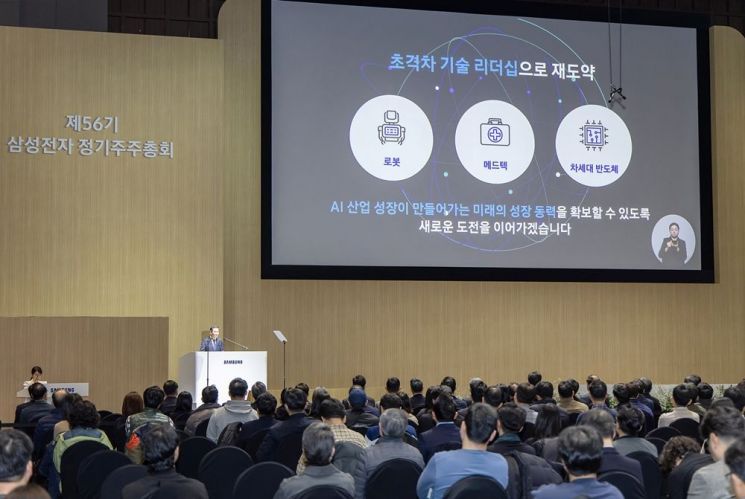 Samsung Electronics held the 56th Annual General Meeting of Shareholders on March 19 last year at the Suwon Convention Center in Suwon, Gyeonggi Province, with shareholders, institutional investors, and management in attendance. Samsung Electronics.
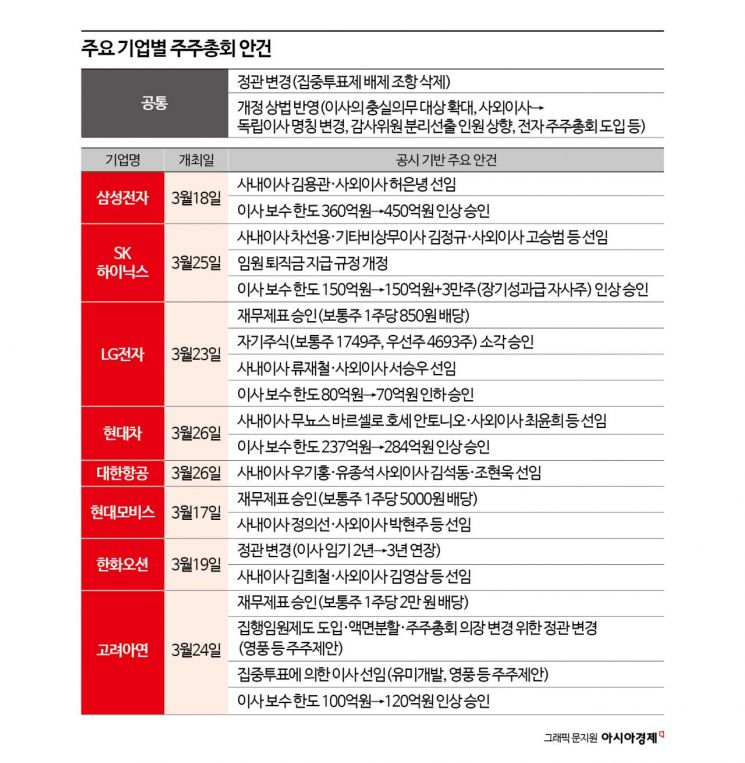
Samsung Electronics plans to strengthen the independence of its audit committee at the shareholders' meeting on the 18th of next month by appointing two audit committee members separately from other directors. The agenda item to appoint Chairman Lee Jae-yong as an inside director, which was initially anticipated, has been excluded from this year's meeting. This is interpreted as a move to slow down, mindful of criticism from retail investors regarding legal risks. The appointment of new inside and outside directors, including Kim Yongkwan, Head of Business Strategy for the Device Solutions (DS) Division, who will newly join the board, will also be on the agenda.
SK hynix has also put forward the introduction of cumulative voting, starting a balancing act between meeting shareholder demands and defending management rights. The company will amend its articles of incorporation to introduce electronic shareholders' meetings and change independent directors. In addition, the agenda will include the appointment of new inside and outside directors, such as Cha Seonyong, Head of the Future Technology Research Institute (CTO), who is nominated as a new inside director this year, as well as amendments to the executive severance pay regulation. As an in-house technology expert, Dr. Cha is expected to contribute to strengthening SK hynix's technological leadership. Major executives, including President Kwak Nojeong of SK hynix, are expected to attend the meeting.
With the 'semiconductor supercycle' driving the share prices of Samsung Electronics and SK hynix to new heights, attention is also expected to focus on whether shareholder return policies will be discussed. This is a result of the passage of the third amendment to the Commercial Act. Under the 2024-2026 shareholder return policy, Samsung Electronics paid a special dividend of 1.3 trillion won in the fourth quarter settlement last year, the first time in five years. SK hynix also announced a shareholder return policy worth 2.1 trillion won earlier this year, based on its record-breaking performance. In addition, SK hynix stated its intention to cancel all of its treasury shares, amounting to approximately 15.3 million shares or about 12.2 trillion won.
LG Electronics also announced last year that it would invest 200 billion won over two years in shareholder returns and began canceling its treasury shares. At the beginning of this year, LG Electronics decided to cancel all of its remaining treasury shares, which is also expected to be on the agenda at this shareholders' meeting. LS Group, which is scheduled to hold its shareholders' meeting at the end of March, is also expected to discuss shareholder return policies and other agenda items. During the process of pursuing the Commercial Act amendment, LS Group announced a plan last year to cancel 1 million treasury shares as a preemptive measure. The first cancellation of 500,000 shares was carried out in August last year, and the second cancellation of about 10.92 billion won is scheduled for completion on the 27th of this month.
At Hanwha Ocean's shareholders' meeting on the 19th of next month, the agenda will include approval of the financial statements and consolidated financial statements, as well as amendments to the articles of incorporation. The amendments include reflecting equal dividend standards, introducing electronic securities, improving dividend procedures, revising the bylaws, and extending the term of directors from two to three years. This is intended to improve the efficiency of the dividend process and the stability of board operations at the same time. The extension of director terms is interpreted as a measure to secure continuity in management.
Meanwhile, this year's shareholders' meetings are characterized by a complex interplay not only of governance reform but also of business structure reorganization for future market leadership and fierce battles over management rights.
At its regular shareholders' meeting scheduled for the 26th of next month, Hyundai Motor plans to add 'car rental business' to its business purposes, signaling the company's entry into a new business area. Hyundai Motor has so far participated indirectly in the rental car market through Hyundai Selection. Through this addition, Hyundai Motor will directly handle vehicle rentals, which the industry sees as its official entry into the rental car market. Its affiliate, Kia, already lists car rental business as one of its main businesses and operates Kia Rent-a-Car.
Korea Zinc, which is engaged in a management dispute with Young Poong and MBK, has the appointment of directors whose terms are expiring as a key agenda item at this shareholders' meeting. Since cumulative voting applies, the composition of the board will depend on how effectively each side can consolidate its votes, making this a key point to watch. The current management is likely to try to maintain stable control by rallying votes around core candidates, while the opposing side will also aim to secure a significant number of seats by consolidating its forces. Korea Zinc plans to persuade shareholders by highlighting last year's record performance and its mid- to long-term strategies, while Young Poong is focusing on governance reform by introducing an executive officer system.
Variation in Directors' Remuneration Limits by Business Conditions
Directors' remuneration limits varied by company performance. Benefiting from the semiconductor sector, Samsung Electronics will raise its directors' remuneration limit from 36 billion won last year to 45 billion won this year. The general remuneration limit remains at 26 billion won, but the long-term performance remuneration limit increased from 10 billion won to 19 billion won. This appears to be linked to the company's performance driven by the semiconductor division last year.
SK hynix will also raise its directors' remuneration limit. The maximum amount last year was 15 billion won, but this year it will be set at 15 billion won plus 30,000 shares. This method provides treasury shares as long-term performance-based stock compensation, separate from cash. Hyundai Motor, which posted solid results even amid last year's tariff environment, also raised its directors' remuneration limit to reflect performance, increasing it from 23.7 billion won last year to about 28.4 billion won this year, a hike of around 4.7 billion won.
On the other hand, LG Electronics, which recorded its highest-ever sales but turned to an operating loss of 109 billion won, reduced its directors' maximum remuneration limit from 8 billion won last year to 7 billion won this year. Previously, the company had already lowered the limit from 9 billion won in 2023 to 8 billion won in 2024, and now it has cut the limit once again.
Experts predict that the Commercial Act amendment will lead to greater participation from minority shareholders in the future. Lee Joonseo, Professor of Business Administration at Dongguk University and former president of the Korean Securities Association, said, "Although minority shareholders may not immediately exercise major shareholder proposal rights since share prices have risen significantly, their participation in shareholders' meetings is expected to be much higher than in the past. However, in companies with poor performance, the atmosphere may be quite different as activist investors could intervene."
Kim Woochan, Professor of Business Administration at Korea University, commented, "Although companies are deleting exclusion clauses in compliance with the mandatory cumulative voting, some are reducing the number of directors or extending directors' terms to blunt the effects of cumulative voting, which is concerning. To ensure minority shareholders' interests are protected, it is necessary for the National Pension Service or asset management companies participating in the Stewardship Code (institutional investors' proxy voting guidelines) to take a more active role."
© The Asia Business Daily(www.asiae.co.kr). All rights reserved.














