Held Press Conference at Gwangju City Council
Urged Establishment of Criteria for Conversion to Autonomous Cities
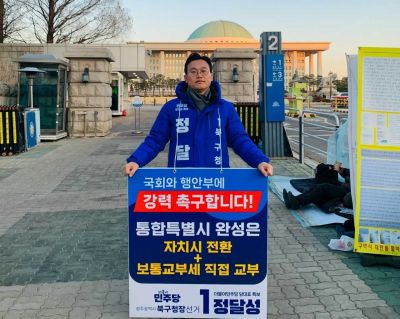
Jung Dalseong, special advisor to the Democratic Party leader and member of the Gwangju Buk-gu Council, who has declared his candidacy for the Buk-gu mayoral post in the June 3 local elections, pointed out the issue of fiscal imbalance among autonomous districts that has emerged during the process of integrating South Jeolla Province and Gwangju into a single special city, and called for the explicit stipulation of direct allocation of local allocation tax and a joint response by local election candidates.
On the 26th, Jung held a press conference in the briefing room of the Gwangju City Council and stated, "To achieve substantive completion of the South Jeolla-Gwangju special city integration, the special law must stipulate the conversion of Gwangju’s five autonomous districts into autonomous cities and the direct allocation of ordinary local allocation tax."
He said, "As of last year, despite the fact that the 22 cities and counties in South Jeolla Province had an average population of only about 80,000, they received support totaling about 400 billion won for cities and about 280 billion won for counties when combining ordinary local allocation tax and adjustment grants," and added, "In contrast, the five autonomous districts of Gwangju have a much larger average population of about 270,000, yet the adjustment grants they receive through the city amounted to only about 86.6 billion won on average."
According to Jung’s explanation, in the case of Buk-gu, in addition to the existing annual adjustment grants of 110 billion won, between at least 150 billion won and up to 300 billion won in local allocation tax would need to be directly allocated for its fiscal capacity to be on par with the cities and counties of South Jeolla Province.
Jung stressed, "We have a structure in which the population and administrative demand are higher, but fiscal resources are far lower," and warned, "If this gap is maintained even after integration, the integration will inevitably become an expansion of imbalance rather than a path to development."
Previously, to resolve this issue, Jung visited the National Assembly in person, conveyed his views to Democratic Party leadership figures such as Party Leader Jung Cheongrae, Floor Leader Han Byungdo, and Supreme Council Member Park Ji-won, as well as local members of the National Assembly, and held a one-person protest in front of the National Assembly.
Jung officially proposed to Kang Gijung, Mayor of Gwangju, Kim Youngrok, Governor of South Jeolla Province, other prospective candidates for the integrated mayoral post, and the candidates for the heads of the five districts of Gwangju that they should: establish a joint response system for the five autonomous districts of Gwangju; prepare a phased roadmap for transitioning to direct allocation; and codify the criteria and procedures for conversion to autonomous cities.
He concluded by saying, "Integration is about structure, not about a name. The metropolitan and basic local governments, as well as the National Assembly and local governments, must all make responsible decisions and take joint action."
Meanwhile, Jung completed his preliminary candidate registration on the 20th in order to run for the Buk-gu mayoral post in Gwangju in this year’s local elections.
© The Asia Business Daily(www.asiae.co.kr). All rights reserved.












