Ahead of March Enforcement of the Integrated Community Care Support Act
Building a One-stop Support System for Medical Care, Long-term Care, Housing, and Personal Care
Gwangjin-gu in Seoul (Mayor Kim Kyungho) has drawn up its 2026 integrated care project plan to coincide with the nationwide enforcement in March this year of the Act on Integrated Support for Community Care Including Medical Care and Long-term Care, and will begin full-scale operations.
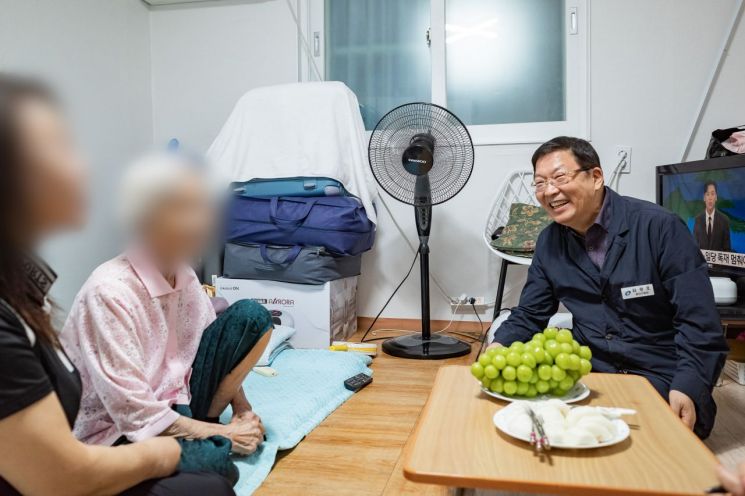 Kim Kyungho, Gwangjin District Mayor, visited a household eligible for integrated care in September last year to hear their views. Provided by Gwangjin District.
Last year, the district was selected as a participating local government for the Ministry of Health and Welfare’s technology-supported integrated care project and for the Seoul Metropolitan Government’s pilot project for the Integrated Care Support Center, and over the past year it has laid the groundwork for the initiative. This year, under the vision of “Happy Gwangjin, where people continue to live healthy lives in the place they have always lived,” the district will work to complete a community-based care system focused on five key areas: healthcare, health, long-term care, personal care, and housing.
The scope of service beneficiaries will also be expanded. Eligibility will be broadened from the existing standard of seniors aged 65 or older to include persons under 65 with severe physical or brain lesions disabilities, and any resident of the district who has difficulty with daily living due to frailty, accidents, or illness will be able to apply.
In the healthcare sector, the district will provide home visits by doctors for residents with limited mobility (Long-term Care Home Medical Center), customized exercise programs through health home visits to help with post-discharge adaptation, polypharmacy management, and dementia safety management. In the daily living sector, it will minimize blind spots in care through the Care SOS Project, which bundles temporary home care, meal provision, hospital accompaniment, and housing improvement, as well as by installing fall-prevention items, offering meal support for low-income seniors, and operating a welfare check service using AI phone calls.
The district has established a public-private cooperation system centered on three zones: Junggok, Guui Square, and Jayang, in collaboration with community service centers, welfare centers, public health centers, and the National Health Insurance Service. It plans to promote integrated support that spans from application and consultation to comprehensive assessment, service provision, and follow-up management.
The application process has also been simplified. By making a single call to the newly established “Gwangjin Integrated Care Call Center (02-450-1160),” residents can receive guidance from consultation through to service linkage, and an integrated care information page has been created on the district office’s website so that all related information can be easily viewed at a glance.
Mayor Kim Kyungho of Gwangjin-gu said, “We will do our utmost to ensure that all residents in need of care, including seniors and persons with disabilities, can enjoy a dignified and healthy life not in facilities, but in the places where they have always lived.”
© The Asia Business Daily(www.asiae.co.kr). All rights reserved.












