Strengthening Local, Essential, and Public Healthcare Deemed Important by 87.8%, the Highest Response Rate
Specialized Subcommittees to Be Formed Next Month... "We Will Develop Measures That People Can Tangibly Feel"
The Medical Innovation Committee has selected 10 agenda items across 3 areas, including strengthening local, essential, and public healthcare, and decided to operate specialized subcommittees for each area on a biweekly basis.
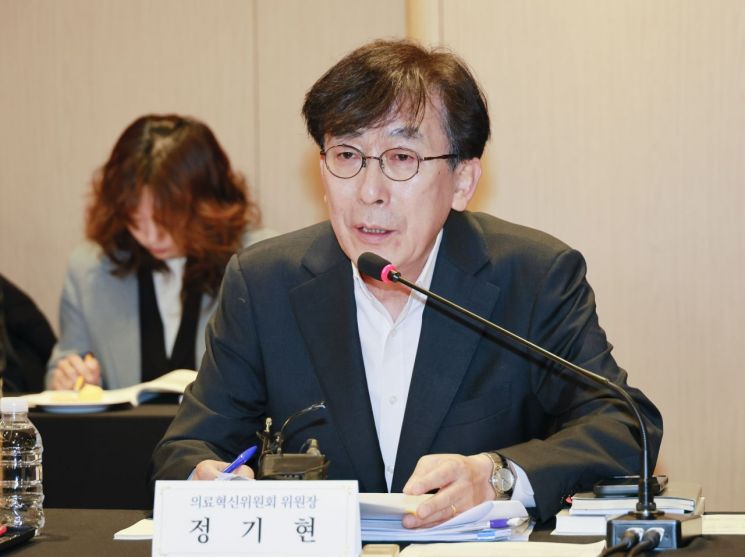 Jeong Gihyeon, chair of the committee, is speaking at the 3rd Medical Innovation Committee meeting held on the 26th at the Koreana Hotel. Ministry of Health and Welfare
The Medical Innovation Committee, an advisory body under the Prime Minister, announced that it held its 3rd meeting on the 26th at the Koreana Hotel in Jung-gu, Seoul, chaired by Chairman Jung Kihyun, and confirmed the following as future discussion agendas: strengthening local, essential, and public healthcare; establishing a healthcare system in preparation for a super-aged society; and enhancing sustainability in preparation for future environments. The final agenda items were determined by reflecting the results of public opinion collected on a draft that had been narrowed down through workshops and meetings of private-sector members. The composition of the members of the specialized subcommittees is scheduled to be finalized in March.
As the committee toured four medically underserved areas during February - Geochang in South Gyeongsang Province, Wonju and Pyeongchang in Gangwon Province, South Jeolla Province, and Ganghwa and Ongjin in Incheon - it found that residents in these underserved areas felt the gaps in essential medical services, such as emergency care and childbirth, more acutely, and that they frequently had to travel outside their regions for treatment due to insufficient medical infrastructure. Opinions were also raised about the need to expand not only physician staffing, but also nursing, caregiving, and care services.
The committee also conducted a "national survey on healthcare in Korea." A survey of experiences in using medical services showed that residents in medically underserved areas experienced service gaps due to unmet medical needs at a relatively higher rate than those in non-underserved regions.
In the perception survey on medical services, it was revealed that the level of recognition that there are sufficient medical institutions within the community was significantly lower in medically underserved areas than in non-underserved regions. As a result, narrowing the quality gap in medical services between large hospitals in the Seoul metropolitan area and regional general hospitals emerged as the top-priority area for improvement, ranking highest in both importance (87.5%) and urgency (43.4%).
In the perception survey on the committee's discussion tasks, strengthening local, essential, and public healthcare received the highest response rate, with 87.8% of respondents saying it is important.
Chairman Jung Kihyun of the Medical Innovation Committee said, "Because the innovation agendas discussed at this meeting were determined by reflecting not only the views of the committee members but also the opinions of the public, they are topics that people genuinely feel are urgent," adding, "Through the specialized subcommittees formed this time, we will immediately begin full-fledged discussions and develop measures that people can tangibly feel."
© The Asia Business Daily(www.asiae.co.kr). All rights reserved.












