Forum on Parental Leave Outcomes and Sustainable Funding Structures Held on the 26th
"We must explore diverse funding options, including general taxation and new funds"
Japan separated the accounts by revising the Employment Insurance Act in 2020
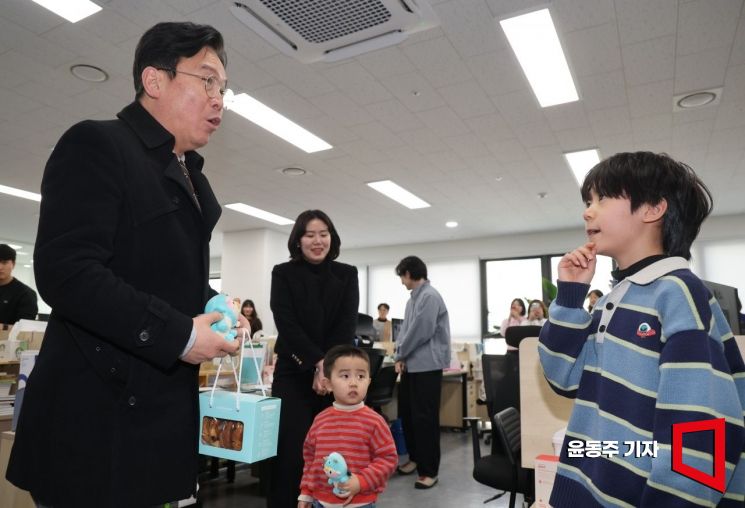 Kim Younghun, Minister of Employment and Labor, visited Sosohansotong Company on January 26, which pioneered the "10 a.m. start time during childcare," and presented gifts to employees' children. 2026.01.26 Photo by Yoon Dongju
"The total amount of parental leave benefits increased from 1.2 trillion won in 2020 to 3.6 trillion won last year. It is difficult for the rapidly rising expenditures to be covered solely by the increasingly depleted Employment Insurance Fund. We need a social discussion on securing separate funding sources." (Jung Sungmi, Research Fellow at the Korean Women's Development Institute)
With the number of parental leave users surpassing 180,000 last year, criticism has been raised that there are limits to financing the system solely through the current Employment Insurance Fund. As the fund is already virtually exhausted, many argue that funding sources must be diversified, including general taxation and new funds, in order to prevent premium hikes for the 13.8 million workers who pay employment insurance contributions.
Number of parental leave users jumped 40% in one year after benefits increased and leave period extended
On the 26th, the Ministry of Employment and Labor held a forum titled "Performance of the Parental Leave System and Sustainable Funding Structures" at the Royal Hotel in Jung-gu, Seoul, together with the Korea Labor Institute. The forum was organized to review the outcomes of the parental leave system and discuss sustainable funding structures at a time when responding to low birthrates and supporting work-family balance are emerging as national priorities.
The number of people receiving parental leave benefits last year was 184,329, an increase of 52,000 (39.1%) from the previous year. Compared with 10,000 in 2005, this is more than an 18-fold increase. Even compared with 87,000 in 2015, ten years ago, the figure has more than doubled.
In particular, the number of male recipients reached 87,000 last year, accounting for 36.5% of all parental leave users, the highest level on record. In 2020, the share was 23.5%. This means an increase of 13 percentage points in five years.
The nearly 40% increase in the number of people receiving parental leave benefits in just one year is due to the government’s substantial strengthening of childcare support programs. The maximum monthly parental leave benefit was raised from 1.5 million won to 2.5 million won, and when both working parents take parental leave, the maximum leave period was extended from the previous 12 months to 18 months.
Research Fellow Jung Sungmi of the Korean Women's Development Institute, who attended the forum, assessed that "as a result of strengthening the 'Daddy Bonus' program and couple-based shared caregiving, male participation has increased and we have been able to take a step closer to making parental leave a universal practice."
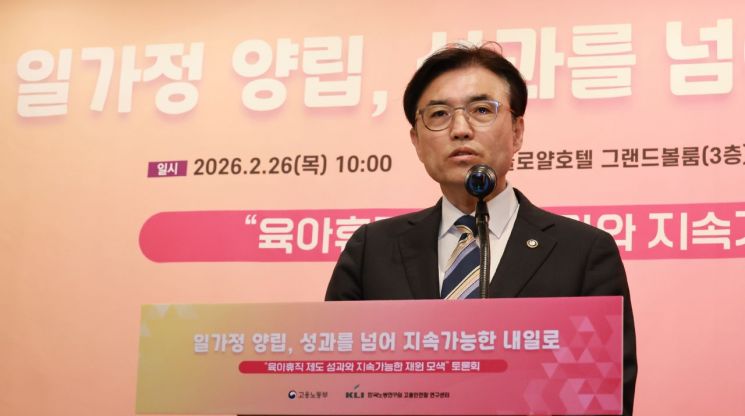 Kwon Changjun, Vice Minister of Employment and Labor, attended and spoke at a forum on the performance of the parental leave system and the search for a sustainable funding structure on the 26th. Ministry of Employment and Labor
"Employment Insurance Fund alone is not enough... To sustain the成果, we must redesign the funding structure for long-term sustainability"
The成果 are clear, but the limitations are also evident. As the activation of the parental leave system has led to a rapid expansion of fiscal spending, alarm bells are ringing over the financial soundness of the Employment Insurance Fund. Currently, parental leave benefits are paid from the unemployment benefits account within the Employment Insurance Fund, and expenditures have surged from 1.2121 trillion won in 2020 to 3.6292 trillion won last year.
As a result, total spending on maternity protection and childcare support programs within the unemployment benefits account - including maternity leave benefits, parental leave benefits, and reduced working hours during the childcare period benefits - has risen from 11.2% of the account in 2020 to 24.5%.
Jung noted, "As spending on maternity protection from the Employment Insurance Fund surges, concerns are mounting over its financial soundness," adding, "Although transfers from the general account have been expanded from 180 billion won in 2020 to 550 billion won in 2025, this is not sufficient compared with the scale of the increase in parental leave expenditures." As of the end of last year, excluding borrowings, the Employment Insurance Fund was running a deficit in the 4 trillion won range, due to a sharp increase in expenditures during the COVID-19 crisis and the expansion of coverage.
Kim Seonae, Head of the Employment Policy Team at the Korea Employers Federation, also said, "Up to now, the parental leave system has mainly evolved by focusing on raising benefit levels, but we now need to review it with a sense of crisis as to whether the finances can withstand it," and added, "In the end, I am concerned that this will act as a factor pushing up employment insurance premiums."
Experts unanimously argued that, for the system to continue delivering成果, the Employment Insurance-centered funding framework must be redesigned. Park argued, "To secure sustainable finances, we need to examine various options such as separating out a dedicated account within the Employment Insurance Fund, creating a new fund, expanding support from the national treasury, and utilizing other funds."
In Japan, as in Korea, parental leave benefits were originally paid from unemployment benefit funds, but as the number of users increased and budgetary pressures grew, the Employment Insurance Act was revised in 2020. Under the current structure, the parental leave benefits account has been separated from the existing unemployment benefits account within the Employment Insurance Fund, and one-eighth of its funding is now covered by the national treasury.
At the forum, participants also pointed out that the current parental leave benefit policy fails to cover non-standard workers such as dependent contractors and freelancers. Because the funding source is employment insurance, support is focused on wage workers, creating blind spots. According to Jung, there are 71,000 people who fall into the following categories: temporary and daily workers with children aged under one, sole proprietors, and workers who left their jobs within one year before childbirth or shortly after. Professor Yoon Dongyeol of the Department of Business Administration at Konkuk University explained, "Because parental leave benefits are linked to core population policies, we need to design the system in a way that encompasses all working parents."
Kwon Changjun, Vice Minister of Employment and Labor, who attended the forum, said, "The increase in the number of people receiving parental leave benefits is clear evidence that the system is changing workplaces on the ground." He went on to say, "Childcare support benefits are not a cost, but an investment in the future of the Republic of Korea," adding, "For that investment to continue, cooperation across society as a whole is essential."
© The Asia Business Daily(www.asiae.co.kr). All rights reserved.













