Atmospheric vortices shaped by island and mountain terrain with strong winds
Large-scale sediment dispersion driven by seasonal current changes
Jeju coastline sees increased response amid influx of seaweed
A unique weather phenomenon in which clouds twist like a spiral pastry and line up across the sky over Jeju has been observed again. After being captured by a National Aeronautics and Space Administration (NASA) satellite, it has now also been detected by a Korea Meteorological Administration satellite, drawing public attention.
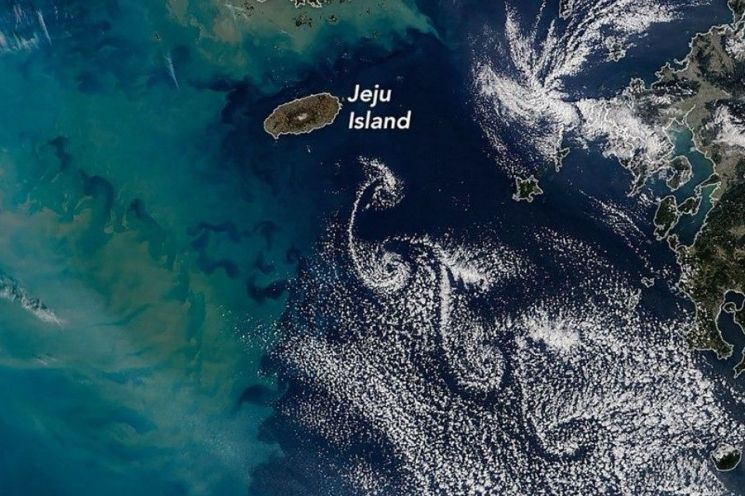 The Jeju Karman vortex phenomenon released on the 24th (local time) by the National Aeronautics and Space Administration (NASA).
On February 24 (local time), the National Aeronautics and Space Administration (NASA) released satellite images showing bands of clouds forming over the skies near Jeju Island, rotating alternately to the left and right. This phenomenon is called a "Karman vortex street," which occurs when wind passes an obstacle such as an island or a mountain and generates alternating vortices. It is also commonly referred to as the "Karman vortex."
A Karman vortex street forms when wind maintains a steady speed and direction as it flows past an obstacle. Vortices appear alternately in a counterclockwise direction on the right side and in a clockwise direction on the left side, lining up in a row. This phenomenon is likely to develop when warm air is accumulated in the lower atmosphere and relatively thin clouds, such as stratocumulus or cumulus clouds, are widely spread at higher altitudes. When a high mountain or an island is located above the inversion layer, the airflow is disturbed and distinct vortex clouds are created.
Jeju Island, which includes Hallasan at an elevation of 1,950 meters, is particularly known as an area where Karman vortices are frequently observed. In fact, the phenomenon formed in the southern sky over Jeju on the morning of February 14, and a similar appearance was observed on February 18. Due to the characteristics of an island situated in the middle of the sea, the southern waters of Jeju are an area where changes in airflow are clearly manifested.
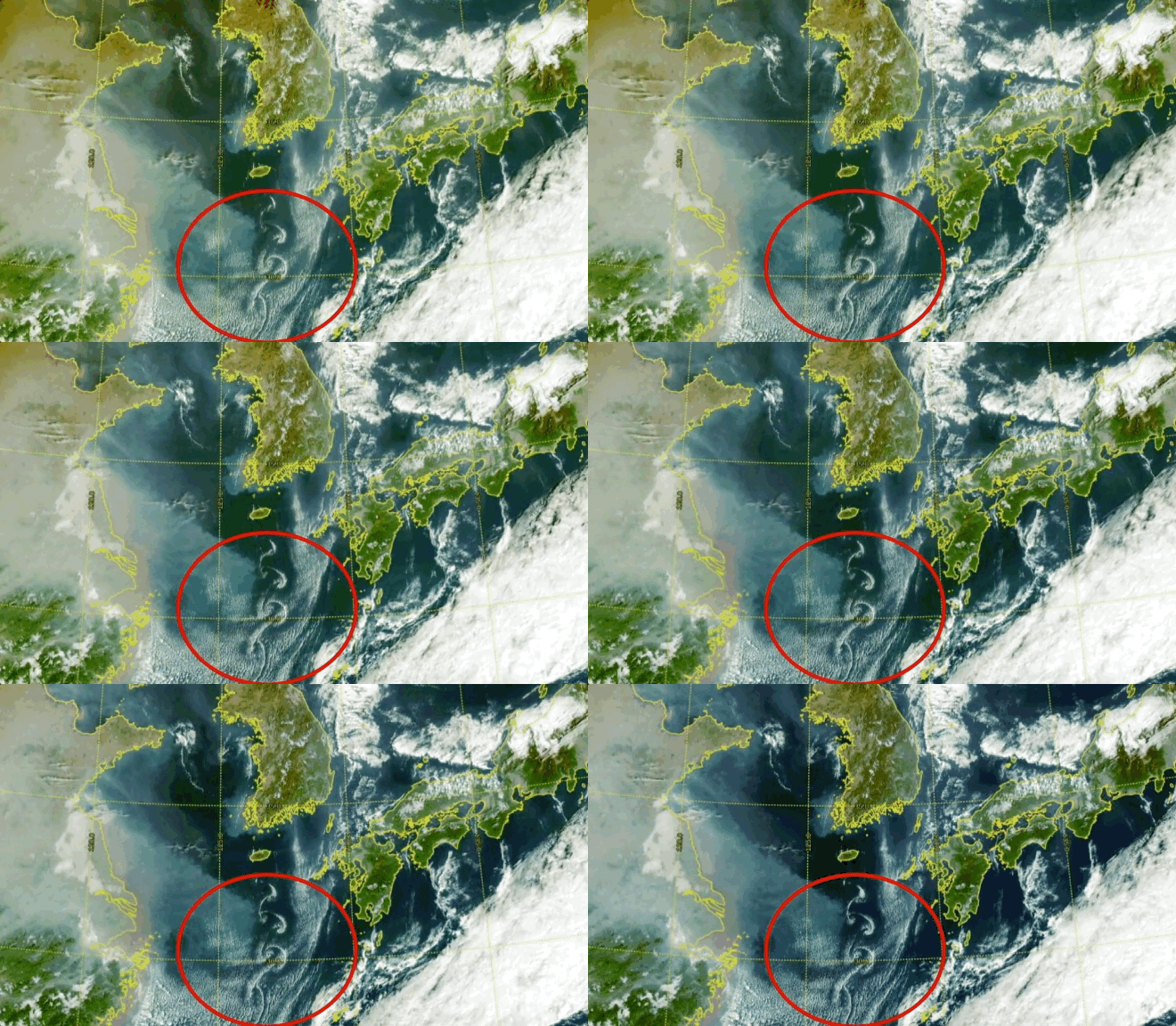 Jeju Island, home to Hallasan, which reaches 1,950 meters above sea level, is known as a region where Karman vortices are frequently observed. In fact, the phenomenon formed in the southern sky over Jeju on the morning of the 14th, and a similar appearance was observed on February 18. Korea Meteorological Administration
Online commenters who saw the images reacted in various ways, saying, "It's fascinating," "It looks like the shape of the wind is visible to the eye," "Hallasan seems to be protecting the Korean Peninsula," and "It feels like the power of Seolmundae Halmang." An official from the Korea Meteorological Administration explained, "A Karman vortex street is not a dangerous weather phenomenon," adding, "It is a peculiar airflow change caused by the geographical characteristics of Jeju Island, which is located in the middle of the sea."
Meanwhile, the latest satellite images also captured the large-scale spread of sediments generated along the coast of Jiangsu Province in China, dispersing into the Yellow Sea. It is analyzed that water mixed with brown sediments has spread extensively due to seasonal winter current changes and vertical mixing. Recently in Jeju, changes in the marine environment have continued, with large amounts of Sargassum horneri drifting in from the southern coast of China and covering the shoreline. Jeju Island, which normally activates its emergency response task force in March, began operating it early this year in January to respond. As this natural spectacle has been observed together with simultaneous changes in marine and atmospheric conditions, interest in environmental changes in the waters around Jeju is growing.
© The Asia Business Daily(www.asiae.co.kr). All rights reserved.













