Growth forecast raised from 1.8% to 2.0%, with semiconductor boom contributing 0.2 percentage point
Upward pressures at work, including government measures to support consumption and investment, despite sluggish recovery in the construction sector
"Current account surplus of 170 billion dollars"... Far exceeding the previous forecast of 130 billion dollars
The Bank of Korea raised its forecast for Korea's economic growth rate for this year from 1.8% to 2.0%, with the biggest contribution coming from the "semiconductor boom," backed by a supercycle. Government measures to support consumption and investment, a favorable global economic trend, and the assumption that the timing of tariff imposition on semiconductors and pharmaceuticals will be postponed also contributed to the upward revision of the growth rate.
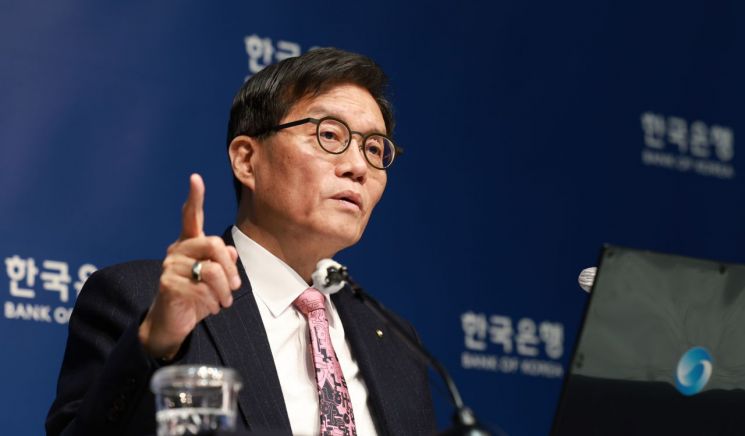 Lee Changyong, Governor of the Bank of Korea, is speaking at a press briefing held after the meeting to decide the direction of monetary policy on the 26th. Bank of Korea
Quarterly outlook for this year... First-quarter growth rate of 0.9% "Considerably above the initial forecast"
According to the Bank of Korea's economic outlook for February released on the 26th, the growth forecast for Korea this year was 2.0%, which is 0.1 percentage point higher than the projection made in November last year. This is attributed to the expansion of the semiconductor upturn and a better-than-expected global economic trend, despite the impact of U.S. tariffs and the sluggish recovery in construction investment.
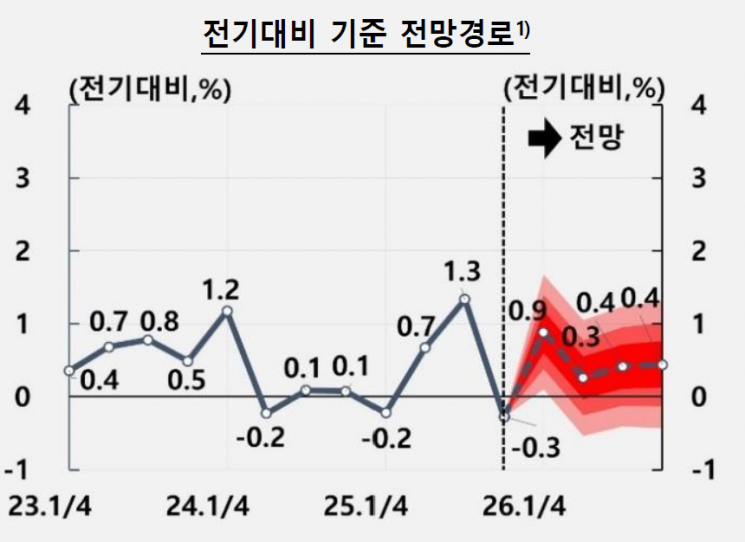
The Bank of Korea presented this year's quarterly growth rate forecasts (quarter-on-quarter) as 0.9% for the first quarter, 0.4% for the second quarter, 0.4% for the third quarter, and 0.4% for the fourth quarter. In the first quarter of this year, consumption is expected to continue its recovery, while exports will show strong growth, mainly in semiconductors. In addition, the base effect from the previous quarter's negative growth (-0.3%) will be seen mainly in the investment sector. As a result, the growth rate is projected to significantly exceed the initial forecast of 0.3% and approach 1.0%, reaching 0.9%. After the second quarter, a moderate expansion of the consumption recovery is expected due to improved income conditions, and export growth is projected to continue, driven by robust global investment in artificial intelligence (AI) and a better-than-expected global economic trend, leading to a favorable growth trajectory. However, the Bank of Korea expects that the weak recovery in non-IT sectors such as construction will partly constrain growth. At a press briefing held after the Monetary Policy Board meeting on the direction of monetary policy that day, Bank of Korea Governor Lee Changyong noted, "The growth rate for the non-IT sector this year is 1.4%, the same as in the previous projection, and considering the upward revision of the overall forecast, the gap between IT and non-IT has widened further."
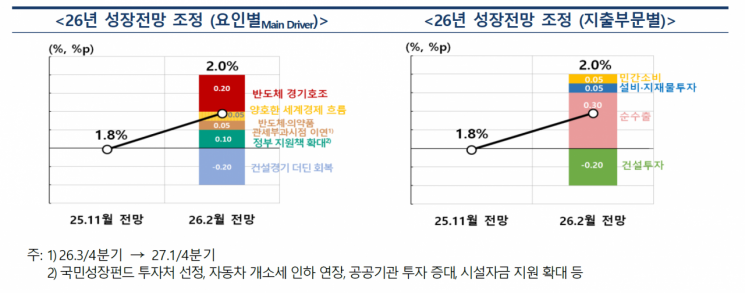
Growth forecast for this year revised up by 0.2 percentage point, with a major contribution from "soaring semiconductors"
Next year, while the recovery in domestic demand continues, exports are also expected to increase thanks to continued global economic growth and expanded semiconductor production capacity, resulting in a growth rate of 1.8%. This is 0.1 percentage point lower than the 1.9% forecast made in November last year. Governor Lee explained, "Semiconductors and other IT manufacturing contributed 0.7 percentage point to this year's growth rate and are projected to contribute 0.5 percentage point next year," adding that this decline in contribution has affected the reduction in the overall growth rate.
The 0.2 percentage point upward revision in this year's gross domestic product (GDP) growth rate is largely attributed to the semiconductor boom, which contributed 0.2 percentage point. This is sufficient to offset the downside factor of the sluggish recovery in the construction sector (-0.2 percentage point. Other upward pressures included a favorable global economic trend (0.05 percentage point), the assumption of a postponement in the timing of tariff imposition on semiconductors and pharmaceuticals (0.05 percentage point), and government measures to support consumption and investment (0.1 percentage point).
This year's consumer price inflation is forecast at 2.2%. While demand-side pressures remain limited, cost pressures in some items such as electronic devices and insurance premiums led the Bank of Korea to raise its forecast by 0.1 percentage point compared with November last year. The consumer price inflation rate, which inched up to 2.4% in the fourth quarter of last year, is expected to remain close to 2% throughout this year and then reach the target level of 2.0% next year.
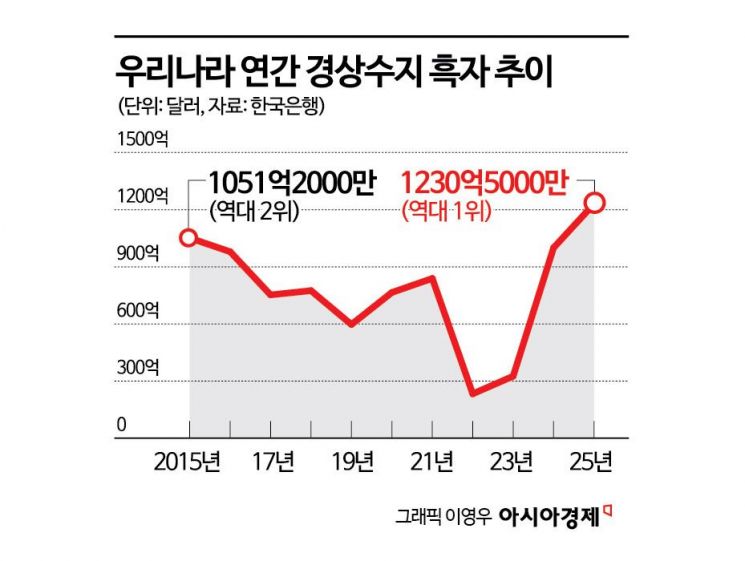
Current account surplus forecast for this year sharply raised to "170 billion dollars"
The current account surplus for this year is projected to reach 170 billion dollars, far exceeding the previous projection path. This is well above the earlier forecast of 130 billion dollars and also significantly higher than last year's record surplus of 123.1 billion dollars.
The goods account surplus is expected to increase significantly, mainly due to a sharp rise in semiconductor prices. In its February economic outlook, the Bank of Korea projected this year's goods account surplus at 189.6 billion dollars, far exceeding the previous forecast of 138.6 billion dollars. However, the Bank of Korea expects the deficit in the services account to widen due to increased demand for industrial service patent royalties and other items as the economy recovers, as well as rising subscription payments for digital service platforms.
The increase in the number of employed persons is expected to slow somewhat from 190,000 last year to 170,000 this year, but the weakness in private-sector employment conditions is projected to ease. In the employment outlook path, government measures for youth employment constitute an upside risk, while the impact of restructuring in some industries remains a downside risk.

If the optimistic scenario is applied, this year's growth rate could rise to 2.2%
In the market, expectations for an accelerated growth of the AI industry and concerns about overinvestment in AI are mixed. Taking this into account, the Bank of Korea analyzed alternative scenarios for the outlook on Korea's semiconductor exports.
Under an optimistic scenario in which semiconductor exports continue to grow at a high rate, this year's growth rate rises to 2.2%. This scenario assumes that competition to secure semiconductors intensifies due to the spread of physical AI, and that as state-led AI initiatives accelerate, Korea's semiconductor export volumes continue to grow at a pace close to last year's level. In this case, this year's growth rate would be 0.2 percentage point higher than the baseline forecast, and next year's growth rate would rise by 0.3 percentage point to 2.1%. At the same time, the inflation rate is estimated to rise by 0.1 percentage point both this year and next year.
By contrast, under a pessimistic scenario, this year's growth rate is projected to be limited to 1.8%. This scenario assumes that AI profitability falls short of expectations and that physical bottlenecks such as power shortages intensify during the expansion of data centers, causing the growth rate of semiconductor export volumes to slow rapidly to around 6% this year and around 3% next year. Under these assumptions, next year's growth rate would be limited to 1.5%.
© The Asia Business Daily(www.asiae.co.kr). All rights reserved.













