Coastal and offshore production jumps 16.3%, led by recovery in mackerel and squid
Distant-water output down 20.2%... Government to fully introduce TAC and push ITQ system
Last year, Korea's total seafood production is estimated to have increased by 8.7% from the previous year. In particular, coastal and offshore fisheries production rose by 16.3%, showing a recovery trend and breaking out of the slump of the past few years.
According to the Ministry of Oceans and Fisheries on the 26th, total domestic fisheries production in 2025 (including coastal and offshore fisheries, marine aquaculture, distant-water fisheries, and inland fisheries) reached 3,934,971 tons. This represents an 8.7% increase compared with 2024 (3,619,275 tons). The production value also increased by 1.4% to 10.2366 trillion won, up from 10.0976 trillion won in the previous year.
The increase was driven by coastal and offshore fisheries and aquaculture. Coastal and offshore fisheries production came to 977,648 tons, up 16.3% from the previous year (840,635 tons), while the production value rose 9.4% to 4.5656 trillion won.
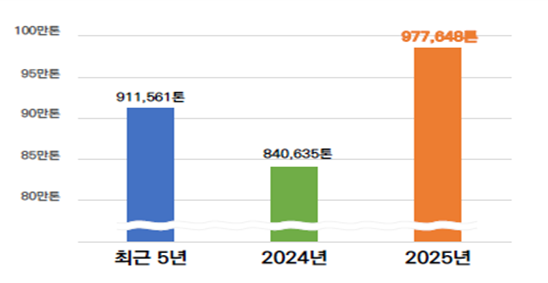
Marine aquaculture production also increased 12% to 2,530,277 tons from 2,258,623 tons a year earlier, and its production value climbed 2.1% to 3.8017 trillion won. In contrast, distant-water fisheries production fell 20.2% to 382,660 tons from 479,398 tons in the previous year, and the production value declined 19.9% to 1.2196 trillion won.
In inland fisheries, production volume increased to 44,386 tons (up 9.3%), but production value decreased to 649.7 billion won (down 4.2%).
The recovery in coastal and offshore production was largely due to a sharp increase in several key species. Compared with the previous year, production of mackerel rose to 202,554 tons (up 62.1%), squid to 31,006 tons (up 128.5%), anchovy to 150,009 tons (up 25.0%), and blue crab to 26,409 tons (up 26.9%). The ministry cited as a major factor the formation of year-round mackerel fishing grounds in the southern East Sea, which boosted large purse-seine catches and increased the number of fishing operations.
However, production of some species decreased, including horse mackerel at 20,489 tons (down 49.0%), herring at 23,176 tons (down 16.5%), Spanish mackerel species at 34,767 tons (down 8.6%), and red snow crab at 26,756 tons (down 5.3%).
To turn the production recovery trend into a sustainable structure, the government will also revamp its resource management system. The Ministry of Oceans and Fisheries plans to fully introduce the Total Allowable Catch (TAC) system to all fishing vessels and to gradually introduce an Individual Transferable Quota (ITQ) scheme that allows quota trading within the allowable catch limits.
© The Asia Business Daily(www.asiae.co.kr). All rights reserved.












