Announcement of the "4th Basic Plan for Fisheries Resource Management"
Expansion of TAC and Pilot Introduction of ITQ
Drive to Restore Coastal and Offshore Production to 1 Million Tons
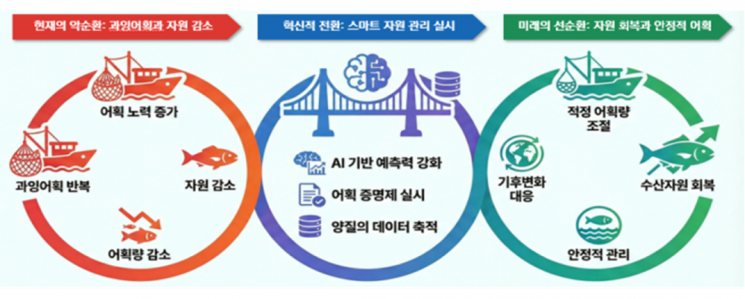
The Ministry of Oceans and Fisheries is launching a medium- to long-term fisheries resource management innovation initiative, aiming by 2030 to restore coastal and offshore fishery resources to 5.03 million tons and fishery production to 1 million tons. The plan is to lay the foundation for a sustainable fisheries industry by expanding the Total Allowable Catch (TAC) system in response to climate change and establishing an artificial intelligence (AI)-based resource management framework.
On the 26th, the ministry announced that it will establish and implement the "4th Basic Plan for Fisheries Resource Management (2026-2030)," which sets out the policy direction for fisheries resource management over the next five years. This plan is a legally mandated five-year plan under the Fisheries Resource Management Act and has been newly prepared following the conclusion of the 3rd plan last year.
As changes in species distribution and declines in fisheries resources due to recent climate change intensify, the need for total catch management based on scientific resource assessment is growing. In fact, over the past 56 years, the surface water temperature of Korea's coastal and offshore seas has risen by about 1.44 degrees Celsius, more than double the global average of 0.7 degrees. Fisheries resources have also plummeted since the 1980s and have remained stagnant or continued to decline in recent years. As of 2024, the estimated volume of fisheries resources stands at 3.24 million tons, and coastal and offshore fishery production is around 840,000 tons.
In response, the government has set the vision of "Innovation of the Sea Opening the Future, Abundant Fisheries Resources Shared by All," and presented three main policy directions: (1) advancing the fisheries resource management system to respond to climate change, (2) establishing an integrated, ecosystem-based strategy for fisheries resource recovery, and (3) strengthening responsible participation in fisheries and voluntary resource management. To this end, it will pursue six key implementation strategies and 19 detailed tasks.
First, the government will expand the TAC-centered resource management system. It will reorganize the current three-stage application framework of the system into five stages and, in connection with the enactment of the Sustainable Coastal and Offshore Fisheries Development Act, expand the types of fisheries and species to which TAC applies. It will also promote the pilot introduction of an Individual Transferable Quota (ITQ) system. In addition, it will increase the number of species subject to resource assessment from 75 to 80 and strengthen the scientific assessment framework by differentiating assessment cycles according to the importance of each species.
The ministry will also establish an AI-based resource management system. It will build a data management framework that integrates and standardizes climate, fisheries resource, and marine environment data, and develop a Korea-specific fisheries resource AI platform that can predict changes in multi-species, multi-area, and long-term fishing ground conditions. Through this, it plans to establish a system that can identify species at high risk of rapid resource decline at an early stage and predict changes in fishing conditions in real time.
Fisheries resource recovery policies will be expanded from a "species-level" approach to an "ecosystem-level" approach. The ministry will develop climate-adaptive habitat restoration technologies and introduce a wide-area resource creation model. It also plans to institutionalize the carbon absorption function of seaweed-based ecosystems by expanding pilot projects for a marine forest carbon trading scheme and a blue credit system.
In addition, it will operate programs to reduce fishing effort, supporting the reduction of aging fishing vessels and fishing gear and the transition to eco-friendly gear, while gradually expanding mandatory electronic catch reporting. It will also establish the foundation for responsible fisheries by introducing a bycatch management system and strengthening smart enforcement.
Acting Minister of Oceans and Fisheries Kim Seongbeom said, "The 4th Basic Plan focuses on transitioning to AI-based scientific resource management in response to climate change and on strengthening the role of local governments," adding, "We will faithfully implement the plan so that a sustainable fisheries resource use and management system can be realized in the field."
© The Asia Business Daily(www.asiae.co.kr). All rights reserved.












