Ministerial Task Force on Consumer Price Management
Investigation into Four School Uniform Manufacturers and Their Nationwide Outlets
Key Monitoring of Unfair Practices Involving Essential Food Items
As part of measures to eradicate collusion in the school uniform market, long criticized by parents as a major financial burden, the Korea Fair Trade Commission has launched an on-site investigation on a nationwide scale. The Ministry of Education will conduct a full survey covering 5,700 middle and high schools.
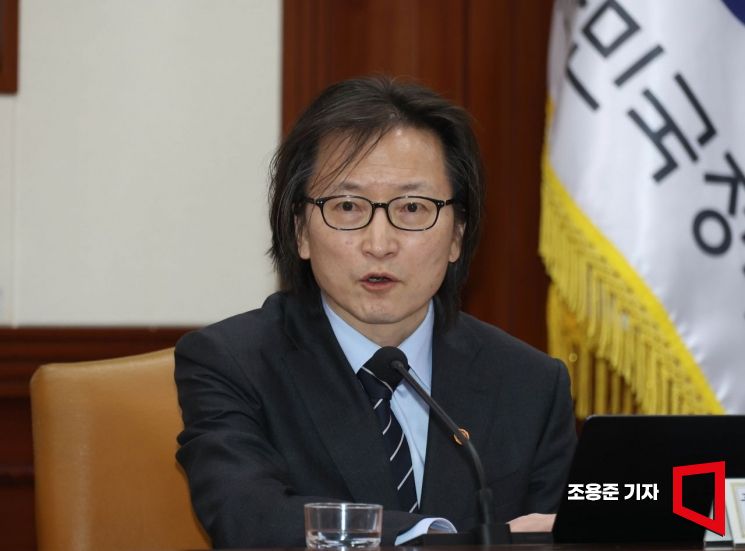 Joo Byungki, chairman of the Korea Fair Trade Commission, attended and spoke at a ministerial task force meeting on the special management of consumer prices held at the Government Complex Seoul in Jongno-gu, Seoul, on February 26, 2026. Photo by Jo Yongjun
On Feb. 26, at the ministerial task force meeting on special management of consumer prices held at the Government Complex Sejong, Korea Fair Trade Commission Chairman Joo Byunggi stated, "School uniforms, which have recently been at the center of controversy over high prices, are an item where customary collusion has continued," adding, "We have mobilized the Fair Trade Commission headquarters and all five regional offices to swiftly launch a nationwide investigation into four school uniform manufacturers and around 40 outlets across the country." He went on to say, "Through this investigation and its follow-up measures, as well as the deliberation next month on the bid-rigging case involving 27 companies and 136 schools in the Gwangju area, we will strictly sanction violations of the law and eradicate entrenched collusive practices at the root."
Lee: "School uniforms are too expensive"... Full survey of 5,700 middle and high schools and plan to phase out suit-style uniforms
Previously, President Lee Jaemyung had ordered strong countermeasures, pointing out that "recently, it is said that the cost of purchasing school uniforms is approaching 600,000 won," and that "when we told them to supply at low prices, they unfairly took profits using taxpayers' money." Presiding over the meeting, Deputy Prime Minister for Economic Affairs and Minister of Strategy and Finance Koo Yooncheol said, "We will never overlook expedient or illegal acts that undermine market confidence and will see to it that they are corrected to the end," and added, "We will not allow anyone to profit by engaging in collusion or unfair practices involving essential consumer prices such as food, which is most important for people's livelihoods." At the meeting, "measures to improve and strengthen the management of school uniform prices and private education fees" and "plans to review and improve the tariff quota system" were each announced.
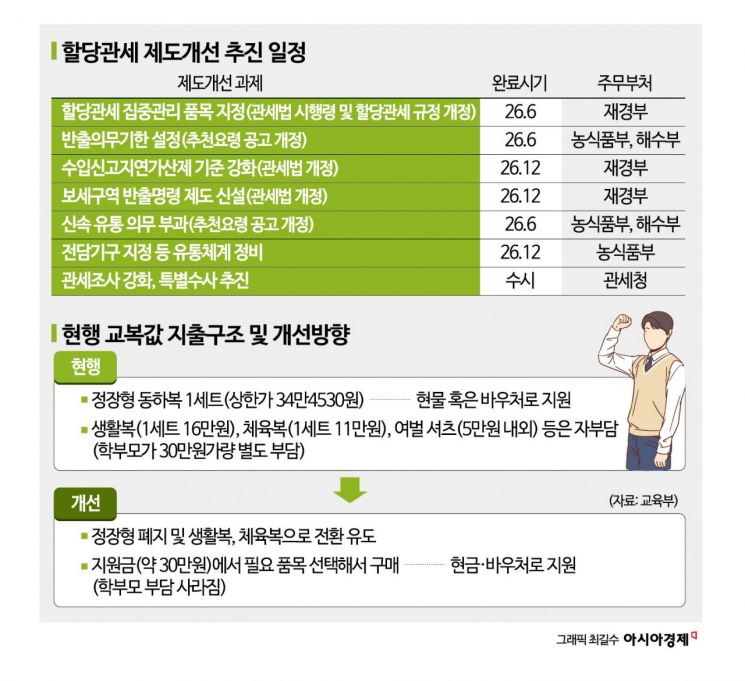
As a measure to address school uniform prices, the Ministry of Education plans to conduct a "full survey of school uniform expenses" from Feb. 27 to March 16, together with metropolitan and provincial education offices, targeting about 5,700 middle and high schools nationwide, and to set item-by-item price ceilings, including for daily wear uniforms. The maximum price for school uniforms for the 2026 academic year (344,530 won) will remain the same as the previous year, but when daily wear uniforms (about 160,000 won per set), gym uniforms (about 110,000 won per set), and extra shirts (around 50,000 won) are taken into account, an additional burden of about 300,000 won is incurred.
The government is also pushing to replace expensive and uncomfortable suit-style uniforms with daily wear uniforms and gym uniforms. The support method, which has been centered on in-kind support, will be diversified into cash and vouchers.
The school-led bulk purchasing system, which has focused on major brands, will be improved by granting extra points in bidding to small businesses and producer cooperatives and providing joint brand consulting. The government will respond strongly, in cooperation with the Korea Fair Trade Commission, to unfair trading practices such as bid rigging, and will apply a zero-tolerance policy, including referring cases for criminal investigation when violations are detected. For private education fees, a special inspection will be conducted to prevent de facto fee hikes through excessive collection of so-called "other expenses," such as mock test fees and material costs, in addition to regular tuition. To ensure effective sanctions, the upper limit for fines will be significantly raised from the current 3 million won to 10 million won, and the introduction of a surcharge system to claw back unjust gains will also be pursued.
Lee: "We told them to supply cheaply, but they profiteered"... Designation and management as key monitoring items, and a sharp increase in fines
The Ministry of Strategy and Finance will overhaul the tariff quota system. The tariff quota, which was actively used by the Yoon Suk Yeol administration as a tool to curb inflation, has provided support of more than 1 trillion won annually for around 100 items each year since 2022.
First, the government will designate and manage items with a high likelihood of unfair practices as "key monitoring items." These will include food-related items with storability, such as frozen meat and food ingredients, items with a history of past violations, and items with complex domestic distribution structures. Once designated as key monitoring items, the current rule on the mandatory deadline for removal from bonded areas (40 days), which now applies only to livestock products, will be applied, and any violations will result in the collection of customs duties. A new standard will also be introduced for customs chiefs to order expedited removal when rapid supply is needed. If this is violated, the current maximum administrative fine of 1 million won will be raised to 5 million won (provisionally). When companies violate both the obligation to remove goods from bonded areas and the obligation to distribute them quickly, they will face both additional customs collection and penalties restricting future allocations of tariff quota volumes. A dedicated body will be designated to centrally manage the entire process of import, distribution, and sales for tariff-quota items. Existing tariff quota recommendation agencies, such as the Korea Agro-Fisheries & Food Trade Corporation (aT), are being mentioned as candidates.
The government is also pushing to simplify the multi-stage distribution structure in which goods pass through importers, wholesale and retail logistics centers, and retailers before reaching consumers, by expanding the share of direct supply to distribution channels such as large discount stores. It will conduct intensive customs investigations into importers that repeatedly delay removal from bonded areas and companies that inflate import prices and report them at artificially high levels. For companies that engage in malicious acts such as fraudulently obtaining tariff quota recommendations, the government plans to carry out high-intensity special investigations.
© The Asia Business Daily(www.asiae.co.kr). All rights reserved.













