NHIS Slashes Fecal Occult Blood Test Positive Rate from 30% to 14%
Enhancing Accuracy and Safeguarding Financial Soundness through Quality Management of Screening Institutions
The National Health Insurance Service has achieved significant results in reducing unnecessary colonoscopies and greatly improving screening accuracy by investigating and managing the results of fecal occult blood tests for colorectal cancer conducted at health checkup institutions.
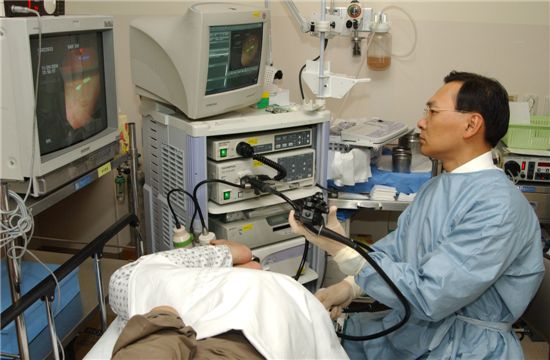
According to the National Health Insurance Service on February 26, an analysis of the status of fecal occult blood tests at colorectal cancer screening institutions in 2024 showed that some institutions had a markedly higher positive rate than the average. In response, the Service conducted on-site and written investigations in August 2025 targeting the top 93 institutions with high positive rates.
As a result, the average positive rate at these institutions plunged by 15.9 percentage points, from the previous 30.0% to 14.1% after the investigation. Consequently, 5,137 people avoided undergoing unnecessary colonoscopies, and this led to savings of approximately 665 million won in National Health Insurance finances, according to the Service.
For example, in the case of Hospital A, the positive rate had previously reached 48.5% due to factors such as examiner inexperience and the use of inappropriate test materials produced in-house. However, after the Service’s corrective measures, the positive rate dropped to 2.8%, indicating a substantial improvement in test accuracy.
Colorectal cancer is a malignant tumor that develops in the mucous membrane of the large intestine, with major symptoms including bloody stool, abdominal pain, and weight loss. The fecal occult blood test currently used in colorectal cancer screening checks for the presence of blood in stool. Using a test strip, the test can be completed within two minutes, and the results are easy to interpret, so it is widely used as a simple, basic screening test.
Every year, 6.5 million people undergo fecal occult blood tests for colorectal cancer screening, and about 270,000 of them test positive and are then selected to undergo colonoscopy. However, when this test is positive, the probability of actually detecting colorectal cancer is only 2-10%, and even when including adenomatous polyps, it is only about 20-30%. For this reason, the test has long been criticized for its limited accuracy in colorectal cancer screening.
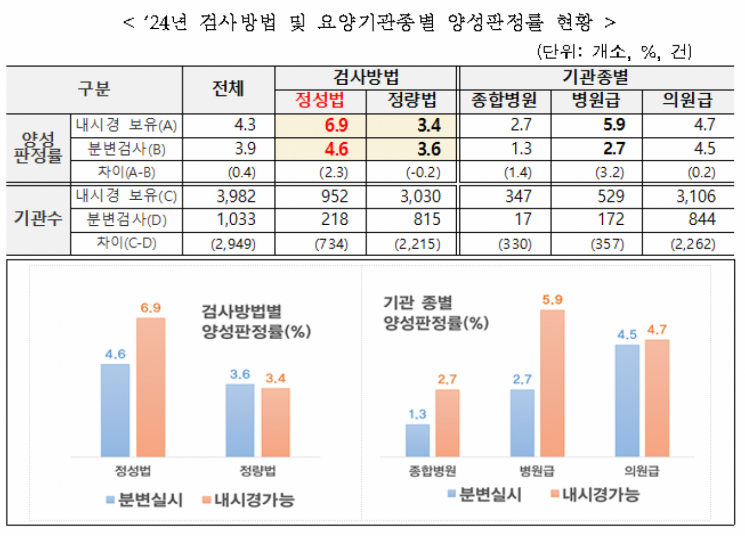
There are two types of fecal occult blood tests, the qualitative method and the quantitative method. According to the Service’s analysis, as of 2024, the positive rate for the qualitative method was 6.7%, while that for the quantitative method was 3.4%, showing a difference between the two.
In particular, although the positive rate of fecal occult blood tests has been decreasing year by year, the proportion of colonoscopies performed on those who test positive has been on the rise. In 2024, among institutions performing colonoscopies, there was no difference in the positive rate for the quantitative method. However, for the qualitative method, institutions equipped with endoscopy facilities recorded a positive rate of 6.9%, which was 2.3 percentage points higher than the 4.6% at institutions that only performed stool tests.
Jeong Kisuk, President of the National Health Insurance Service, said, "Reducing the false-positive rate in colorectal cancer screening and minimizing unnecessary follow-up tests will not only ease the psychological burden on examinees, but also help enhance the sustainability of National Health Insurance finances," adding, "We will continue to pursue evidence-based quality management to create an environment in which the public can trust and undergo screening."
© The Asia Business Daily(www.asiae.co.kr). All rights reserved.












