North Korea Concludes 9th Party Congress... Drives Home Message to South Korea: "Permanently Excluded from the Category of Compatriots"
After concluding the 9th Congress of the Workers' Party of Korea, North Korea reaffirmed its "hostile stance" toward South Korea. It declared that it would "permanently exclude" South Korea from the "category of compatriots" and disparaged the new government's efforts for peaceful coexistence as "a clumsy charade and a poor piece of work." In contrast, it left room for dialogue with the United States, saying, "If it withdraws its hostile policy, there is no reason we cannot get along well." With U.S. President Donald Trump scheduled to visit China at the end of March, attention is focusing on the possibility of North Korea-U.S. talks.
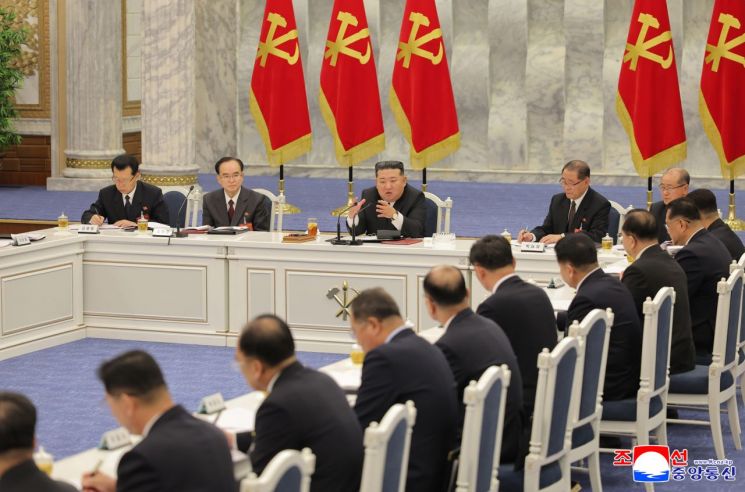 The Korean Central News Agency reported on the 26th that Kim Jongun, General Secretary, presided over the 1st Political Bureau meeting of the 9th Central Committee of the Workers' Party at the Party Central Committee headquarters in Pyongyang on the 25th. February 26, 2026 Yonhap News
On the 26th, the Korean Central News Agency reported remarks by Kim Jong Un, Chairman of the State Affairs Commission of North Korea, made in a general review of work conducted on the 20th and 21st. The outlet said, "Comrade Kim Jong Un ... has put a historic end to the abnormal relationship that has existed on the Korean Peninsula for nearly 80 years and has made a final major decision to establish relations with South Korea as the most hostile state-to-state relations," stressing that this is "the unchanging, principled position of our Party and government."
However, it has not been confirmed whether this content was reflected in the Party rules revised at this congress. Im Eulchul, a professor at the Institute for Far Eastern Studies at Kyungnam University, analyzed it as "an unprecedentedly belligerent anti-South declaration stating that, as an 'irreversible nuclear-weapon state,' North Korea will permanently sever ties with South Korea, which it defines as its most hostile state, and, when necessary, will subdue it with overwhelming force (nuclear weapons)." He added, "By emphasizing that nuclear possession has gone beyond a mere declaration and is now stipulated in the Constitution, North Korea has drawn a 'line of no retreat' that it will never put its nuclear weapons on the negotiating table, even if the regime changes or the international situation shifts."
In this regard, a senior presidential office official presented a principled position, stating, "We will continue to work to open a future of mutually beneficial coexistence in which the two Koreas peacefully coexist and prosper together." The Ministry of Unification, commenting on North Korea's failure to respond to efforts for "peaceful coexistence," said, "We will not be swayed by North Korea's attitude, and we will consistently pursue our policy of peaceful coexistence on the Korean Peninsula."
Regarding the United States, North Korea signaled a willingness to talk but attached the condition that Washington must "respect the current status of our state as stipulated in the Constitution." The outlet had earlier stated that the "advancement of nuclear weapons development" was written into the North Korean Constitution. In other words, this is interpreted as an explicit demand for recognition of its status as a "nuclear-weapon state" as a condition for dialogue with the United States. Under the Nuclear Non-Proliferation Treaty (NPT) regime, there are only five legally recognized nuclear-weapon states (P5), including the United States, and the possibility that the international community will accept North Korea as such is virtually zero.
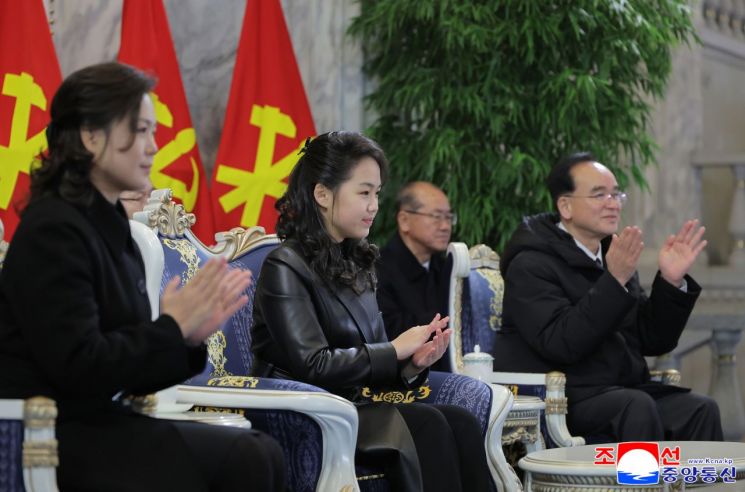
Meanwhile, the North Korean Party Congress that opened on the 19th concluded the previous day after seven days of proceedings. At the military parade held at night on the closing day, Pyongyang emphasized strengthening its main strike assets for attacks against the South. At the parade, Chairman Kim said, "We have a long-term plan to strengthen our national nuclear forces year by year, and we will devote all our efforts to increasing nuclear weapons and expanding the means and domains of nuclear operations." This means North Korea intends not only to focus on producing nuclear warheads, but also to pour its efforts into developing a variety of weapons systems to deliver them. He designated the 600 mm multiple rocket launcher, the new 240 mm multiple rocket launcher, and the operational-tactical missile complex as key strike assets for attacks against the South. This includes weapons capable of carrying the Hwasan-31 tactical nuclear warhead. However, it appears that the core strategic assets that appeared at the military parade marking the 80th anniversary of the Party's founding in October last year did not make an appearance this time. At the parade, Kim Jong Un's daughter Kim Ju Ae, who had not appeared during the Party Congress, was in attendance.
© The Asia Business Daily(www.asiae.co.kr). All rights reserved.












