Ministry Introduces Public Services to Ease Childcare Burden on Dual-Income Households
The Ministry of the Interior and Safety on the 26th selected the “10 a.m. Start for Parents of Young Children Support Program, Childcare Support Service, and All-Community Elementary Care and Education” as hidden innovative public services. “Hidden innovative public services” is the newly revamped name of the existing “Recommended Public Service of the Month,” which has been used to promote policies that are helpful to policy beneficiaries. The ministry assessed that support measures for dual-income households have actively helped to close childcare gaps.
According to the Local Area Employment Survey by Statistics Korea, as of 2024, dual-income households accounted for 58.5% of households with children under the age of 18, and this share has been steadily increasing since 2015. During periods when childcare is especially needed, such as the beginning of a new school year, the burden on dual-income families inevitably grows. In response, the government is pursuing a variety of support measures so that dual-income families can balance work and child-rearing, including flexible working hours, in-home care visits, and school-based care.
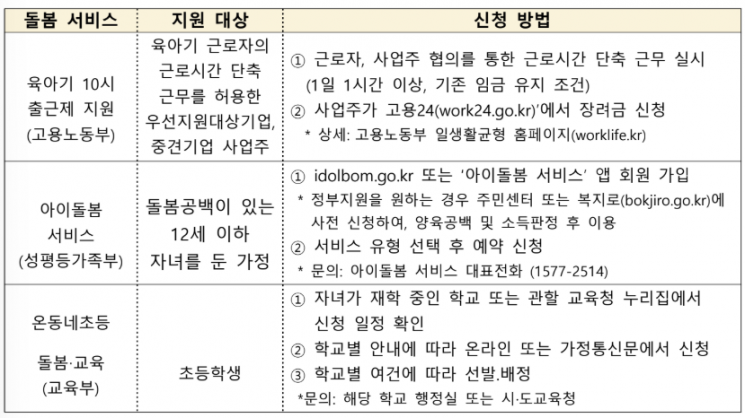
Among these, the 10 a.m. Start for Parents of Young Children program is a project that supports employers who allow workers with children up to age 12 or in the 6th grade of elementary school or below to reduce their working hours by one hour per day without any reduction in wages. Newly introduced this year, the program can be used based on voluntary agreement between workers and employers. Working hours can be flexibly adjusted in various ways, not only by delaying the start time but also by bringing forward the end time. Employers can receive an incentive of 300,000 won per worker per month for up to one year. The support targets are priority support companies (small and medium-sized enterprises) and mid-sized companies.
The Childcare Support Service, overseen by the Ministry of Gender Equality and Family, is a service in which a childcare helper visits the home to look after children up to age 12 in households with childcare gaps. From this year, the income eligibility threshold for government support has been expanded from households at or below 200% of the standard median income to those at or below 250%. In addition, for households with a heavy childcare burden, such as single-parent, grandparent-grandchild, disabled, and teenage-parent households, the annual hours of government support have been increased by 120 hours from the previous 960 hours to a maximum of 1,080 hours. The service is provided in various types, including full-day care (for children aged 3 to 36 months) and hourly care (for children up to age 12).
The Ministry of Education’s “All-Community Elementary Care and Education” policy provides high-quality care and education to elementary school students who wish to participate, through cooperation between schools and local communities. It aims to enhance the quality of school-based care and education operations and to provide seamless care by having schools and communities work together to actively utilize local resources. For 3rd-grade elementary school students who wish to participate, a “After-School Program Voucher” worth 500,000 won per year is provided, expanding students’ choice of programs and easing parents’ burden of education expenses.
Detailed information on the “hidden innovative public services” can be found on the Government Innovation website (Innovation24), as well as on YouTube, Instagram, and other platforms.
Vice Minister Kim Minjae of the Ministry of the Interior and Safety said, “The government is focusing its efforts on public services that help alleviate the difficulties faced by dual-income households in raising children,” adding, “We will continue to pursue government innovation that brings tangible changes to people’s lives.”
© The Asia Business Daily(www.asiae.co.kr). All rights reserved.












