First working-level meeting under Administrator Oh Taeseok... Review of 2026 implementation plans for space development and satellite information
Construction of solid-fuel facilities at private launch site and establishment of K-SSA... Expansion of AI-based satellite information services
The government will invest 1.1605 trillion won in the space sector in 2026. The second phase of lunar exploration (lunar lander development), the fifth launch of the Nuri rocket, and an early deployment program for a methane-based reusable launch vehicle will be fully pursued. A total of 129.2 billion won will also be invested in the field of satellite information utilization, launching a new project to expand AI-based satellite information services.
The Korea AeroSpace Administration announced that on the 26th in Sejong, it held the 9th Space Development Promotion Working Committee and the 2nd Satellite Information Utilization Working Committee, presided over by Administrator Oh Taeseok, and deliberated and approved the 2026 implementation plans of major statutory mid- to long-term plans. This was the first official working committee meeting since the inauguration of the second Administrator, Oh Taeseok.
Lunar lander and fifth Nuri launch... Early deployment of reusable launch vehicle
According to the 2026 implementation plan of the revised 4th Basic Plan for Space Development Promotion (2023-2027), this year’s government budget for the space sector (excluding some defense and security items) totals 1.1605 trillion won. Following the previous year (1.0008 trillion won), investments of more than 1 trillion won will continue.
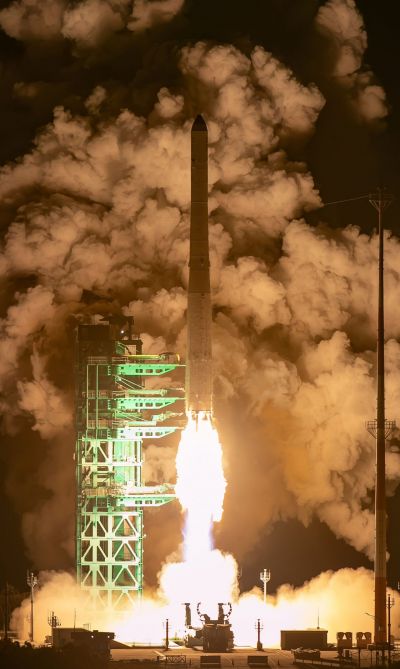
The lunar lander development project, which is the second phase of lunar exploration, will be fully launched, and the fifth launch of the Nuri rocket will be carried out following the successful fourth launch led by the private sector last year. The Next-Generation Launch Vehicle Development Project, whose feasibility review was completed last year, will also move into full swing, and an early deployment program for a methane-based reusable launch vehicle will be promoted.
The Basic Plan for Space Hazard Preparedness includes a multi-ministerial joint development of a radar-based space surveillance system and the establishment of a national space situational awareness system (K-SSA) based on civil-military cooperation. It also includes a project to build solid-fuel launch support facilities at the first-phase private launch site, which is scheduled to open in 2027.
129.2 billion won for satellite information... Expansion of AI services and advancement of public utilization
Under the 2026 implementation plan of the 3rd Comprehensive Plan for Satellite Information Utilization (2024-2028), a total of 129.2 billion won will be invested this year in 42 projects across 13 ministries in the field of satellite information utilization.
A new project to expand AI-based satellite information utilization services has been included, and the advancement of public services in areas such as weather, oceans, and the environment will be promoted. Technology development for the utilization of Next-Generation Medium Satellite Nos. 2 and 4 will continue, and international cooperation will be expanded to respond to the climate crisis and large-scale disasters.
Administrator Oh Taeseok said, "The agenda items submitted today are not just business plans but a survival strategy for Korea’s aerospace sector," and added, "We will push forward actively to make aerospace a new national growth engine."
© The Asia Business Daily(www.asiae.co.kr). All rights reserved.












